Showing posts with label Quiapo Church. Show all posts

Visita Iglesia: Quiapo Church

Yesterday, My Beloved Wife and I went to Santa Cruz Church for the Siete Palabras. I was appalled on our way to the church because of the crowd blocking the every path to our destination.

Black Nazarene Devotees at Quiapo Church

It was like mini-Fiesta of the Black Nazarene. Devotees walked barefoot and many of them brought their replicas of the Black Nazarene.

Young devotees of the Black Nazarene

I suddenly remembered that it was FRIDAY, which meant it was Quiapo Day. It was also Good Friday, making it a more special day for the Black Nazarene devotees.

Quiapo Church, officially known as the Minor Basilica of the Black Nazarene, is one of the popular churches in the Philippines and the most popular church in Manila. Millions of people from different parts of the world go to Quiapo Church to join the Translacion every 9th day of January.

Quiapo Church

Quiapo Church is a memorable place for me. This is where I brought Foong, a Malaysian friend and fellow blogger, to eat the much dreaded balut. This is where I received kumpil or the Sacrament of Confirmation. I see Quiapo Church, almost every day, that’s why it became a part of my life.

The district of Quiapo was established in 1586 by the Governor General Santiago de Vera. The first structure of Quiapo Church, built by Franciscan missionaries, was made of bamboo and nipa and was destroyed by fire in 1639. It was replaced by a stronger structure that was partially destroyed by an earthquake in 1863.

The next structure of Quiapo Church was completed in 1899 through the efforts of Reverends Manuel Roxas and Eusebio de Leon. Sadly, Quiapo Church was again destroyed by fire in 1929.

Images of saints at the side of Quiapo Church

The current structure of Quiapo Church was planned by the National Artist, Juan Nakpil. The church is colored cream white. Two belfry flank the main structure of the church. Each side of the church has statues of saints, my favorite of whom is the one holding a cross.

Images of saints at the side of Quiapo Church

Many people go to Quiapo Church just to see and touch the image of the Black Nazarene. Some patiently wait the long queue for the pahalik, or kissing the image. Some visitors of Quiapo Church are just contented in touching the replica of the Black Nazarene in front of the church.

Devotees touching the replica of the Black Nazarene

Many devotees testify that our God answered their prayers after theur prayed to the Black Nazarene. Those who are ill were healed. Those who had problems with their family, finances and faith were also solved. In fact, many of the Black Nazarene devotees are people who are giving thanks to our God because of the blessings that He gave to them. 

Interior of Quiapo Church

The church’s interior is beautiful. Its ceiling and walls are not fully decorated with images and symbols. These parts of the church were simple and almost bare. What’s packed with decorations is the altar, the center of which is the image of the Black Nazarene.

Altar of Quiapo Church

The image of the Black Nazarene came from Mexico, through the Galleon trade between Manila and Acapulco. It was alleged that the image became black because of the fire on the galleon that burned the image.

Image of the Black Nazarene at the altar of Quiapo Church

Unknown to many, the image of the Black Nazarene at the altar of Quiapo Church is not wholly original. It is a combination of original head and replica body sculpted by Gener Manlaqui. The original body and replica head is the one that travels during the Translacion.

Dome of Quiapo Church

I always look up at the dome every time I visit Quiapo Church. My favourite part are the sculpted images of the four symbols of the four evangelists; namely; Matthew, Mark, Luke, and John.

Symbols of Saint John and Saint Matthew

I like the design of Quiapo Church’s tabernacle. The image of lamb on the top of it perfectly signifies Christ who is the lamb sacrificed for the salvation of all. Unfortunately, the tabernacle was placed at the side.

Tabernacle of Quiapo Church

I have plenty of memories in this church and I know that more memories will be added. I do wish to join the next Translacion so I can experience what the devotees experience during that day. I do hope that my next blog post will be about that holy event.

Quiapo Church is the last church to be featured for this year’s virtual Visita Iglesia. This signals the end of our waiting because tomorrow we will commemorate the victory of our Lord against death. Jesus is ALIVE. Hallelujah!

---

Some the information that I posted here were obtained from the following:

1. Phiippine Historical Committee marker at Quiapo Church
2. Quiapo Church and Black Nazarene articles in Wikipedia.
3. History of Quiapo Church article in Minor Basilica of the Black Nazarene website.

---

Visita Iglesia is a Catholic tradition of visiting seven churches during Maundy Thursday. For each day, this Holy Week, I will feature one church as a sort of virtual Visita Iglesia.
.

Wedding Prep: How I Received Kumpil or the Sacrament of Confirmation in Quiapo Church

We received a list of requirements when we booked our church for the wedding. Among the requirements are the certificates for Baptism and Confirmation (Kumpil). I easily obtained a copy of my Baptismal Certificate. What’s missing, unfortunately, is my Confirmation Certificate.

I asked my parents about it and even inquired with our parish but to no avail. I couldn’t find my certificate because I discovered that I didn’t receive the Sacrament of Confirmation in the first place! My parents forgot about it.

Unfortunately, the rite of confirmation in our parish only happens once a year. I totally missed it and I might even miss (or move) our wedding because of it.

“Why bother with Kumpil in the first place and mess your wedding?”, some of you might ask. The answer is that we really want to have a church wedding. Me and My Beloved Wife will not settle for less (read: civil wedding) because we believe in the importance of this ceremony in our life. If the Church says that Kumpil is important then we will obey her no matter what.

Quiapo Church


Good thing that Quiapo Church has a weekly schedule for Kumpil. This is where I availed of this sacrament.

The actual rite is just a small part of Quiapo Church's Confirmation program that runs from 8 AM to 12 noon every Sunday. The rite is just one hour or less depending on the number of confirmants. What ate up the whole half day of the program is the seminar prior to the rite. The lecturers of that seminar taught us about the teachings of the Church.


Some of you might be wondering why there is a Sacrament of Confirmation. According to the Catechism:

“Confirmation perfects Baptismal grace; it is the sacrament which gives the Holy Spirit in order to root us more deeply in the divine filiation, incorporate us more firmly into Christ, strengthen our bond with the Church, associate us more closely with her mission, and help us bear witness to the Christian faith in words accompanied by deeds”.

In short, the Kumpil help us grow spiritually because it gives us plenty of graces. Thus, the Church wants every couple to receive this sacrament because it will strengthen them in their married life.

Painting of kumpil by Vander Weyden
(Source: Wikipedia)
Those who want to receive the Sacrament of Confirmation in Quiapo Church should register first to get a schedule for the rite. You need to submit your Baptismal Certificate with a note “For Marriage Purposes” and then fill-up a form. You must also bring a valid ID. The fee for Kumpil is 380 pesos.

Quiapo Church is very strict that's why confirmants must come on time. Latecomers will be asked to register again (and pay another 380 pesos). Only one ninong or ninang are allowed inside. Friends and family members will be prevented from entering.

Confirmants should also go to confession prior to Kumpil.

The certificate of Confirmation can be obtained 1 week after the rite. The certificate costs 50 pesos.

I am glad that Qiuapo Church offers Kumpil. It solved my problem about Confirmation requirement for our wedding.

Read about my post about the Sacrament of Confirmation or Kumpil, if you have more questions about this sacrament.

If you're in the same predicament as me, then I highly suggest that you go to Quiapo Church for kumpil. I think that there other churches that have regular schedule for kumpil. 12Eighteen mentioned in blog post that the National Shrine of St. Michael and the Archangels offers kumpil every Thrusday and Sunday.

If you know of other churches that offer kumpil, please share it with us.

A Worker Who Can’t Work

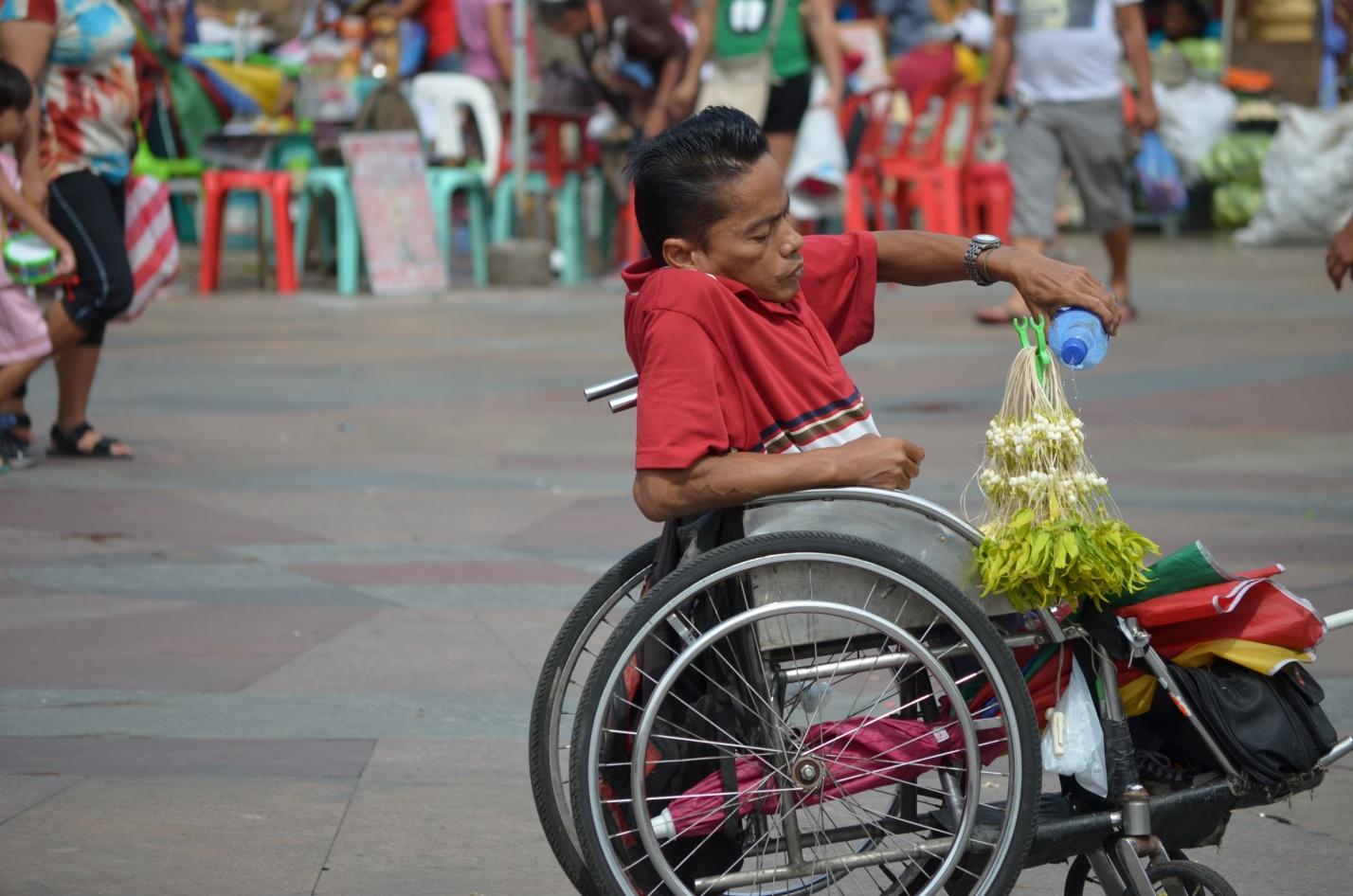
Friday is Quiapo Day. Devotees and parishioners fill up Quiapo Church entirely and even extends to areas outside of the church. This is an opportunity for vendors to maximize their profit by selling stuffs related to the faith of the people. I saw some vendors selling rosaries, anting-anting, sampaguita and religious relics. Some are just tapping churchgoers to ask for some money. Each has their own story. Each has their own lifestyle and routine. But what is caught the most by my camera is the story of two guys, who are on wheel chairs, not begging for money but use their remaining capacity to earn a living.

The sun is high as I arrived at a very historic place, the Plaza Miranda. This is where a bombing happened in 1972 that killed nine people. It is regarded as the place of Philippine political discourse and one of the markers before the Martial Law. I wonder if people here are aware of the significance of the place where they are standing. I hope that they appreciate even the small things they may not be aware of.

This guy caught my eyes. His job was extreme and ordinary. ‘Kuya,’ as I called him, startled me because he works despite of his inability to walk. He is a Sampaguita vendor in front of the Quiapo Church. At first I felt sorry for this guy but as I watched his work, I can see an inspiration.

Determination and perseverance. Even under the sun, ‘Kuya’ strived to sell sampaguita. I felt sorry to see him alone in such a busy street with no one buying from him. Later, I saw that that loneliness is only for a short time because he has his ‘kabaro’ which I call ‘Kuya (2).’ They don’t mind if they didn't sell. They are even located in a place not attractive to buyers. But I can still see the smile on their faces. What's important is that they have something to talk about.

Upon seeing this, I immediately ran to them and ask them if that job could make them survive. ‘Kuya (2)’ even smiled back at me saying, “minsan may pangkain lang sapat na.” He said that even in a Friday they are not sure if they will earn or not. This is what I love with these two - they are very entertaining. It seems that they are friendly to all those selling in Plaza Miranda. No competition, they were all friends.

When I get in touch with them, many parishioners bought at them. It is where I feel as if I am a gift from heaven to them. I said to them, “kuya malaking kita ‘yon ha.” But he replied, “’di pa rin natin masasabi ‘yan. Mamayang gabi pa malalaman.” Many devotees, person by person, started buying at them. I saw their pockets started to have many coins then I asked them, “magkano ho puhunan ‘niyo diyan at kita niyo sa isang araw?” Then he replied, “minsan nasa sixty, ‘yung puhunan namin 350, nakakakain naman kami.”

Their life is not easy. It is hard to move their wheelchairs when authorities are confiscating their sampaguitas and when vehicles are crossing their way. It is even hard to stay under the sun. Yet, they don’t forget to smile. This was the realization in my life that I had because of this photo essay - contentment. We are busy on our work. We are busy pleasing people. We are busy because of our complicated lives. We spent time in depositing money in our banks. We become stressed to all the school requirements yet, these two guys remind me not to forget smiling. I realized that it is us who makes our lives complicated. Their lives are happier than ours. This makes me feel that simple life is better. It is easier to only worry for the food that we are about to eat. How lucky are these people that even in their wheelchairs, they found happiness and contentment. Before I left them, ‘Kuya’ told me that he is also a college graduate. He even knew that I am a Mass Communication student without me telling him.
.
Sampaguita vendor on a weelchair at Quiapo Church
Kuya is ready to sell sampaguita on a Friday, Quiapo Day, at Plaza Miranda where many devotees are expected.
.
Kuya waits for the Final Blessing so that he can sell to parishioners who are getting out of the church.
.
The shadow is the effect of the sun as it rises which kuya does'nt bother to evade. He instead covered his head with towel but still he has no buyer.
.
Kuya's 'kabaro' arrives with a pack of stories to tell him. Smile is inevitable from their faces even if they haven't sold sampaguita yet.
.
Kuya and his kabaro were not just the Sampaguita vendors there. That is why it is hard for them to sell.
.
Still, they welcome their co-vendors and even chat with them. They treat them as friends not competitors.
.
Kuya's 'kabaro' continues to call churchgoers to buy sampaguita from them.
.
Kuya and his 'kabaro’ still fail to sell their Sampaguita and people just ignore them.
.
Finally, kuya's ‘kabaro’ has his 'buena mano' and this made kuya smile.
.
Kuya's 'kabaro' continues to sell not just once but twice. Kuya said that his capital for this is P350.
.
Children begging for alms is a usual event once a buyer bought sampaguita from them.

.
It's hard for them to move their wheelchairs once vehicles cross their way but they continued to sell our National Flower.
.
Police authorities let the sampaguita vendors sell in the prohibited area as long as they don’t disturb church services.
.
She is their last buyer as I leave the area. Kuya said that their usual profit is P60 per day yet they are happy for they survive each day with food.
---

The photos taken and the article written by Eljohn Marin, a student and an aspiring lawyer. Visit his blog: The Law and Me.

Another World at Lacson Underpass

The area around Quiapo Church is not what it seems. Beneath its grounds is another world where hidden people lurk and await humans who are kind enough to give them their cash…

 …and it is cash that they will get if you like what they sell. Pretty creepy, eh? I hope not because I am just talking about Lacson Underpass.
.
Welcome to Lacson Underpass

Lacson Underpass is a circular underground complex that connects the roads around the Quiapo Church. Pedestrians use this underpass to cross Quezon Boulevard. I, on the other hand, usually go to Lacson Underpass to pee because the public toilet is located there.

I got the chance to visit Lacson Underpass again one early morning. I also managed to get few photos.
.
Lacson Underpass is still empty of vendors

Lacson Underpass is quite empty in the early morning. Come in the late morning and you will see that vendors fill the whole area, making it hard for pedestrians to pass through.
.
Lacson Underpass underground stores
Still sleepy vendors in Lacson Underpass.

Lacson Underpass was named after Arsenio Lacson, who is a former mayor of Manila. This guy is quite popular because an avenue, located beside the University of Santo Tomas, was named after him. He also has monument located near Santa Cruz Church.

Since Lacson Underpass is located right beside Quiapo Church, you can expect to see Catholic religious items for sale.
.
Lacson Underpass - religious items for sale
Looking for image of Santo Nino? Black Nazarene? Mama Mary? You find them here.
.

Lacson Underpass exit
Lacson Underpass exit. To the right is Quiapo Church. To the left is Carriedo Street.


---

Visit Ahab Reviews and Tips and know how to reserve flights at ZestAir.

Follow me in Facebook, Twitter, Flickr, Tumblr and YouSayToo.

Carriedo Street – the Little Divisoria

I talked about the ever-crowded place called Divisoria in a previous post. I mentioned that Divisoria is the place to go to if you are looking for cheap (and bootlegged) items. My Facebook friends reacted on that blog post and they shared their own blog posts about the [in]famous Divisoria. Willy Jose talked about his Divisoria experience when he did his last minute Christmas shopping. Resty Odon posted about his thoughts about Divisoria.

The usual comment that I hear about Divisoria that it is crowded, alongside with other adjectives like cheap and affordable. The set-up in Divisoria is not unique. In fact, being crowded and chaotic is common to marketplaces around the country. Majority of palengke (market) around the Philippines is disorganized with vendors placing their wares in the middle of the streets. One place that is very similar to Divisoria is Carriedo Street, which connects Quiapo Church and Lacson Plaza or Santa Cruz Church.
.
Carriedo Street - Road to Quiapo Church
Carriedo Street as viewed from LRT-Carriedo Station.

The whole stretch of Carriedo is occupied by street vendors. You can buy pirated DVDs, t-shirts, toys, fruits, religious figurines, and other items just by walking along Carriedo.
.
Carriedo Street - street vendors
Looking for shirts? Find it in Carriedo.
.
Carriedo Street - street vendors
Street vendors block the entrance to some buildings like the Carriedo Arcade.

Carriedo Street is the most direct route from LRT-Carriedo Station to Quiapo Church but the pedestrians have to pass through a maze. They should be also wary of the presence of criminals who are looking for ways to snatch people’s cellphone and wallets.
.
Carriedo Street - crowd going to Quiapo Church
Prepare to pass through this crowd to reach Quiapo Church.

There was a time when the mayor of Manila cleared Carriedo Street of street vendors. Well, it seems that the mayor failed because they are back and Carriedo Street is full to the brim with vendors. If you are looking for an easy way to reach Quiapo Church, I suggest that you avoid Carriedo.

---

Visit Ahab Reviews and Tips and read my reminders for PUPCET examinees.

Follow me in Facebook, Twitter, Flickr, Tumblr and YouSayToo.

Filipino Street Food Challenge: Eating Balut and Kwek Kwek at Plaza Miranda

After eating at Kamayan, I took my Malaysian blogger friend to Plaza Miranda, which is in front of Quiapo Church. I took him there because I know that it is the place for Filipino street foods. My friend wanted to taste kwek kwek and balot.
.
Quiapo Church
Quiapo Church

I hope you remember my previous post about kwek kwek. In Quiapo, we tried the balot kwek kwek and the penoy kwek kwek. I thought that my friend will never finish his kwek kwek and he will throw up. For those who do not know, balot (or balut) is a fertilized duck or chicken egg with nearly formed embryo that is boiled and eaten from its shell. Penoy, on the other hand, are duck or chicken eggs that are developed after 9 or 12 days. Penoy is also eaten like a balot, but the "scary" embryo is not there.
.
Kwek Kwek
Recycled photo of Kwek kwek.

Well, my friend managed to eat kwek kwek and he said that he like it. Kwek kwek costs 10 pesos per piece.

After that, we looked for a balot vendor. You know what? My friend did not gross out. He easily gobbled the balot.
.
Balut
This is balot (a.k.a. balut)

Well, my friend is brave, unlike my friends from America who can't even finish half of balot.

---

Image of balot taken from Cebu-food.com. Information about balot and penoy taken from Wikipedia.
.

Procession of the Virgin of Antipolo

I happened to drop by Quiapo Church while I'm on my way to NAIA Terminal 3. I was surprised to see many people inside the church even though it is not Friday.
.
Many people inside Quiapo Church


When the Mass ended, I saw the image of Mama Mary being carried from the altar to Plaza Miranda amidst the throng of devotees waving their white handkerchiefs.
.
Our Lady of Antipolo inside Quiapo Church

What I witnessed is the start of the "Alay Lakad" of Our Lady of Peace and Good Voyage, who is popularly known as Our Lady of Antipolo. The procession proceeded to the image's permanent residence in Antipolo Cathedral.
.
Close encounter with Our Lady of Antipolo
A devotee's close encounter with Our Lady of Antipolo.

The "Alay Lakad" is done in the evening of April 30th until dawn of May 1st. The procession done to commemorate the return of the blessed image from Quiapo Church to Antipolo Cathedral on 1945. Our Lady of Antipolo reached Quiapo Church when she was evacuated from Antipolo Cathedral during the Second World War.

The faithful devotees, with their great gratitude to God, join the yearly Alay Lakad in honor of Mama Mary.
.

Focus on Jesus!

Last Friday, thousands of people flocked to Manila to attend the largest fan’s day in the Philippines: the Feast of the Black Nazarene of Quiapo. Many, including the media, touted the event as a a proof of how the Filipinos love our God. But is it really the case?

True. The devotees, especially the hardcore ones, experienced a lot of ordeal on that day. Many came to Quiapo from their homes barefoot. Many where crushed, pushed around and stepped upon when they tried to get close to the image of the Black Nazarene. Some of them even fainted. But what is the meaning of their devotion? Is it necessary that they undergo those ordeals so that they could show how much they love God? Or does God require His flock to suffer to hear their pleas?

On the morning of the feast day, the Archbishop of Manila said in his homily that it is not necessary for anyone to touch the image of the Black Nazarene to show his or her devotion to Jesus Christ. What is important is their faith in the Lord and their love to Him. Instead of saying amen to the archbishop, the fanatics booed him off, they booed off the homily, and they booed off the truth.

What they did summed up the devotion of the fanatics of the Black Nazarene. Their devotion now focused on the image and not on WHOM it represents. They believe that the image had some miraculous power that will grant their wishes. What they are doing is a step away to idolatry and it is highly dangerous to their faith. The image of Black Nazarene is just an image, made of wood. It can’t walk and it can’t walk, and it can’t heal anyone on it’s own accord. It is by God’s will alone that anyone is healed from his or her afflictions.

The devotion of the Black Nazarene fanatics is commendable, but they focus those devotions beyond the image and make it show on the way they live. Faith in God and true Christian living is the key to a happy life. The fanaticism on the Black Nazarene must be stopped. The bishops should teach the fanatics that the Black Nazarene is just an image. These fanatics must understand that the Lord is the center of our life and loving Him and serving Him is the most important thing in this world and in our life.

Of course, there are devotees of the Black Nazarene who understands their Faith. They are not exaggerated when showing their devotion and they truly focus it to Jesus Christ. Such devotees are commendable and their number should increase.