Showing posts with label Marikina City. Show all posts

Visita Iglesia: Immaculate Conception Church (Concepcion Uno, Marikina)

Today is Palm Sunday and this means that finally entered the Holy Week or Semana Santa. This also means that I will my start the Virtual Visita Iglesia, which is my Holy Week tradition in this blog where I feature one church or chapel per day from Palm Sunday to Black Saturday. My virtual Visita Iglesia is based from the real Visita Iglesia that is usually done by visiting 7 churches or more on Maundy Thursday. The first church to be featured in this year's Virtual Visita Iglesia is the Immaculate Conception Church in Concepcion, Marikina.

Immaculate Conception Church in Marikina

A visit to my parents in Marikina means a visit to the Immaculate Conception Church in Barangay Concepcion Uno. This church has been a part of my mother's life. I believe that this is where she was baptized and had her first communion. Even in death this church played a role for this is where we brought our beloved grandparents, uncles, and aunts for their final blessings.

Immaculate Conception Church in Marikina

The Immaculate Conception Parish was once a part of the oldest and primary parish of Marikina, which is Our Lady of the Abandoned Parish.

Angel in Immaculate Conception Church in Marikina

The Immaculate Conception Church began as a chapel in 1949 in Barrio Bayan-Bayanan through the guidance of Father Jose Mirasol, who was the chaplain of Boys' Town in the nearby Barrio Parang. The chapel became dilapidated after 3 years so the people built a new chapel, the initial funds of which was provided by Manila Archbishop Rufino Cardinal Santos. The construction of the chapel was finished in 1957 and was blessed by Cardinal Santos on December 7 of that year. It was just a day before the feast of Immaculate Conception.

Adoration Chapel of Immaculate Conception Church in Marikina
Adoration Chapel

The name of Barrio Bayan-Bayanan was changed to Concepcion in 1956 by virtue of Republic Act 1514. I guess the name change is due to the rising prominence of the chapel that is dedicated to the Immaculate Mother. Immaculate Conception Parish was established in 1958.

The current church structure is relatively new compared to Our Lady of the Abandoned Church. The cornerstone of the church was laid on the feast day of Immaculate Conception in 1969. The church was finished the next year and was blessed by Cardinal Santos on October 18.

Immaculate Conception Church in Marikina

The church's facade is quite simple. It only has the lines formed by the adobe blocks and a stained-glass window featuring their patroness: Our Lady of the Immaculate Conception.

Facade of Immaculate Conception Church in Marikina

The church has a bell tower that is also adorned by the image of Our Lady on top.

Belfry of Immaculate Conception Church in Marikina

It was a Friday afternoon when I visited the church so the place is not that crowded. The church is almost empty, actually.

Inside Immaculate Conception Church in Marikina

The church was prepped for a wedding. Good thing that I came early or I will not be able to take good photos of the church's interior, particularly its altar.

Wedding in Immaculate Conception Church in Marikina

Our Lady of Immaculate Conception is featured prominently at the altar.

Altar of Immaculate Conception Church in Marikina

Another historical tidbit that I found is that Concepcion Church is at the north end of E. Santos and E. Rodriguez Streets, which was collectively known as Paliparan. These two roads were the runway of the "paliparan" or airfield that the Americans built before World War 2. The runway, which was used by civilian aircrafts, was taken over by the Japanese during the War.

Parallel to the E. Santos and E. Rodriguez is the straight road known as Daangbakal. The name hailed to its past as the tracks of the Marikina Line or the Rosario-Montalban Line. Daangbakal runs straight to Montalban. 

I am quite familiar with Daangbakal because I walked a portion of it from my high school to my relatives in San Mateo. The train tracks are now long gone and only cars and tricycles use this long street. 

The Marikina Line was built by the Manila Railroad Company starting in 1906, then formally opened in 1934, and abandoned in 1936. The Marikina Railway Depot is now the Marikina Elementary School. This historical tidbit helped me understand why there are some old train engines displayed in Marikina, one of which is located at the Riverbanks Mall.

Our Lady of Immaculate Conception

Crescent under the foot of Our Lady of Immaculate Conception

The crescent at the foor of the Virgin Mary is the thing that comes to my mind whenever I hear "Immaculate Conception". The crescent under her feet is one of the attributes of Our Lady of Immaculate Conception. I interpret it to mean that Islam will be at the feet of Our Mother --- that Mama Mary will convert many Muslims and turn them into worshippers of Jesus Christ.

Pope Pius IX declared the dogma of the Virgin Mary's immaculate conception in 1854 through the bull Ineffabilis Deus.

The Church believes that the Virgin Mary is free of the stain of Original Sin since her conception. This privilege enabled her to bear the Son of God in her womb.

Four years later after the declaration of the dogma, the Virgin Mary appeared 4 years later in Lourdes and said "I am the Immaculate Conception."

Prayer to Our Lady of the Immaculate Conception

Most holy Virgin, who wast pleasing to the Lord and became His Mother, immaculate in body and spirit, in faith and in love, look kindly on the wretched who implore thy powerful patronage. The wicked serpent, against whom was hurled the first curse, continues fiercely to attack and ensnare the unhappy children of Eve. Do thou, then, O Blessed Mother, our queen and advocate, who from the first instant of thy conception didst crush the head of the enemy, receive the prayers which, united with thee in our single heart, we implore thee to present at the throne of God, that we may never fall into the snares which are laid out for us, and may all arrive at the port of salvation; and, in so many dangers, may the Church and Christian society sing once again the hymn of deliverance and of victory and of peace. Amen.

Mass Schedule in Immaculate Conception Church

Holy Mass Schedule in Immaculate Conception Church in Marikina

Here are the schedule of the Holy Mass in Immaculate Conception Church in Marikina City:

Monday to Saturday: 6:00 AM, 7:00 AM, 6:00 PM

Sunday: 5:00 AM, 6:15 AM, 7:30 AM, 8:45 AM, 10:00 AM, 3:00 PM, 4:15 PM, 5:30 PM, 6:45 PM, 8:00 PM

First Friday of the month: 6:00 AM, 7:00 AM, 12:00 Noon, 6:00 PM


Schedule of Baptism

Tuesday to Saturday: By appointment

Sunday: 11:00 AM


Schedule of Confirmation: By appointment

Schedule of Confession: Monday to Saturday 7:30 AM and 5:00 PM

Sick Call: By appointment or anytime if emergency case

Schedule of Wedding: Tuesday to Saturday - 9:30 AM, 11:00 AM, 2:00 PM, 4:00 PM

Funeral Blessing: By appointment or Any day at 1:30 PM

Funeral Mass: By appointment or any day at 2:00 PM

- - -

Visita Iglesia is a Catholic tradition of visiting seven or fourteen churches during Maundy Thursday. For each day, this Holy Week, I will feature one church as a sort of virtual Visita Iglesia.

Read about the churches that I visited this year

Palm Sunday: Immaculate Conception Church in Concepcion Uno, Marikina

Holy Monday: Santo NiƱo de Paz Chapel in Greenbelt, Makati

Fig Tuesday: Our Lady of the Most Holy Rosary Chapel in SM Makati

Spy Wednesday: Santa Rosa de Lima Church in Santa Rosa, Laguna

Maundy Thursday: Saint John Paul II Chapel in NAIA Terminal 3

A Visit to the Cows of Marikina Heights' Evolution Park

Blog Title Card - A visit to Evolution Park of Marikina Heights

Some years ago, before the pandemic, my parents brought us to a public park that has statues of cows. My Little Ones, Samuel and Samantha were happy "playing" with the cows.

So, during our Christmas visit to my parents, we decided to bring our three Little Ones, once again, to the cows of Marikina Heights.

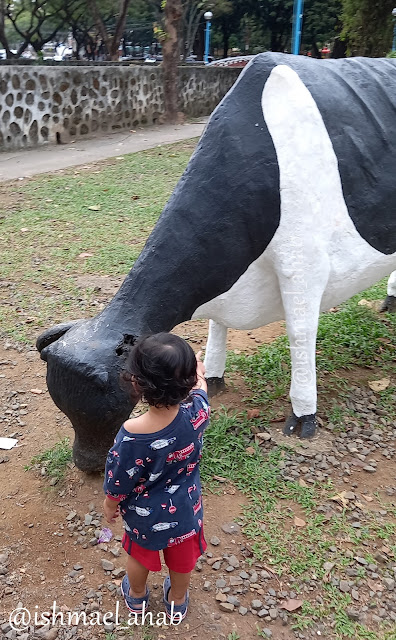
Our youngest child was overjoyed upon seeing the "cows". He immediately ran up to them while saying "moo moo moo".

Playing with the Cows of Marikina Heights

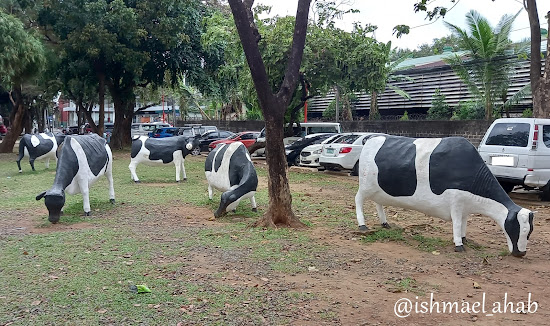
There are plenty of cows in this part of Marikina.

Cows of Marikina Heights

The cow statues recall Marikina's past as a hacienda of the rich and influential Tuason Family during the Spanish Period. Marikina Heights, the barangay where the park is located, was once a ranch where the Tuasons pastured cows, goats, carabaos, and horses.

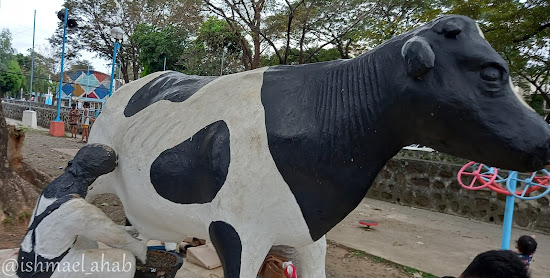
Milking the Cow of Marikina Heights

The highlight of the park is the statue of a lady milking a cow. It marked Marikina's past as a major player in the dairy industry. In fact, the city's Marikina Dairy Industries was the first to introduce condensed milk in the Philippine market in 1967.

The park is located beside a creek along Champagnat Avenue. This park is named Evolution Park, which I found unusual because I cannot find the park's connection with "evolution".

My little ones enjoyed "playing" with the cows and riding on them. Our bunso is the most happy because it is as if he was interacting with real cows.

Playing with the Cow of Marikina Heights

Near the cow statues are the public exercise equipment like the monkey bars and static bikes.

Evolution Park of Marikina Heights

These are not meant for kids but our Little Ones enjoyed them nonetheless.

The real playground is located a few steps away at the Marikina Hardin ng Bayan. This was where our kids enjoyed the slides.

We didn't stay long at the playground because it was very crowded. There were so many kids competing for the slides and swings. It was quite risky in this time of pandemic. I think the Marikina City government should add more slides and swings or make more playgrounds in other parts of the city.

As a history buff, what piqued my interest in Marikina's Evolution Park is the monument dedicated to the PEFTOK soldiers.

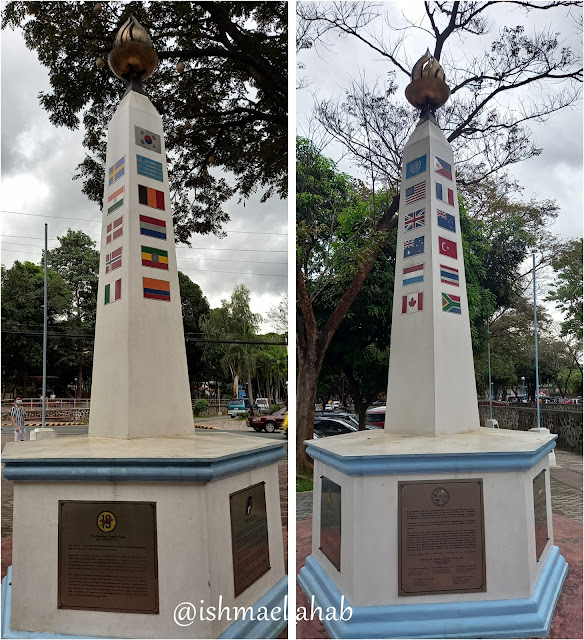
PEFTOK Memorial in Marikina Heights

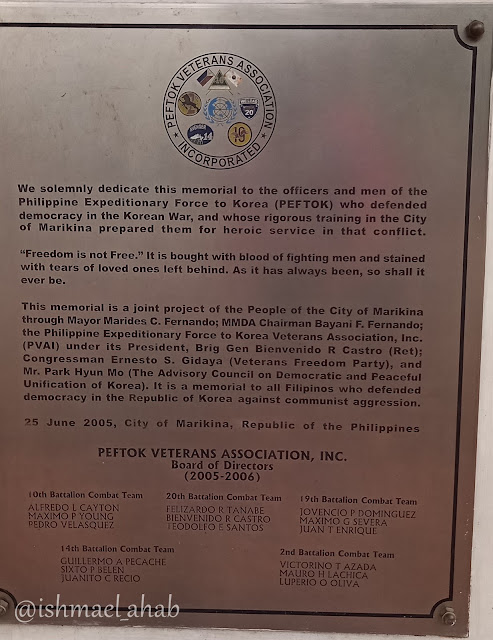
PEFTOK, which is the acronym for Philippine Expeditionary Forces to Korea, are the Filipino soldiers who fought in the Korean Peninsula to stop the advance of communist forces to South Korea.

PEFTOK Plaque in Marikina Heights

The PEFTOK Monument was erected through the efforts of PEFTOK Veterans, the City Government of Marikina, and other organizations on June 25, 2005 - exactly 55 years since the start of the Korean War. The monument was placed to commemorate the officers and men of PEFTOK and to memorialize their bravery in their defense of the democracy of South Korea.

The monument was placed in Marikina City because it was the training ground of the PEFTOK soldiers before they were sent to Korea.

The monument bears the flags of the nations that joined the fight against the communists in the Korean Peninsula. Some of the nations I recognized are South Korea, Greece, India, USA, UK, Australia, New Zealand, France and the Scandinavian countries of Sweden, Norway, and Denmark.

PEFTOK Memorial in Marikina Heights

The monument also featured the following the following Combat Battalion Teams (BCT) of PEKTOK:

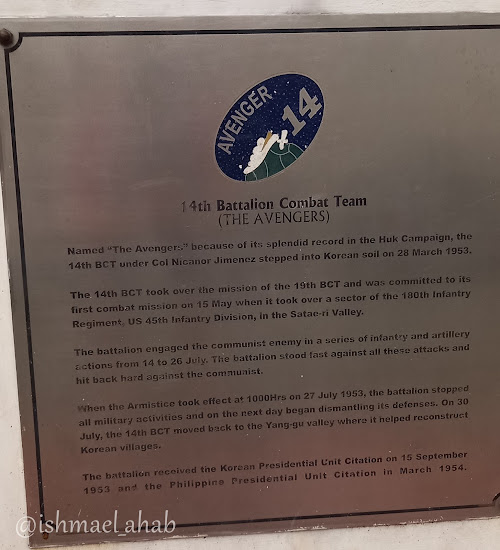
1. 14th BCT (Avengers)

14th Battalion Combat Team PEFTOK Plaque in Marikina Heights

2. 2nd BCT (Peacemakers)

2nd Battalion Combat Team PEFTOK Plaque in Marikina Heights

3. 19th BCT (Bloodhounds)

19th Battalion Combat Team PEFTOK Plaque in Marikina Heights

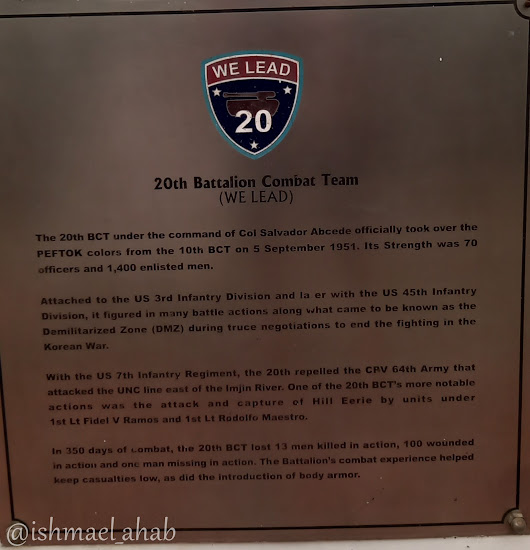
4. 20th BCT (We Lead)

20th Battalion Combat Team PEFTOK Plaque in Marikina Heights

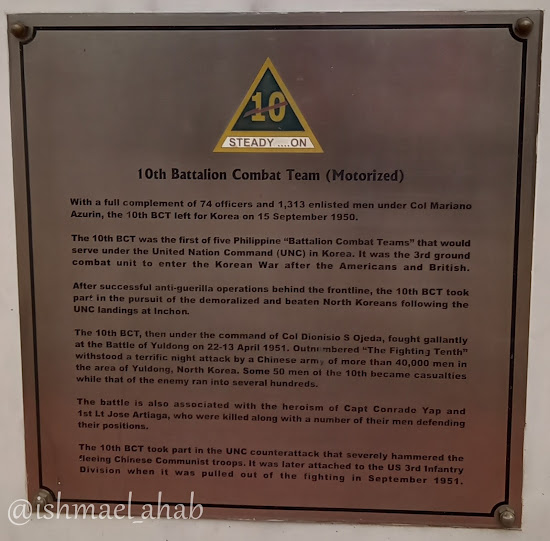
5. 10th BCT (Steady On)

10th Battalion Combat Team PEFTOK Plaque in Marikina Heights

There are interesting historical tidbits written on the monument. One is that President Fidel Ramos, then a first lieutenant, also fought in the Korean War.

The PEFTOK soldiers, particularly the 10th BCT, became legendary during the Battle of Yultong where 900 PEFTOK soldiers fought around 2,000 to 5,000 Chinese and North Korean soldiers.

Filipino soldiers of 10th BCT at Yultong Hill during the Korean War
Soldiers of 10th BCT at Yultong Hill (source: Wikipedia)

The Battle of Yultong started in the evening of April 22, 1951. The 10th BCT is guarding Yultong Hill with the soldiers of USA, Turkey, Puerto Rico, Belgium, and UK. During the intense fight, the soldiers of other countries retreated while the 10th BCT stood their ground. In the end, the 10th BCT defeated the commie horde and prevented them from going further to South Korea.

Aside from the PEFTOK, Evolution Park also features the flags of the Philippine Revolution.

The Evolution Park is one of the reasons why I considered moving to Marikina. This city has public parks and open space. The residents are disciplined. Their streets are clean.

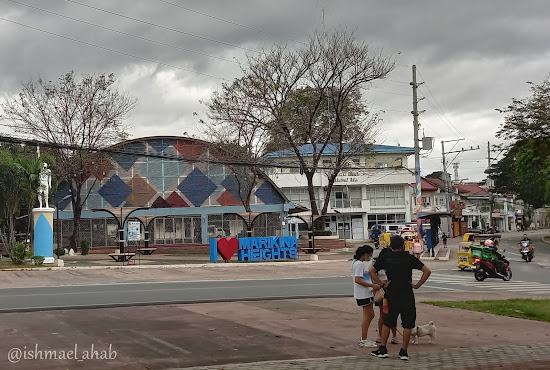
I Love Marikina Heights

This pales in comparison to the city in the supposedly more provincial Laguna, where I currently reside. This city lacks a public park, save for the concreted plaza at the poblacion. The nearest open space from our house is a private cemetery. The wide open spaces are owned by the Ayalas. The residents are burara and dugyot. The streets are dirty. Heck, even the city highway has few decent sidewalks.

I digress...but what I really want is a city with a decent public park and Marikina is a model for that.

My Little Ones enjoyed their short visit to the cows of Evolution Park. It reminded me of the fun I had, when I was little, running in wide open spaces in our province. We were free to run around, fly a kite, and do many things. Now my kids had to make do with a small space in our subdivision.

As for me, I enjoyed learning more about the history of gallant Filipino soldiers who fought in Korea and their Marikina connection. This blog post was actually meant to be about the cow statues of Marikina but ended up as another blog post about Philippine history.

- - -

Notes:

1. Information about the Battle of Yultong came from Remembering the Battle of Yultong: A Great Victory (Philippine Army website) and Wikipedia.

2. Information about the dairy industry in Marikina came from the National Dairy Authority.


.

When in Marikina - We Buy Leather Shoes

When Filipinos are looking for good quality shoes, the place that they go to is the City of Marikina, which is known as the "Shoe Capital of the Philippines". So when I was in need of a pair of office shoes, My Beloved Wife and I dropped by a shoe factory in Barangay Concepcion Uno known as CPoint.

Marikina leather shoe store - CPoint


The shoe factory of CPoint is located along Bagong Silang Street in Concepcion Uno.

At first I did not know that it was a shoe factory because the store looks more like a cafe.

CPoint Cafe and Shoe Store in Marikina City

There are really nice chairs where I sat when I am fitting shoes. This is also the good place to sip your coffee or tea.

Yes, you can sip your coffee or milk tea here because CPoint is a shoe store and a cafe rolled into one. That means that you can shop for shoes while sipping your coffee or tea.

CPoint shoe store offers milk tea and coffee.

Milk Tea and Coffee at CPoint, Marikina City

I did not order any coffee or milk tea so I do not know if its worthy to be included in your Facebook or Instagram posts.

Unfortunately, those who have allergy or asthmatics may not enjoy CPoint’s cafe because the air inside the store smells strongly of glue.


The reason for the glue smell is because at the back is the shoe factory. I actually saw, through the back door, workers make CPoint Shoes. Unauthorized persons are not allowed in the factory so I was not able to get a good photo. However, this the Marikina City Government website has this good photo of CPoint's shoe factory:

CPoint Shoe Factory in Marikina City
(Source: Marikina City Government)

According to a story in the Marikina City Government website, the shoe store/cafe/shoe factory of CPoint stands on the spot of the former shoe factory where the shoe maker parents of CPoint owner Noel Evangelista were employed once.

Noel Evangelista now owns the area of that old factory and turned it into a spot of a 5-storey headquarters of his shoe company.

CPoint Shoe Store where you can buy Marikina leather shoes


Most of the shoes on display are made of leather and there are so many of such shoes to choose from!

Shoes for Sale in CPoint Marikina

The popularity of CPoint shoes took off Eat Bulaga’s Maine Mendoza visited CPoint during Eat Bulaga's "Juan for All, All for Juan" segment. Maine even shared the CPoint shoes that Jose Manalo bought for her.

Aside from shoes, CPoint also sells other leather products like belts and leather bags. 

Leather Belt at CPoint Marikina

The shoes that I chose are these smooth and shiny charol shoes. 

CPoint Marikina Black Leather Charol Shoes
(Source: CPoint FB page)

I chose charol because I don't need extra effort to make it shiny. I got these shoes for 925 pesos. The CPoint staff told me a tip in taking care of my charol shoes. She said that I use kerosene to clean the shoes. She told me not to use Kiwi or similar shoe shine products because it can ruin my charol shoes.

There is another CPoint shoe store a few meters away from the 5-storey CPoint shoe store/cafe/shoe factory. The store is much smaller but also has plenty of shoes to choose from.

Marikina Leather Shoes at CPoint

After C Point, My Beloved Wife and I went to neighboring Jednic Store where we bought sandals. 

Jednic Marikina Leather Sandals

Many resellers go to this shop to buy sandals. These resellers get discounts or factory price because they buy on bulk. My Beloved Wife, on the other hand, only got the regular price for a few pairs of sandals. Still, the regular price is much lower than those in SM or other shopping malls.

Jednic Slippers Marikina

I can say that I got a good pair of office shoes for a reasonable price. Buying shoes in Marikina is much better than going to the shopping malls, where the price of the same Marikina-made shoes are astronomical.

- - -

Read more about my adventures in Marikina City:

Visita Iglesia 2019: Our Lady of the Abandoned Church of Marikina City

Visita Iglesia 2019: Our Lady of the Abandoned Church of Marikina City

Visita Iglesia: Our Lady of the Abandoned Church in Marikina City

Marikina is my favorite Metro Manila City because of its cleanliness and the discipline of its citizens. Compared with other Metro Manila cities, Marikina's streets are litter-free, its public market is clean and organized, and its government provide the best sanitation services. I placed this city in high regard that I considered moving. Alas! Real property in Marikina is very expensive and, therefore, beyond my financial capacity.

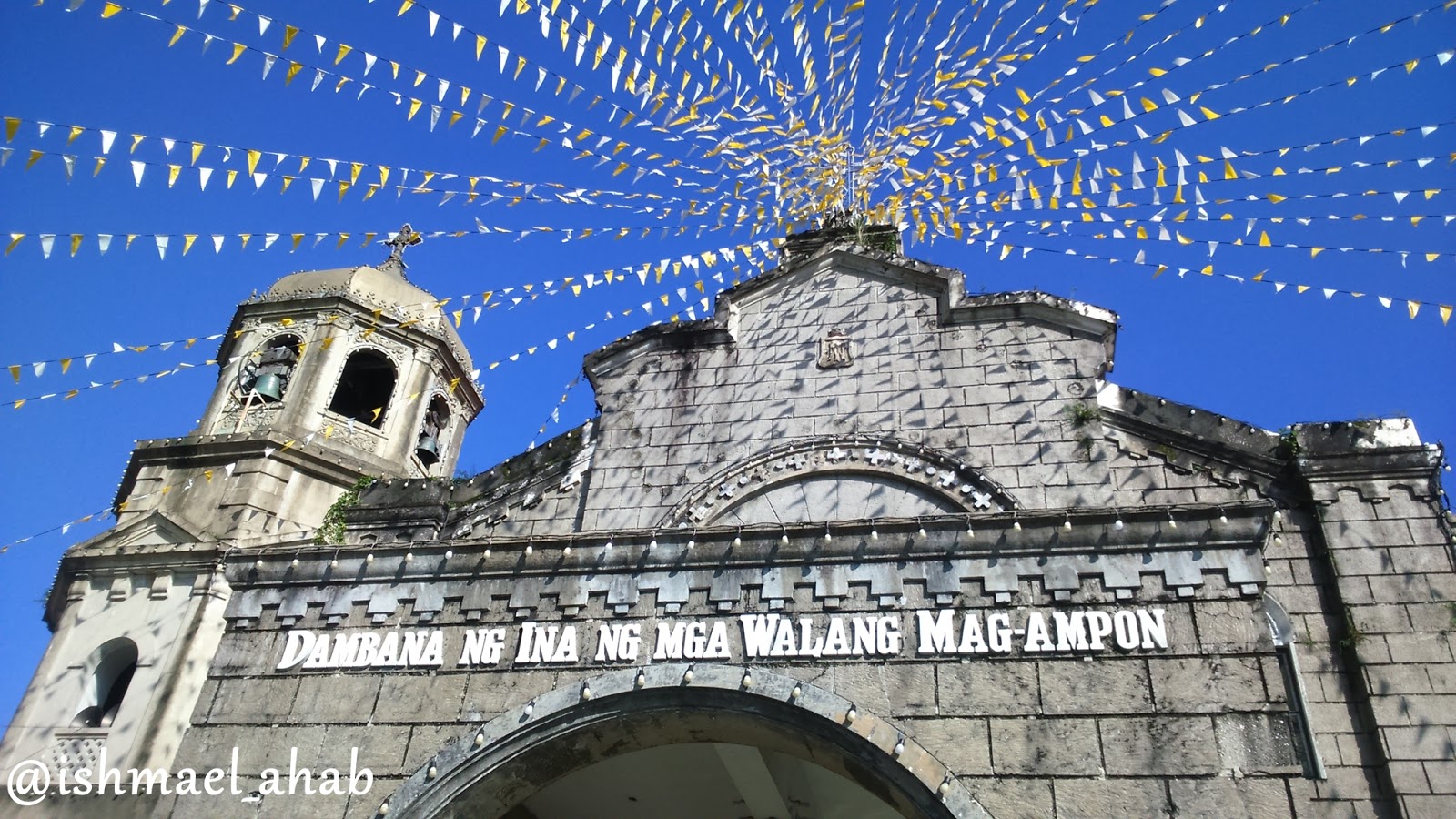
Another thing that I like is the effort of Marikina City government to preserve heritage structures. They even have a programs to promote heritage in the city like this Heritage Mapping Project that involved school teachers in the city. One of the heritage structure that MarikeƱos are proud of is their main parish church: Santuario y Parroquia de Nuestra SeƱora de los Desamparados, popularly known as Diocesan Shrine and Parish of Our Lady of the Abandoned. Tagalogs call this church as Dambana ng Ina ng mga Walang Mag-Ampon.

Dambana ng Ina ng mga Walang Mag-ampon or Our Lady of the Abandoned Church in Marikina CIty

We visited this church after our morning walk along the Marikina Riverbanks. My jaw dropped the moment I saw the stone structure of this church.

Statues of Jesus' apostles at Our Lady of the Abandoned Church in Marikina CIty

I am always overjoyed whenever I see old churches like this church in Marikina. Such ancient and beautiful structures are great relief from banal and tasteless architectural style of today. Sadly, many “modern” church adopted the ugly modern style.


Our Lady of the Abandoned Church in Marikina is of Baroque architectural style, which was said to be promoted by the Catholic Church to counter the simplicity and austerity of Protestant architectural style. Baroque meant to inspire worship by filling the eyes with beauty inspired by God.

The beautiful Our Lady of the Abandoned Church in Marikina CIty

Marikina was once ruled by the descendants of Lakan Dula, ruler of the Bayan ng Tondo. In 1571, Spanish conquistador Miguel Lopez de Legazpi landed in Maynila and proclaimed the place as the capital of the young Spanish colony. Some of the Augustinian missionaries that accompanied Legazpi ventured out of Maynila and, in 1572, reached Chorillo in the present-day Barangay Barangka. A church dedicated to San Isidro Labrador stands on the site, where I believe the Augustinians built their first chapel in Marikina.

National Historical Institute marker for Our Lady of the Abandoned Church in Marikina CIty

Marikina was the site of intense rivalry between the Augustinians and the Jesuits. The Augustinians were the first to reach Marikina and established a visita in Barangka. The Jesuits reached Marikina in 1630 and established a new visita in the now Barangay Jesus de la PeƱa. The Jesus de la PeƱa Chapel that was established by the Jesuits still stands today. The Jesuits also crossed Marikina River and established a visita in Barangay Sta. Elena. In the same year, Marikina was transferred to the Jesuits by the Archbishop of Manila.

The Jesuits started improving Marikina by inviting Chinese traders and agriculturists. The visita's population grew and its economy improved so much so that Marikina was elevated into a full-pledged parish in 1681 and was placed under the patronage of Our Lady of the Abandoned.

Marian image at Our Lady of the Abandoned Church in Marikina CIty


Mama Mary began to be honored as Our Lady of the Abandoned in 1401 in Valencia, Spain when a hospital for the mentally ill, homeless, and abandoned children was established. The original image of Nuestra SeƱora de los Desamparados (Our Lady of the Abandoned) was said to be created by three angels. Legend says that three pilgrims requested free board and lodging of three days in the hospital. The hospital administrators, after noticing that no sound emanated within the room where the pilgrims stayed, forced open the door on the fourth day. The pilgrims were gone but inside the room is the image of Mama Mary, which later on called as Our Lady of the Abandoned. The wife of a hospital administrator, who was blind, regained her sight after touching the image. Thus, it was believed that the pilgrims were in fact angels who gifted them with the miraculous image of the Virgin Mary. 

In the Philippines, the oldest image of Our Lady of the Abandoned is in the old church of Santa Ana, Manila. The said image was made in Valencia, Spain and was touched to the original image of Our Lady of the Abandoned before being sent to the Philippines. Unfortunately for MarikeƱos, their original image of Our Lady of the Abandoned was burned during the Filipino-American War. The image enshrined in their church was made in 1902. The image was made through the generosity of MarikeƱos, who provided the funds and materials for it. 

Painting depicting the procession of Our Lady of the Abandoned in Marikina CIty

MarikeƱos love the Virgin Mary and many of them experienced miracles through their devotion to Our Lady of the Abandoned. Notable of these miracles happened during the Second World War when a Japanese aircraft dropped two bombs over the church. The first bomb destroyed most the church but the Marian image was unharmed while the second bomb did not explode, thus saving the townspeople. I remember a similar miracle, also attributed to the Virgin Mary, that saved the Baguio Cathedral from aerial bombs.

Other miracles attributed to Our Lady of the Abandoned in Marikina include the safe passage of a guerilla from Japanese checkpoint during the War, rescue of kidnapped children of a Filipino-Chinese, and the full-healing of a man from lung cancer.

Image of Our Lady of the Abandoned in front of Our Lady of the Abandoned Church in Marikina CIty

Because of MarikeƱos devotion to Our Lady of the Abandoned and the miracles attributed to her, the image was episcopally crowned in 2002 and then canonically crowned in 2005 during the reign of Pope Benedict XVI.

The baptistry featuring the image of Our Lady of the Abandoned in Our Lady of the Abandoned Church in Marikina CIty

The construction of the current stone structure of Our Lady of the Abandoned Church was started 1687 after the parish was returned to Augustinians. The old church in Jesus de la PeƱa was abandoned because of incessant flooding of Marikina River. The parish was transferred to higher ground at Our Lady of the Abandoned Church. The parish was finally transferred to the Jesuits in 1690, the same year when the construction of Our Lady of the Abandoned Church was finished. A royal decree in 1696 firmly placed Marikina under Jesuit jurisdiction, thus ending the Augustinian-Jesuit “War” in Marikina with the victory for the Society of Jesus.

Dios te Salve, Maria in Our Lady of the Abandoned Church in Marikina CIty

“Dios te Salve, Maria” is the phrase that welcomes visitors entering. It is the opening phrase of the Hail Mary prayer that is usually said while praying the Holy Rosary.

Aisle and beautiful ceiling of Our Lady of the Abandoned Church in Marikina CIty

On the ceiling are paintings depicting the life scenes of our Lord Jesus that are being meditated while praying the Holy Rosary. 

Wedding arch and wedding decorations in Our Lady of the Abandoned Church in Marikina CIty

The altar features the miraculous image of Our Lady of the Abandoned on a beautiful retablo. Too bad that there was a wedding during my visit so I was not able to take a good photo of the altar.

Altar of Our Lady of the Abandoned Church in Marikina CIty

My visit Our Lady of the Abandoned introduced me to the beautiful heritage of Marikina. I did not expect that this city have hidden gems and those gems are being preserved and taken care of by the MarikeƱos and their city government. 

---

Our Lady of the Abandoned in Marikina CIty
(Source: OLA Parish FB page)

Prayer to Our Lady of the Abandoned or Nuestra SeƱora de los Desamparados (Tagalog) 

Ave Maria, ikaw ang mapagmahal na Inang kumakalinga sa aming lahat. Ikaw ang mahabaging Ina na kumukupkop sa mga walang masilungan. Kami ay lumalapit sa iyo, bukod na pinagpalang Ina ng aming Panginoon. Ikaw ang aming Reyna; pamunuan mo kami sa paglaban sa kasamaan. Ikaw ang aming Guro; papaglinawin mo ang aming isip sa panahong kapos kami sa pang0unawa. Ikaw ang aming Ilaw; tanglawan mo kami nang 'di kami maligaw sa dilim. Ikaw ang aming Lunas; hilumin mo ang sakit ng aming kaluluwa at katawan. Amin Ina, ipagtanggol mo kami sa aming pagkaapi. Aliwin mo kami sa amin hapis. Palayain mo kami sa aming pagkaalipin sa aming mga kahinaan. Onang mapagkawanggawa, ilahad mo ang iyong mga kamay sa mga kapus-palad na nangangailangan ng iyong tulong. Inang sangkatauhan, ipanalangin mo kami at akayin sa landas patungo kay Hesukristong Panginoon namin. Amen.

Kami'y iyong ipanalangin, mahabaging Ina ng mga Walang Mag-ampon.

---

Writing this blog post felt like I was writing a thesis. I made in-depth research about the history of Marikina and its churches. I made this timeline, compiled from various Internet sources, which I believe would be useful for those doing their own research about Marikina City.

1572 - Augustinians arrived at Chorillo in Barangka. Maria Concepcion Rapisora-Lagos mentioned in her dissertation that the Augustinian friars built Jesus de la PeƱa Chapel (or precursor structure) in Nangka. 

1630 - The Jesuits arrived to Mariquina and celebrated mass at a warehouse. The warehouse is now the Jesus de la PeƱa Church. The Archbishop of Manila transferred Marikina from the Augustinians to the Jesuits. The Jesuits crossed Marikina River and established Barangay Sta. Elena. Probably, they built the first structure of Our Lady of the Abandoned Church.

1681 - Marikina was elevated into a parish and placed under patronage of Our Lady of the Abandoned.

1687 - Marikina is returned to Augustinians with the town San Mateo, Rizal. Jesus de la PeƱa was abandoned because of incessant flooding. The parish was transferred to the church in Sta. Elena. The construction of the current stone structure of Our Lady of the Abandoned was started this year.

1688 - Marikina parish became independent from Pasig.

1690 - Marikina was returned to the Jesuits. The construction of Our Lady of the Abandoned Church was finished.

1696 - Jesuits’ jurisdiction over Marikina was confirmed by a Royal Decree.

1791 - The church in Barangay Sta. Elena was consecrated to Our Lady of the Abandoned.

1898 - Wikipedia source claims that the first image of Our Lady of the Abandoned in Marikina was burned during Filipino-American War. However, that War started in 1899. It is more probable that the image was burned during the Tagalog Rebellion led by Katipuneros. 

1902 - The second image, which is the one currently enshrined in in the church,  was made.

2002 - Episcopal coronation of Our Lady of the Abandoned in Marikina.

2005 - Canonical coronation of Our Lady of the Abandoned in Marikina.


---

Visita Iglesia is a Catholic tradition of visiting seven churches during Maundy Thursday. For each day, this Holy Week, I will feature one church as a sort of virtual Visita Iglesia.


References:

Panalangin sa Nuestra SeƱora de los Desamparados, Birhen ng Marikina transcribed from the photo of Lloyd Rainier Sexon

Mother of Refuge article by Tomas U. Santos in The Varsitarian

Virgen de los desamparados in Wikipedia

Barangays of Marikina in Wikipedia