Showing posts with label Spanish heritage. Show all posts

The Old Spanish Fort in Olongapo and the Naval Legacy of Subic Bay

Spanish Naval Base in Subic Bay

Subic Bay will always be in my mind as the last stronghold of Uncle Sam in the Philippines. It was known as the best naval base of the USA in the Southeast Asian Region. Its deep and fairly protected harbor can handle battleships, submarines, and even large aircraft carriers.


I always thought that the naval history of Subic Bay started during the American Colonial Period until I saw this relic from the past during one of my visit to Olongapo City:

The ruins of Spanish Naval Base and an old cannon in Olongapo City

An old plaque, probably placed by the Americans, tells the history of this old Spanish fort.

Plaque about the old west gate of the Spanish Naval Base in Subic Bay

The old plaque reads:

Old West Gate 
This gate was the entrance to the original Spanish Naval Station established in Subic Bayin 1885. The principal Spanish construction lay to the east along what is now Rivera Point and consisted of an arsenal, several warehouses, and a number of shop buildings. 
The base at Subic-Olongapo was used by the Spanish Navy to provide repair supply, ammunition and medical support for ships. The post was commanded by the Second Commandancia of the base at Cavite and was considered a subsidiary of that command. 
The Spanish garrison remained in possesion of the Subic-Olongapo Base until June of 1898 at which time they were driven out by Filipino forces. The area was formally occupied by the U.S. Navy in September of 1899.

The plaque stated that the story of the Spanish fort began in 1885. However, the naval history of Subic Bay actually started much earlier.

In 1542, Spanish explorer Juan de Salcedo discovered Subic Bay but he did not see the value of the bay for the small Spanish colonial navy. It is the Augustinians who took notice of Subic Bay and in 1607 Father Rodrigo de San Miguel established the town of Subic, which included the area which is now called as Olongapo City.
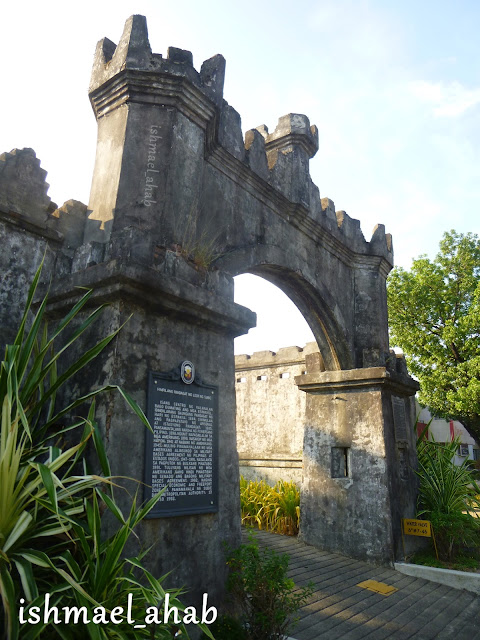
The west gate of the former Spanish Naval Base in Subic Bay

The Spanish Colonial Government was contented with its naval base in Cavite until tragedy struck in 1762 when the British captured the Cavite naval base and occupied Intramuros as part of the Seven Years War. The Spaniards discovered the value of Subic Bay and established a naval base there while fighting the Brits.

King Alfonso XII of  Spain formally established the Subic Bay Naval Base in 1884. The construction of Arsenal de Olongapo began in 1885. It was placed under the the deputy commander (segunda commandancia) of the Cavite Naval Base. As the old plaque says, the Spanish naval base in Subic Bay consisted of an arsenal, warehouses, and shop buildings. The Subic Naval Base was grand based on this 1885 painting:

Painting of the Spanish Naval Station in Subic Bay (1898)
(Source: morefun.ph)

The Subic Naval Base was captured by Filipinos during the revolution in 1898 but the Americans drove them out in 1899 during the brutal Filipino-American War.

National Historical Commission marker for the West Gate of the Spanish Naval Base in Subic Bay

The West Gate (also known to many as the Spanish Gate) is accessible so I was able to pass through it. Unfortunately, the remains of the gate is all there is to see. 

Bamboo palisade at the old West Gate of the Spanish Naval Station in Subic Bay
The bamboo wall at the back of the old West Gate.

In an old photo, the West Gate has a bell placed on its walls.

Spanish Gate in Olongapo City in Subic Bay circa 1910
The West Gate of the old Spanish Naval Base in Subic Bay taken in 1910 (source: Taga Gapo Ka Ba?)

Another old photo shows the bell transferred from the wall to the arched gate.

The Spanish Gate in Olongapo City
(Source: Pilipinas Retrostalgia)

The bell is now gone and what remained are the gate and the bare walls.

It is good to see that this Spanish fort is well preserved. I believe, however, that it is “luckier” than the other Spanish forts found in the provinces. Many of these old forts are in the advanced state of decay and destruction.
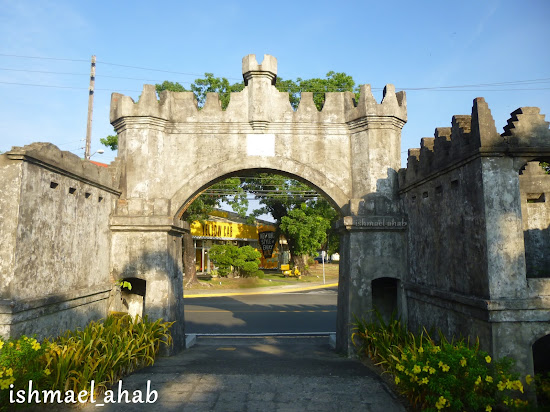
The west gate of the Spanish Naval Base in Subic Bay


I am delighted to accidentally discovered this relic of the past. It is good to know that Subic Bay has great historic legacy other than being an R and R place for American GIs.

---

Read about my other latest adventures in Subic Bay

Yummy Eats at Meat Plus Cafe (Subic Bay)
Sleepover in By the Sea Resort Hotel (Barretto, Olongapo)

---

The history of the old West Gate of the Spanish Naval Base in Subic Bay came from the following sources:

MoreFun.ph
Municipality of Subic website
Subic Spanish Gate in Wikipedia
.

Other Parts of Intramuros

Working in Manila gave me the benefit to be near the historic Intramuros. I have visited the “walled city” for three times already. My last visit is when I brought an office visitor on a tour inside the “walled city.”

I always go to the usual spots during my previous visits to Intramuros. The spots that I never fail to visit are the Manila Cathedral, San Agustin Church, the canons on the walls and Fort Santiago. Most tourists go to these spots because it is the ones listed on the itineraries of tour guides and even of pedicab drivers, who double as unofficial tour guides.

I visited Intramuros again last year to run an errand for a friend. Instead of taking the usual route, I decided to enter Intramuros through the path least taken by tourists. I entered Intramuros through Magallanes Drive. This road is directly connected to Jones Bridge and stretched along the National Press Club office. Since I am walking in front of the National Press Club office, I was not surprised to see a statue of Graciano Lopez Jaena.
.
Intramuros - statue of Graciano Lopez-Jaena

Graciano Lopez Jaena founded La Solidaridad, which is the newspaper used by propagandists pushing for reforms in the Philippine colonial government under Spanish rule. Being one of the propagandists and a journalist earned him the right to have a statue in front of the National Press Club office.

There is another statue on the other side of the street, just across the National Press Club office. It is the monument of Queen Isabel II, which marks Puerta Isabel II.
.
Intramuros - statue of Queen Isabel II
Statue of Queen Isabel II

Puerta Isabel II, which was opened on 1861, is the last gate to be built in Intramuros. The gate was part of the route of tranvia (streetcar) in the 19th Century. The statue of Queen Isabel II was originally unveiled at Plaza Arroceros. The statue was removed, stored and then placed in front of Malate Church. It was finally placed in front of Puerta Isabel II in 1975.

A short walk from Puerta Isabel II is a dilapidated building that is located near the Bureau of Immigration building. The building is called as Aduana, which acted as the Customs House during the Spanish Era. It also housed the Intendencia General de Hacienda (Central Administration), the Treasury and Casa de Moneda (Mint).
.
Intramuros - ruined side of Aduana
The ruined side of Aduana.

The building experienced numerous destruction and restoration. The last catastrophe was in 1979 when it was destroyed by fire. It was partially restored by the National Archives in 1998.
.
Intramuros - restored side of Aduana
Restored side of Aduana.

Just near the Aduana is an interesting monument that is composed of a concrete pole that has a cross with nailed body of Christ at the top. That monument is called as the Cruceiro and is popular in Spain.
.

Intramuros - the Cruceiro

Cruceiro or wayside stone cross are monuments established Catholics in Autonomous Region of Galicia in Northwestern Spain. The Cruceiro serves as a marker for pilgrims going to Santiago de Compostela, where the remains of Saint James the Apostle are located. The wayside cross also serves as a reminder of Divine Protection and place of prayer for Catholics. The Cruceiro inside Intramuros was donated to the City of Manila in 2002.

Before I went out of Intramuros, I managed to get a snapshot of San Agustin Church.
.
Intramuros - San Agustin Church during the night
San Agustin Church during the evening.

I believe that there are more things to discover inside Intramuros. All I have to do is to go to the areas that are beyond the usual routes of tourists. The Puerta Isabel II, the Cruceiro and Aduana are just few of the many things that are in store for travelers who are willing to unearth the rich history of Intramuros.

If you are a tourist and tired of the usual Intramuros spots like Fort Santiago, then I suggest that you walking to other nooks of the walled city.

---

Want to read more posts about Intramuros? Read my visit to San Agustin Museum. You can also read on my visit to the usual spots in Intramuros like Fort Santiago and Manila Cathedral.


Follow me in Facebook, Twitter, Flickr, Tumblr and YouSayToo.

Short Stop at San Agustin Museum

Our office had a foreign visitor and after visiting our office, he asked the bosses for a tour around some interesting places in Manila before he go back to the USA. Fortunately, my boss appointed me as the visitor's tour guide. I brought him in Intramuros and the first place that we visited is the Manila Cathedral, where we were awed of its magnificent pipe organ.

The next place that we visited is the San Agustin Museum located right beside the San Agustin Church. I already visited San Agustin Church during my previous tours inside Intramuros. I can't remember what the interior of San Agustin looks like because I just saw it briefly during my second visit. What I do recall is the outside of San Agustin Church, with its stone statues of lions.
.
Front of San Agustin Church.

I brought our visitor to San Agsutin Museum to show the Philippines' rich Catholic heritage. Just like my visitor, it is my first time to enter the museum. Entrance fee to San Agustin Museum is 100 pesos per person. There are few people during our visit so there is no queue at the ticket booth.

We were greeted by a giant bell when we passed through the main entrance of San Agustin Museum. The giant bell is similar to the one I saw at Puerta Real and Revellin de Real during my first visit to Intramuros.
.
Very old bell at San Agustin Museum
Giant bell of San Agustin Museum.
Embossed on the bell is the year 1829. It may mean that the bell was made in 1829, which made the bell about 182 years old.

We then entered a room that is full of Catholic religious items that were obviously crafted hundred or so years ago. We saw statues of Mama Mary that is made of ivory. We saw crosses that are made of precious metals like gold. Most of the religious items we saw were made of ivory or gold that will make thieves drool. I am awed by the fact that people during those times venerated Mama Mary and the saints so much that they are willing to offer up their ivory and gold to make images in their honor. The fact that many old images of Mama Mary and saints are of precious items made them the favorite targets of thieves who just want to sell them at the black market at high prices.

Taking photos is not allowed inside the room where the precious religious items are located.

We just walked inside the San Agustin Museum where we saw few interesting things like a painting of Miguel Lopez de Legazpi's landing on the Philippines:
.
San Agustin Museum: painting of Miguel Lopez de Legazpi's landing

What caught the attention of our visitor is this painting:
.
Painting of a nun saint at San Agustin Museum

He thought that the lady in the painting is a Muslim woman because of her dress. I told him that the lady is a nun and it is one of the usual garbs of some nuns up until now. His is reaction is not surprising because it is very rare, nowadays, to see a nun in public wearing a dress that is similar with the one in the painting.
.
Back of San Agustin Museum
The area at the back of San Agustin Church.
We decided to get out of the museum when we reached the garden at the back of San Agustin Church. Too bad that we didn't know that the San Agustin Museum has a second floor and there are other areas worth visiting.

The next time I visit San Agustin museum, I will make sure that I will look at its every nook and crannies.

The next place we visited is the walls of Intramuros and Fort Santiago. I have no new blog post about those two places. So if you are interested, just read my first visit to Intramuros.

You can contact the San Agustin Museum at telephone numbers 527-4060 and 527-4061 for more information.

---