Showing posts with label Manila. Show all posts

Visita Iglesia: Minor Basilica of Our Lady of the Pillar (Santa Cruz, Manila)

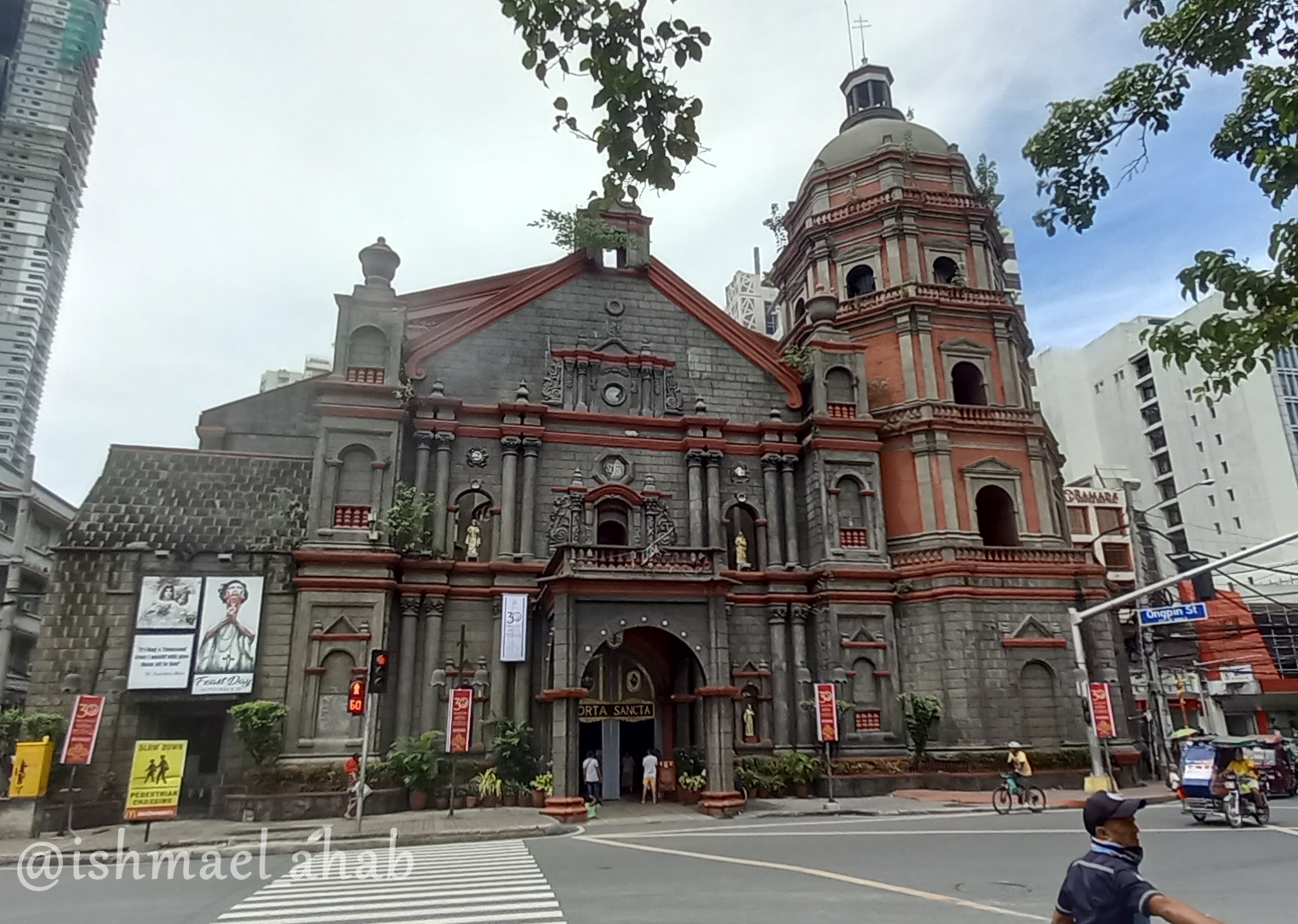
It was 12 years ago when I did a virtual Visita Iglesia of Santa Cruz Church in Manila. For that many years I witnessed this church change from white to brown-orange then back to immaculate white. Spiritually, this church grew from a simple parish in Santa Cruz to minor basilica dedicate to Our Lady of the Pillar.

Minor Basilica of Our Lady of the Pillar in Santa Cruz, Manila

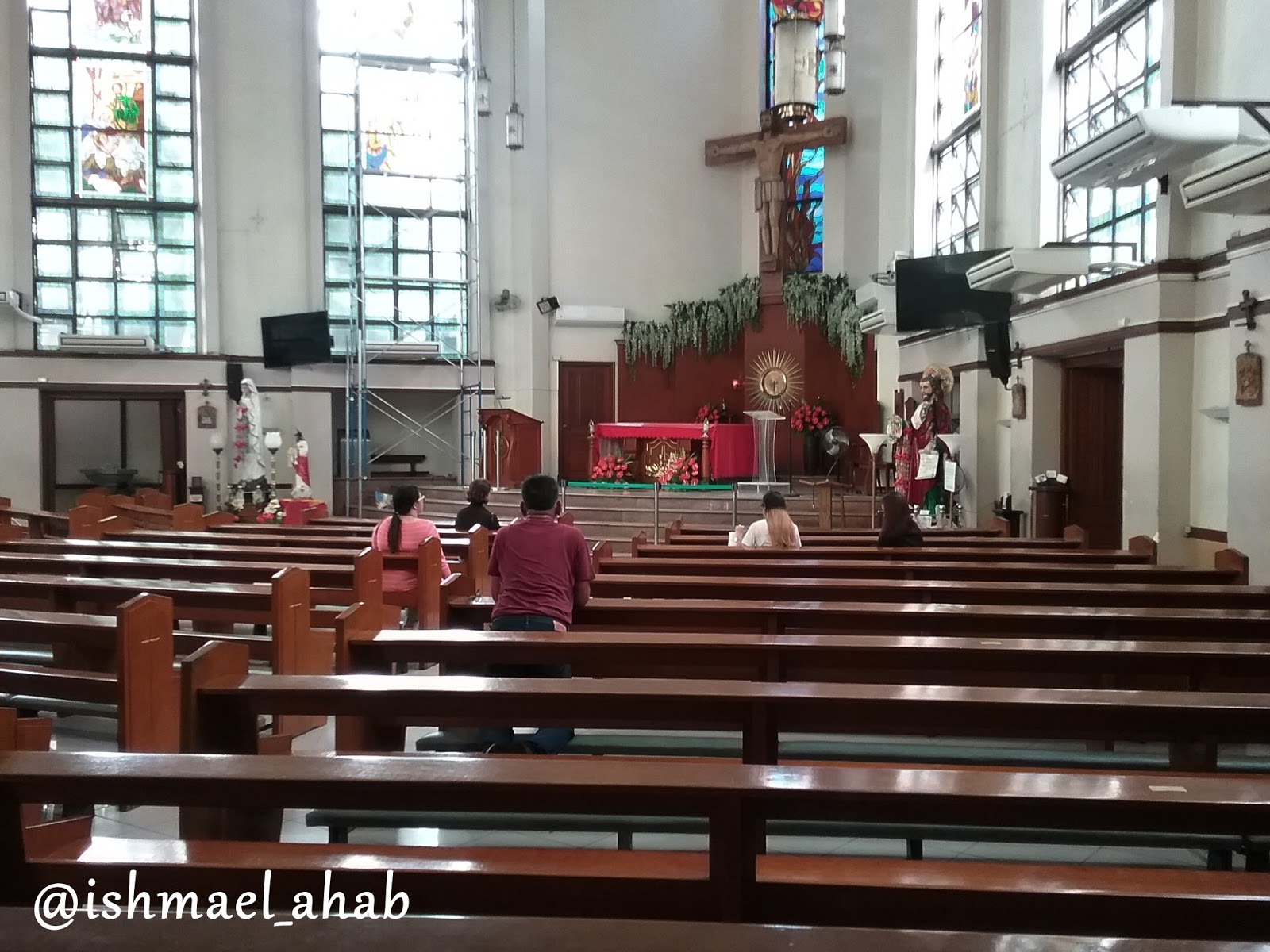
I am always drawn to this church simply because this is the only church that I encountered having Blessed Sacrament displayed upon the altar almost whole day every day. Praying directly to Jesus, in His mystical form of Holy Bread, is the closest we have to conversing to Jesus face-to-face. And I took advantage of that in Santa Cruz Church almost each time I go to the City of Manila.

Eucharistic Adoration in Minor Basilica of Our Lady of the Pillar in Santa Cruz, Manila
Holy Eucharist at the altar of Santa Cruz Church

The exposition of the Blessed Sacrament, which is the flesh of Jesus, is the charism of the Sacramentinos who administer this church. This religious society, known officially as Congregation of the Blessed Sacrament, focuses on promoting Jesus in the Eucharist. They do this by Eucharistic Adoration in their churches.

The Congregation was founded by a French priest Saint Julian Eymard, who felt an overwhelming love for Jesus Christ in the Eucharist while holding the Blessed Sacrament during a Corpus Christi procession. This experience led him to profess the love of Jesus through the Blessed Sacrament. Thus, the Holy Eucharist became the center of the religious life of the Sacramentinos.

Saint Peter Julian Eymard in Minor Basilica of Our Lady of the Pillar in Santa Cruz, Manila
Saint Peter Julian Eymard, founder of the Order of the Blessed Sacrament.

The Sacramentinos were assigned by the Manila Archbishop to manage Santa Cruz Church in 1957. Saint Peter Julian Eymard was established as the secondary patron of the church in 1984. His image stands at one side of the altar. On the other side is the most revered image of Santa Cruz’s primary patron: Nuestra Señora del Pilar or Our Lady of the Pillar.

Nuestra Señora del Pilar in Minor Basilica of Our Lady of the Pillar in Santa Cruz, Manila
Nuestra Señora del Pilar

The devotion to Our Lady of the Pillar was introduced by the original caretaker of Santa Cruz, Church: the Jesuits. The image of Our Lady of the Pillar was enshrined by the Jesuits in Santa Cruz in 1643.

The started Santa Cruz Church as a simple stone and wood church in 1619 to minister to the Chinese immigrants living in Santa Cruz area. It was the Chinese who built the church, thus this is one of the heritage churches by the Filipino-Chinese Catholics like the Binondo Church located at the other end of Ongpin Street.

Our Lady of the Pillar in Minor Basilica of Our Lady of the Pillar in Santa Cruz, Manila

The devotion to Our Lady of the Pillar originates to the earliest apparition of Mama Mary. It is believed that Mama Mary appeared to Saint James the Apostle when is having difficulty in converting pagans in  Spain. Mama Mary and many angels appeared to Saint James to motivate him and his disciples. This is the first case of bilocation since she is still alive in Jerusalem 

Our Lady of the Pillar in Minor Basilica of Our Lady of the Pillar in Santa Cruz, Manila

The altar of the church was temporarily changed during the elevation of the church into a minor basilica.

Our Lady of the Pillar in Minor Basilica of Our Lady of the Pillar in Santa Cruz, Manila

The temporary altar looks grand but the real altar is much simpler. It is meant to honor our Holy Mother during the special occassion. The Sacarmentinos and devotees worked hard for their church to receive the recognition from Pope Francis as minor basilica.

Speaking of Pope Francis, I distinctly remember Santa Cruz Church as the church where I learned about his death. It was afternoon and the bells of Santa Cruz Church is tolling. There was a pig tarpaulin photo of Pope Francis at the side of the altar. I wonder why but I am thinking that maybe the Pope is dead because. And it was true. Pope Francis has just died.

Altar of Minor Basilica of Our Lady of the Pillar in Santa Cruz, Manila

The altar of Santa Cruz Church features the image of the lamb standing on a spring. The water from the spring flows down to the tabernacle indicating that the life-giving water comes from Jesus. The Holy Table features two angels holding the symbol of the Virgin Mary. This definitely shows the honor that the Sacramentinos give to the Holy Mother.

Aside from Our Lady of the Pillar, the Sacramentinos also honor Our Lady of the Most Blessed Sacrament.

Our Lady of the Blessed Sacrament in Minor Basilica of Our Lady of the Pillar in Santa Cruz, Manila

They also honor Our Lady of Deliverance, Empress of China Dong-Lu. This reflects the roots of Santa Cruz Church as the church built for the conversion of Chinese immigrants living in Santa Cruz.

Our Lady of Deliverance, Empress of China Dong-lu in Minor Basilica of Our Lady of the Pillar in Santa Cruz, Manila

During the Boxer Rebellion, soldiers attacked the Chinese village of Dong-lu because it has a small community of Christians. Our Lady of Deliverance appeared with a "fiery horseman" and drove the soldiers away thus saving the Christians and the whole village.

Santa Cruz Church is one of the two churches that I frequented whenever I am in Manila. I always find this church a good place for prayers, especially when the Blessed Eucharist is at the altar.

This church may change its facade, be raised to another level of recognition but its mission remains the same throughout all these centuries. That mission is to bring people closer to Jesus in the Holy Eucharist.

- - -

Visita Iglesia is the Filipino tradition of visiting churches during the Holy Week. This virtual Visita Iglesia is my own tradition wherein I post about one church each day of the Holy Week.

- - -

References

2. Saint Peter Julian Eymard in Congregation of the Blessed Sacrament Province of Saint Ann
3. Sta. Cruz Community in Blessed Sacrament Philippines

Visita Iglesia: Quiapo Church (Manila)

Today is Black Saturday, the day when the superstitious people believe that Jesus is dead. The truth is that this was the day when Jesus descended to Hades to free the worthy souls and brought them to heaven.

The death of Jesus on the cross is not the end but rather a beginning of our salvation. So for the 7th and last day of my virtual Visita Iglesia, I believe that it is good to look at Quiapo Church and the big statue John the Baptist outside of it.


Saint John the Baptist at Quiapo Church


John preceded the Lord and prepared the way of Jesus by proclaiming: "I am a voice crying out in the desert, 'Make straight the way of the Lord.'". I believe that the message is still true even until now. We Christians must make straight the way of the Lord so that he can do wonders in our life. We should straighten ourselves up and prepare for the resurrection of the Lord in our hearts.


Saint John the Baptist at Quiapo Church


The statue of John shows as if he was preaching to the people outside of Quiapo Church. He is shouting at the den of unholy things such as pamparegla, manghuhula, and anting-anting. These unholy things are displayed side-by-side with the images of Nazareno, Mama Mary, Santo Niño, rosaries, and images of saints.


Saint John the Baptist at Quiapo Church


Quiapo Church is the most popular church in Manila because of the thousands of devotees to the Black Nazarene.


Quiapo Church, Manila


What I like about Quiapo Church is the daily schedule for confession. I also regularly drop by their Adoration Chapel before the pandemic.


For more of my story, read about my previous Visita Iglesia in Quiapo Church.

- - -

Visita Iglesia is a Catholic tradition of visiting seven or fourteen churches during Maundy Thursday. For each day, this Holy Week, I will feature one church as a sort of virtual Visita Iglesia.

Read about the churches that I visited this year

Palm Sunday: Immaculate Conception Church in Concepcion Uno, Marikina

Holy Monday: Santo Niño de Paz Chapel in Greenbelt, Makati

Fig Tuesday: Our Lady of the Most Holy Rosary Chapel in SM Makati

Spy Wednesday: Santa Rosa de Lima Church in Santa Rosa, Laguna

Maundy Thursday: Saint John Paul II Chapel in NAIA Terminal 3

Good Friday: Minor Basilica of San Lorenzo Ruiz in Binondo, Manila

Black Saturday: Quiapo Church in Manila
.

Visita Iglesia: Minor Basilica of San Lorenzo Ruiz (Binondo, Manila)

Good Friday is the day when we commemorate the suffering and death of our Lord, Jesus Christ. Now, a certain Philippine president ridiculed Jesus because he let Himself be crucified. That president, who only knows of worldly power, is ignorant of the power of Jesus' sacrifice. Through his sacrifice many Christians were inspired and strengthened to take up their cross, face persecution, and die like Him. One of such men who saw the power of Jesus on the cross is San Lorenzo Ruiz and I will be featuring his shrine in Binondo for the fifth day of my virtual Visita Iglesia.

Binondo Church

San Lorenzo Ruiz is a son of a Chinese convert and a native Filipina Catholic. His life is intimately connected with Binondo Church because he served as a sacristan, educated by Dominican friars, joined the Confraternity of the Most Holy Rosary and became a clerk of the church.

In 1636, he was falsely accused of murdering a Spanish tax collector. To escape the Spanish colonial authorities, Lorenzo joined the Dominicans in their mission to Japan. He left his wife and children without realizing that he will never see them again.

Lorenzo and companions arrived in Japan in the period of extreme persecution under the Tokugawa Shogunate. They were captured, imprisoned for two years, and then were sent to Nishizaka Hill in Nagasaki to be tortured to death.

The Martyrdom of San Lorenzo Ruiz
(Source: AnaStPaul)

Lorenzo and his companions experienced painful forms of torture, such as waterboarding and insertion of bamboo needles under fingernails. Those who managed to stay alive during the ordeal were made to undergo the tsurushi — an execution method in which the victim is hanged upside down then lowered into a pit filled with excrement. The temple of the victim is cut so as to break their will or eventually kill them. Those who apostatized or denied Jesus Christ were released.

Lorenzo Ruiz did not betray our Lord. He even told his torturer these words: "I am a Catholic and I wholeheartedly accept death for God. If I had a thousand lives, I would offer them all to Him".

Lorenzo Ruiz followed the path of martyrdom as his Lord. A common man bore his heavy cross and in the end he received the crown of glory from his Master and Lord.


San Lorenzo Ruiz in Binondo Church

The current parish priest of Binondo said in his homilies that those in Binondo are fortunate because they walk in the aisle where San Lorenzo Ruiz once walked. They looked at the same altar where the first Filipino saint once served.

Binondo Church before the Renovation
Binondo Church before the renovation.

Binondo Church was recently renovated and looks a little different to how it looked many years ago.

The facade was fixed and was highlighted with red paint.

Renovated Binondo Church

The interior was also renovated. The old gray color scheme was replaced by somewhat pinkish palette.

Interior of Binondo Church

The altar was also repainted.

Altar of Binondo Church

My favorite painting of Saint Michael on the ceiling above the altar is still there and the other paintings on the ceilings were also restored.

Painting of the Glorious Mysteries on the ceiling of Binondo Church

At the side of the church is the image of Nuestra Señora del Pronto Socorro or Our Lady of Prompt Succor. This Marian image is not only a religious relic but also a cultural treasure. According to the Cultural Center of the Philippines (CCP), the image of Nuestra Señora del Pronto Socorro is believed to be the remaining painting of a Chinese artisan dating to the 16th Century.

Nuestra Señora del Pronto Socorro

Nuestra Señora del Pronto Socorro was first venerated in the Church of the Holy Kings in the first parian or Chinatown of Manila, which is located in the area occupied by the Manila Central Post Office and Metropolitan Theater. The Marian was later transferred to Binondo Church in 1598.

Our Lady of Prompt Succor

The Chinese who painted the Marian image copied the European version but integrated it with Oriental artistic style. The face of Mary in this image is more Chinese than European. The arrangement of Mary's cape is similar to that of Chinese goddess Kuan Yin.

We can say that the Binondo Church's Nuestra Señora del Pronto Socorro is a fusion of European and Chinese art styles.

Nuestra Señora del Pronto Socorro
(Source: Encyclopedia of PH Art)

The Minor Basilica of San Lorenzo Ruiz is steeped in history. I already talked about the old Chinese tombs in the church, particularly of Juan Dionicio Coqua. A look at the floor at the entrance of Binondo Church and you will see the broken tombstones or piedra china.

Broken Chinese Tombstones in Binondo Church

Binondo Church is a testament of the victory of the Lord through his martyrs. The sacrifices made by our Lord on the cross strengthened Christians like San Lorenzo Ruiz. The horrible and shameful death of our Lord, which is ridiculed by many, is actually the source of strength that brings many people to heaven. May all us emulate San Lorenzo by cleaving to our Lord even if we are persecuted or even at the point of death.

- - -

Visita Iglesia is a Catholic tradition of visiting seven or fourteen churches during Maundy Thursday. For each day, this Holy Week, I will feature one church as a sort of virtual Visita Iglesia.

Read about the churches that I visited this year

Palm Sunday: Immaculate Conception Church in Concepcion Uno, Marikina

Holy Monday: Santo Niño de Paz Chapel in Greenbelt, Makati

Fig Tuesday: Our Lady of the Most Holy Rosary Chapel in SM Makati

Spy Wednesday: Santa Rosa de Lima Church in Santa Rosa, Laguna

Maundy Thursday: Saint John Paul II Chapel in NAIA Terminal 3

Good Friday: Minor Basilica of San Lorenzo Ruiz in Binondo, Manila

Black Saturday: Quiapo Church in Manila

- - -

References:


.

Visita Iglesia 2020: National Shrine of Saint Jude (Manila)

When I was still reviewing for the board exams, our review center brought us to a church just outside of the Malacañan Palace Compound. Back then I didn’t know the reason why our instructors brought us to that particular church. What I do know is that my prayers in that church and the intercession of St. Jude helped me pass the engineering board exam with, surprisingly, “flying colors”.

The church I am talking about is the National Shrine of Saint Jude in San Miguel, Manila.

National Shrine of Saint Jude

St. Jude Thaddeus is one of the 12 apostles of our Lord Jesus Christ. He was often confused with Judas Iscariot, who betrayed our Lord, that it was said that St. Jude was only invoked during desperate situations when the petitioner no longer has other saints to ask for intercession.

National Shrine of Saint Jude

The National Shrine of St. Jude features the image of St. Jude Thaddeus where he is seen holding the image of Jesus. St. Jude is commonly depicted holding the face of Jesus because according to a legend, King Abagar of Edessa requested Jesus to heal him of leprosy. Since the king cannot go to Jesus, he sent an artist to draw His face. Our Lord is impressed with the king’s faith that He pressed His face on a cloth, leaving His face imprinted on it. Jesus then instructed St. Jude to bring the image of His face to the King of Edessa. This is why St. Jude is usually depicted as holding the face of Jesus.

St. Jude in National Shrine of Saint Jude

Just like the other Apostles, St. Jude went to various places to preach the Gospel. He is believed to have been martyred either in Armenia or Beirut, Lebanon. His remains were buried St. Peter’s Basilica in Rome where many pilgrims received powerful intercessions.

St. Jude in National Shrine of Saint Jude

The title of “Patron Saint of the Impossible” was revealed by God to St. Bridget of Sweden and St. Bernard.


Many people go to the National Shrine of Saint Jude every Thursday to bring their petitions and ask the intercession of St. Jude. Most of the petitioners are takers of board exams. St. Jude became popular to board examinees because passing the board exam is “impossible” and failing is not an option.

Inside National Shrine of Saint Jude

The Parish of Saint Jude, first named as the Espiritu Santo Chinese Parish, in San Miguel was established in 1954 to cater to the growing number of Chinese and Filipino-Chinese converts. The original Chinese parish church is the Binondo Church. However, the church cannot cater the growing number Chinese converts. The Chinese Catholics also spread to other parts of Metro Manila, beyond the reach of Binondo Church.

Binondo Church is now a Filipino church managed by secular priests. The Chinese identity of Binondo Church was already lost. The Dominican mission to the Filipino-Chinese was transferred to a small church at the back of Binondo Church.

Unlike Binondo Church, the Chinese identity of the National Shrine of Saint Jude is still alive. A proof of this is the image of a Chinese saint inside the church.

Chinese Catholic Saint in National Shrine of Saint Jude

Too bad that I did not get that saint’s name.

Saints in National Shrine of Saint Jude

The altar of the church features the crucified Jesus Christ. At the back of it is a stained glass that features balls of fire falling from the sun. The effect is that the ball of fire is descending upon our Lord on the cross.

Altar of National Shrine of Saint Jude

The beautiful altar also has the tabernacle at the center.

The National Shrine of Saint Jude transformed from a personal Chinese parish to a territorial parish that cater to communities in the vicinity of the church. This church successfully retained its Chinese roots while growing with the Filipino community in its midst.

- - -

Prayer to St. Jude Thaddeus

Most holy Apostle, St. Jude, faithful servant and friend of Jesus, the Church honors and invokes you universally, as the patron of difficult cases, of things almost despaired of, Pray for me, I am so helpless and alone.

Intercede with God for me that He bring visible and speedy help where help is almost despaired of. Come to my assistance in this great need that I may receive the consolation and help of heaven in all my necessities, tribulations, and sufferings, particularly - (make your request here) - and that I may praise God with you and all the saints forever. I promise, O Blessed St. Jude, to be ever mindful of this great favor granted me by God and to always honor you as my special and powerful patron, and to gratefully encourage devotion to you.

Amen

- - -

Seventh Station: Jesus Falls the Second Time
(Source: Wikimedia)

We are now in the third church for our virtual Visita Iglesia so we pray the:

Seventh Station: Jesus falls the second time

If you missed the earlier stations, I suggest that you visit the churches that we featured earlier in this year’s virtual Visita Iglesia:


- - -

References:

1. St. Jude and History of St. Jude Parish from National Shrine of St. Jude website.
2. St. Jude Thaddaeus from Catholic Online
3. National Shrine of Saint Jude (Philippines) from Wikipedia
4. Novena to St. Jude - Desperate Situations and Hopeless Cases from EWTN
.

Playtime for the Kids in Rizal Park Children's Playground

Fun for the Kids at Rizal Park Children's Playground

According to Pediatrics Journal:

Play is essential to development because it contributes to the cognitive, physical, social, and emotional well-being of children and youth. Play also offers an ideal opportunity for parents to engage fully with their children.
In short, play is good for our children, Samuel and Samantha. It is also a good way of bonding between me, My Beloved wife, and the kids. That's why I join playing toys with the kids. I  join their pretend plays and sometimes horseplay with them.


Unfortunately, our hometown in Laguna woefully lacks public park. That city doesn't have any green public park or a decent playground. This is a big contrast to Baguio City and Tagaytay that have wide green public spaces. In fact, our family has to go to Nuvali just to give the kids a wide green space to run around.

So, one day we decided to bring Samuel and Samantha to a big playground. We brought them to Rizal Park Children's Playground.

Entrance to Rizal Park Children's Playground

Rizal Park Children's Playground is big and has slides, swings, seesaw, and other things that the kids will enjoy. The best thing is that there's no entrance fee, which is like the playground in Baguio's Burnham Park. 

Samuel and Samantha ran with excitement the moment they entered the playground. They went up and down on this rainbow slide.

Rainbow Slide at Rizal Park Children's Playground

They also had a good time with other slides.

Slide at Rizal Park Children's Playground

Swings and monkey bars.

Monkey bars at Rizal Park Children's Playground

What I like about the Rizal Park Children's Playground is the whimsical and playful designs of the park like these bench carried by frogs.

Frog Bench at Rizal Park Children's Playground

Then there is this statue of a fish being eaten by another fish, which is a playful design for a tunnel.

Fishes at Rizal Park Children's Playground

Statues like these reminds me of monsters and characters from Studio Ghibli movies.

Our favorites in Rizal Park Children's Playground is this life-size and larger-than-life statues, such as these dinosaurs:

Dinosaurs at Rizal Park Children's Playground

Then there is giant hippo, where my son bravely entered and had a good photo in its mouth.

Giant hippo at Rizal Park Children's Playground

These statues are the reasons why I wanted to bring my children to Rizal Park Children's Playground. I always see them every time I ride the LRT train and I know that my children will marvel at the dinosaurs.

There is also a big statue of the pawikan.

Giant sea turtle in Rizal Park Children's Playground

Of course, I imagined my kids being devoured by this giant sea turtle.

Pawikan in Rizal Park Children's Playground


The whimsical characters and larger-than-life statues in Rizal Park Children's Playground is very good for enhancing my children's imagination. The people who planned this park really thought about the children who will use this playground.

Rizal Park Children's Playground features things that can be found in fairy tales such as this "shoe house".

Magical shoe house in Rizal Park Children's Playground

Then there is a pumpkin house...

Pumpkin House in Rizal Park Children's Playground

...which reminds of the carriage used by Cinderella.

Rizal Park also has a volcano.

Volcano in Rizal Park Children's Playground

Do not be afraid. That volcano is dormant and will no longer throw up sulfur and ash.

My Little Ones had the great time in Rizal Park Children's Park. I was happy to see them enjoy. Sadly, I observed not-so-good things during our tine there. 

One not-so-good thing is the rudeness of other kids inside the park. These kids throw sand and gravel on the slide and other kids.

Another not-so-good thing graffiti and vandalism of park visitors. I saw plenty of writings in the statue and other park amenities.Other visitors also throw their garbage anywhere.

Graffiti and vandalism in Rizal Park Children's Playground
Graffiti in Rizal Park Children's Playground.

These not-so-good things are not the fault of Rizal Park administrator but by Filipinos themselves! It reflects our nature as Filipinos. And it is saddening. 

Despite the not-so-good Pinoy behavior that I observed, I will still bring my little ones to the Rizal Park Children's Playground because this is one of the very few places where they can experience the joy of play, which is also the joy of childhood.

- - -

Read about my other post about Rizal Park, which is about the Luneta Park Dancing Fountain.