
I was at SM – Bacoor last weekend where I was amazed by an exhibit located at the lower ground floor. It featured the history of the postal service in the Philippines and, of course, letter writing. The best part of the exhibit is PhilPost’s collection of stamps.
 |
| PhilPost's stamp collection on display. |
I also learned a lot about the history of postal services in the country. The Philippine Postal Corporation (PhilPost or PhlPost) points to the year 1767, when the Spanish Colonial Government established the post office in Manila, as its foundation date.
 |
| Milestones of postal service in the Philippines. |
PhilPost’s 1st National Letter Writing Day was done to promote letter writing and postal services in the Philippines. This is a good move for PhilPost since letter writing is now ignored by most people, especially the younger generations.
During my grade school days, letter writing is one of the things that we should learn. We are taught about the parts of the letter. Our teacher also taught us how to start and end a letter. We were even tasked to send our letter by mail!
I’m not sure if letter writing is still being taught in schools.
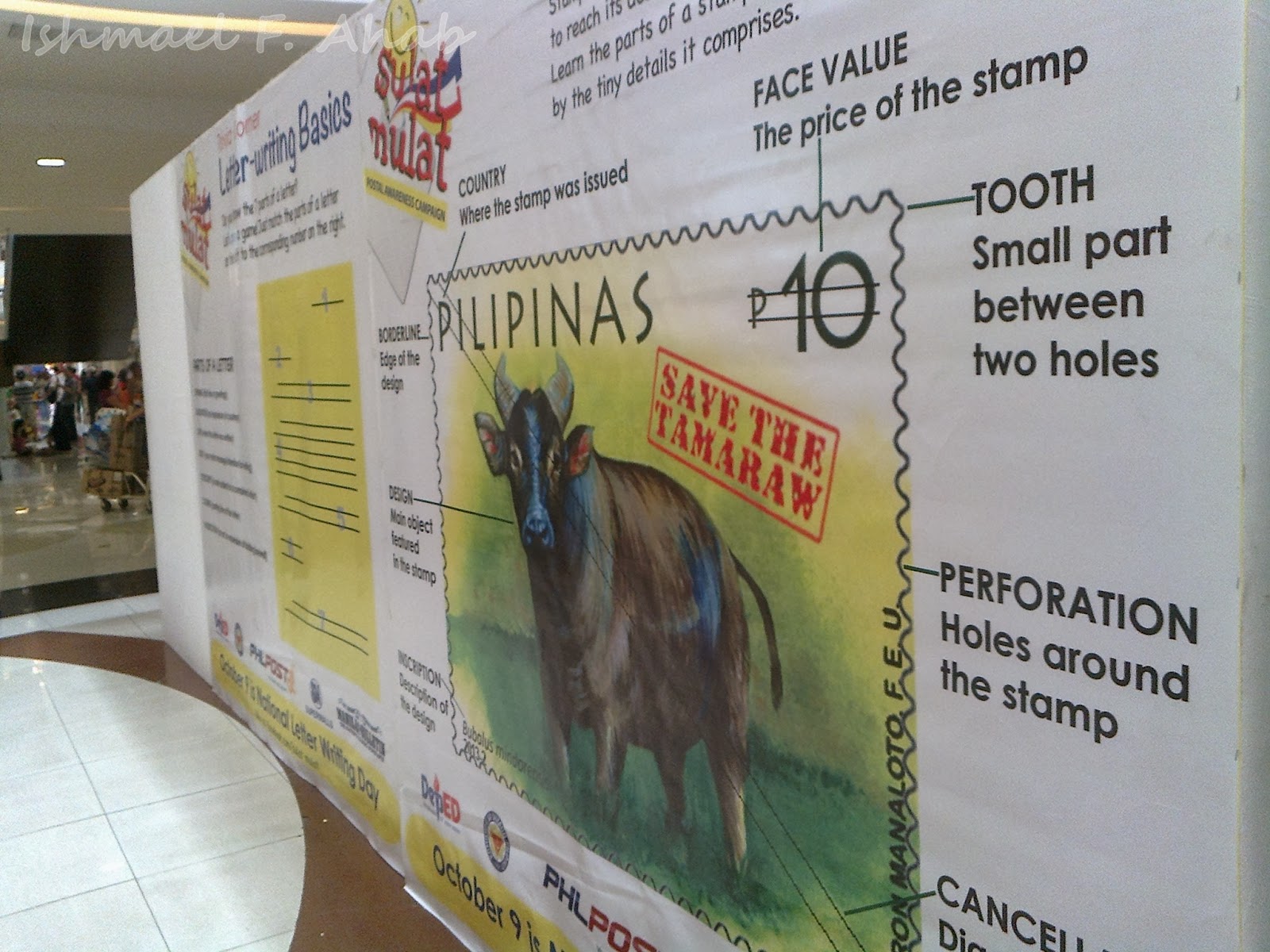
Many stamps produced by PhilPost were on display. Many of them feature plants and animals. Of course, heroes and notable people in Philippine history were also featured in the PhilPost exhibit. My favorite, however, are the stamps featuring the canonization of Saint Pedro Calungsod and the beatification of Pope John Paul II.

 |
| Butterflies (2006), special stamp for APO Philatelic Society (1950) and KKK. |
PhilPost stamps featuring butterflies and flowers are the most common in my collection. Such stamps are my least favorite because I don't like the design.
I also have stamps featuring some notable persons in Philippine history. I think that these kinds of PhilPost stamps are also common.
 |
| Left to right from top to bottom, PhilPost stamps featuring the first stamp issued in the Philippines, Sultan Kudarat, Pio Valenzuela, Rafael Palma, Wenceslao Vinzons, Gregorio del Pilar, Jose Rizal and Ninoy Aquino. |
My favorite kinds of stamps are those featuring churches in the Philippines. Too bad that I only have three such stamps.
 |
| Clockwise from upper left, Morong Church, San Agustin Church and Basilica of Taal. |
All three stamps were issued in 1975. Of the three churches, I only managed to visit San Agustin Church, which is located in Intramuros. I hope to visit the other two churches in the near future.
Aside from stamps issued by PhilPost, I also have stamps that originated from other countries. Here some of them:
 |
| Stamps from Japan, India, Indonesia, USA, Korea, Singapore, Sri Lanka and Thailand. |
I also have stamps from New Zealand and Canada but I didn't included it here.
Aside from the common stamps and old envelopes, another gem in my collection is an envelope of a telegram. I was amazed when I found it because it is rare to see telegram envelopes these days.

Before the advent of telephone, the telegram served as the fastest mean of sending messages to faraway places. I heard from my parents that it is expensive to send a telegram so people try to be as brief as possible. Telegram was usually used for urgent messages.
Stamps are small pieces of paper but it is packed with history. That's why I collect stamps and also the envelopes where they are attached.
It is good that PhilPost is active in promoting letter writing. Such art is somewhat lost to the youth of today. They prefer fast paced communication that they usually forget to think before they send their messages. I believe that letter writing promotes thinking because it requires well constructed sentences.
Letter writing and postal service will not return to their former glory. What I hope that PhilPost's National Letter Writing Day will achieve, at least, is the promotion message composition that was well thought of and patiently composed.
So, to my kababayans, happy National Letter Writing Day!

For more information about the 1st National Letter Writing Day, please visit Sulat Mulat Facebook page and the PhilPost website.


