Showing posts with label Juan Arellano. Show all posts

"Photo-tour" along Jones Bridge

Binondo Chinatown is a district in Manila that was important to the Spanish Colonial Government. Chinese businesses and trade were located in Binondo Chinatown. The old ports of Manila North Harbor and District of Tondo were likewise connected to Binondo. Because of this, the colonial government established a bridge that spanned the Pasig River to connect Intramuros and Binondo. That bridge was named as Puente Grande and then renamed as Puente de España.

Unfortunately, Puente de España was damaged during the floods that occurred on September 1914. The burden of replacing the damaged bridge fell into the hands of the American Colonial Government. The American authorities commissioned Juan Arellano, who was also the designer of the Manila Central Post Office, to design a new bridge which will be placed one block downriver from the original location of Puente de España.

Jones Bridge suffered the same fate of the Manila Central Post Office. Bombs damaged the bridge during the Second World War.
.
Jones Bridge
Jones Bridge

It was said the Jones Bridge was Juan Arellano's masterpiece. It was an arch bridge with ornate designs following the neoclassical style of architecture. The entrance to bridge has pillars with statues at the top.

The entrance to Jones Bridge is now occupied by lion statues.
.
The Chinese lion of Jones Bridge

The lion statues of Jones bridge is a pair. One is a male and the other a female. This one, located on the west side of the bridge, is a male lion statue. I know its "sex" because the male organ was present. The same goes for the Chinese lioness statue located on the east side of the bridge.

The remaining part of the bridge is bare. It seems like that the Philippine government didn't have funds to return Jones Bridge to its former glory. That is understandable. The Philippines is still reeling from the destruction brought by the War.
.
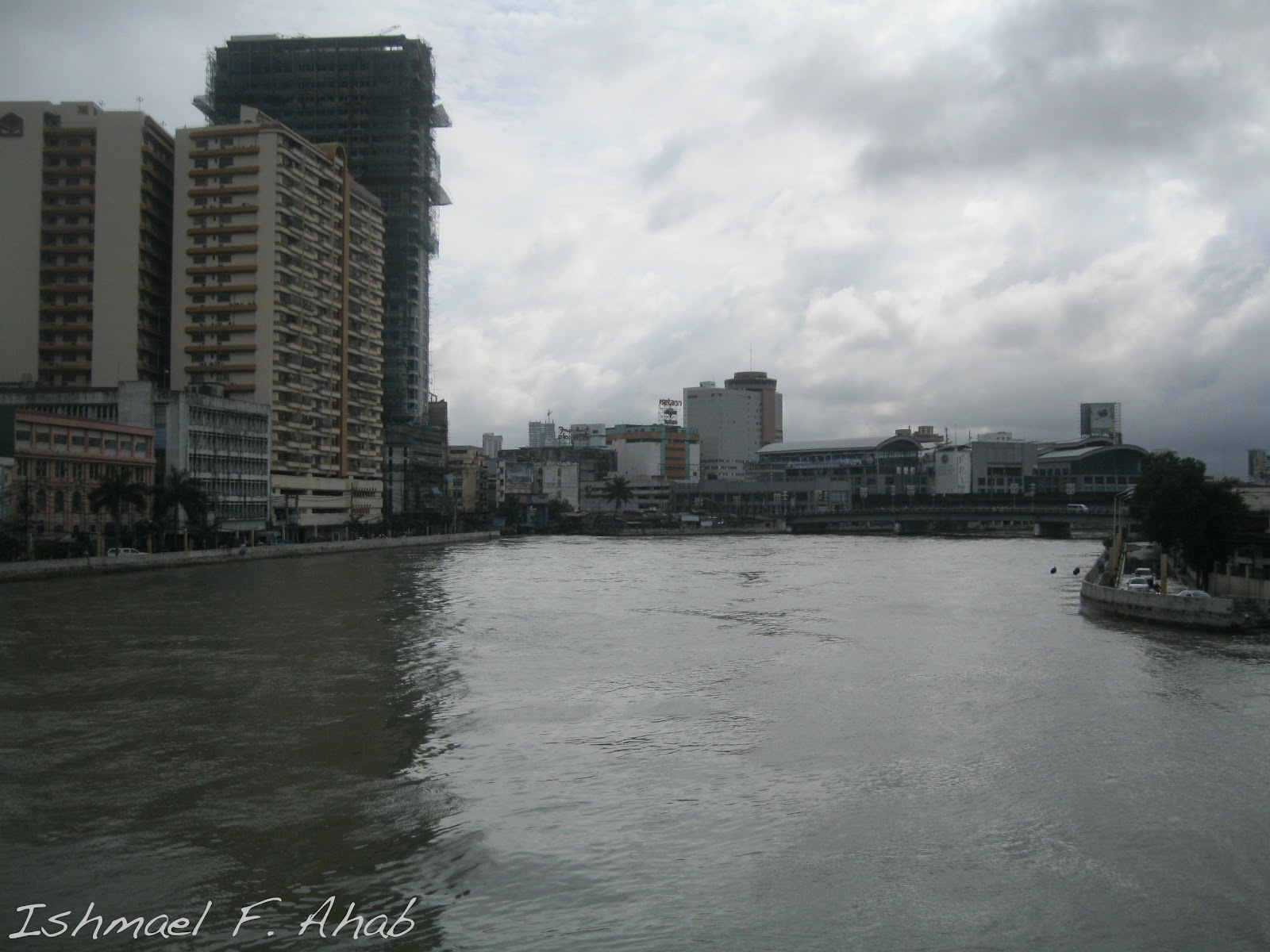
Pasig River and MacArthur Bridge as viewed from Jones Bridge.

I always wonder who this Jones is whenever I pass along this bridge. Sometimes I think that this bridge was named after Tom Jones, who is very popular in the Philippines due to his “Sex Bomb” song.

Alas, I was wrong. Jones Bridge was named after Virginia Rep. William Jones. He was the author of the Philippine Autonomy Act of 1916.
.
The area of Calle Escolta as viewed from Jones Bridge
The area of Calle Escolta.

Jones Bridge is the best way to reach Binondo Chinatown and Divisoria. Vehicles filled with goods always pass by this bridge. This bridge is also not spared of the traffic, especially during the rush hours.
.
Entrance to Binondo as seen from Jones Bridge.
The entrance to Binondo District. Can you see the Filipino - Chinese  Friendship Arch?

Its been a long time since I passed through this bridge. I am missing this place now especially the sunset:
.
Stunning Manila sunset as seen from Jones Bridge

---

Historical information for this post came from Jones Bridge article in Wikipedia.

---

Have you experienced passing through Jones Bridge? Or do you know some historical tidbit about it? Share your experiences and information with us by leaving a comment on the combox below.

Manila Central Post Office

Standing on the southern bank of the Pasig River is a building popular as location for the local movies. I actually saw this building in “Praybeyt Benjamin” of Vice Ganda and another movie, which starred Bea Alonzo. Its columns is very impressive to look at that's why directors and producers like this building.

I am, of course, talking about the Manila Central Post Office.
.
Manila Central Post Office as viewed from Liwasang Bonifacio.


The Manila Central Post Office is my most favorite building in Manila. The neoclassical artchitectural style of this building reminds me of old Greece.
.
Front view of Manila Central Post Office.
The Philippine flag is on half-mast during Sec. Robredo's wake.

The post office building was located between Jones and MacArthur bridges. Locate in front of it is the Liwasang Bonifacio, which contains a unique statue of Andres Bonifacio.
.
Statue of Andres Bonifacio with Manila Central Post Office at the background.


This statue is unique because Andres Bonifacio is not holding any bolo. He is standing as if he is posing for a photo with the Manila Central Post Office as the background.
.
Facade and columns of Manila Central Post Office.


What I like with classical buildings is the presence of tiny details. An example would be the “gargoyle heads” located on the buildings facade. You can see those heads on the photo above. The heads are brown-colored “dots” located above the columns.

Buildings designed before the Second World War are beautiful because the architects are concerned about the minor details. The gargoyle heads on the facade of the Manila Central Post Office are small and unnecessary. These will look invisible to many people going in and out of the post office building. Despite of that, the architect still included it in his design.
.
Hallway of Manila Central Post Office.


The Manila Central Post Office was erected in the year 1926. The original building was designed by Juan Arellano. Unfortunately, this building was destroyed during the “Liberation of Manila” at the end of the Second World War. Ironically, it is the Americans (the so-called liberators) who did the most damage in Manila at the end of the War. Their bombs destroyed most of the pre-War buildings including the post office building.
.
Damaged Manila Central Post Office building after the World War 2 as viewed from Jones Bridge.
(Source: Wikimedia Commons)

.
Damaged Manila Central Post Office as viewed from MacArthur Bridge.
(Source: Wikimedia Commons)

These photos were taken after the Liberation of Manila (1945) by Private Glenn Eve of the US Military. You can visit this site to see other post-World War 2 photos of the Manila Central Post Office.

The Philippine Government rebuilt the post office building. The original design of the building was followed but some people say that the current post office building is a far cry from the design of Juan Arellano.
.
The Postman in front of Manila Central Post Office.


The Postman is located right in front of the Manila Central Post Office building. This statue was erected in 1975 in honor of the employees of the Philippine Postal Service. The Postman serves as a symbol of service excellence that touched the lives of people across the country and around the whole world.
.
Another view of The Post in front of Manila Central Post Office.


The central post office building now serves as the main office of Philippine Postal Corporation (PhilPost). This is where posts around the world are sorted before being sent to their respective destinations within the country. I am glad that our postal service is still alive in spite of being labeled as “snail mail”. The Manila Central Post Office building will continue to be maintained while PhilPost is alive.
.
Front street of Manila Central Post Office.

P.S. Do you want to see what's inside the Manila Central Post Office? This music video features the post office building:


Beautiful video and music. :-) Thank you for pointing me to this video TinTin Sison.

---

Do you experienced sending mail at the Manila Central Post Office? Or did you already visited their impressive neo-classical building? Tell us about your experience by leaving a comment on the combox below.