Showing posts with label Philippine Heritage. Show all posts

Paco Cemetery: Where We Pigeonhole the Dead

In the midst of the concrete jungle that is Manila lays the quiet refuge for the dead of long ago. The Americans, during their occupation of the Philippines, found this place so peculiar that one governor-general described it as the place for “pigeonholing our dead for future reference”.

The pigeonholes for dead now occupied by actual pigeons.

The pigeonholes are located in Paco Cemetery in the Paco District of the Manila.


My interest flared up again when I entered the walls of Cemeterio de Paco. It was like the first time, about a decade ago, when I visited the cemetery for a paper required in Panitikang Pilipino course. I believe that that first visit stirred my enthusiasm in Spanish Colonial Era architecture, history, and heritage left by our forefathers.


Paco Cemetery was built in response to the cholera outbreak that ravaged Manila in the late 18th Century. Maestro de Obras, Don Nicolas Ruiz prepared the plan while the construction work was supervised  by Don Jose Coll. The original cemetery, which actually is the inner wall, was finished on April 22, 1822.

Atop the wall of Paco Cemetery.

The population of the dead grew that another set of niches were needed. So in 1859, Gobernador-General Fernando de Norzagaray ordered the enlargement of the cemetery to 4,540 varas cuadradas (square yards). A Chinese builder won the contract for building the outer circular wall at the cost of 19,700 Pesos.

Many people consider cemeteries as scary places. Paco Cemetery is different. I didn’t felt afraid of the niches or the dead ashes they hold. In fact, Paco Cemetery is the site of many weddings.


Weddings in a cemetery is usually connected to “black weddings” but that is not the case in Paco Cemetery. Weddings held in that place are as solemn and joyous as the weddings in other churches.


St. Pancratius Chapel is a small chapel inside Paco Cemetery. It was named after a Roman citizen who was beheaded for the Faith. The chapel was meant for masses for the dead in the cemetery. Now, the chapel is beginning to be recognized for weddings.


The chapel and the cemetery were originally administered by a chaplain, a sacristan, and eight caretakers. The chaplain used to reside at a residence fronting Paco Cemetery, which is now occupied by the Paco Fire Station.

The chapel is now under the care of San Vicente de Paul Parish. Masses are held every Sunday while weddings may be scheduled from Monday to Sunday.


The beautiful garden of Paco Cemetery may be booked for garden receptions. The place is perfect for couples who wish a vintage ambience. Couples can even have their wedding photos atop the circular walls and I’ve seen beautiful photos shot in that place.

Couples who wish to have their wedding inside the Paco Cemetery should contact the National Parks Development Committee.

I am not the only person who visited Paco Cemetery during that afternoon. Most of the visitors were students from the nearby school and couples like this one:
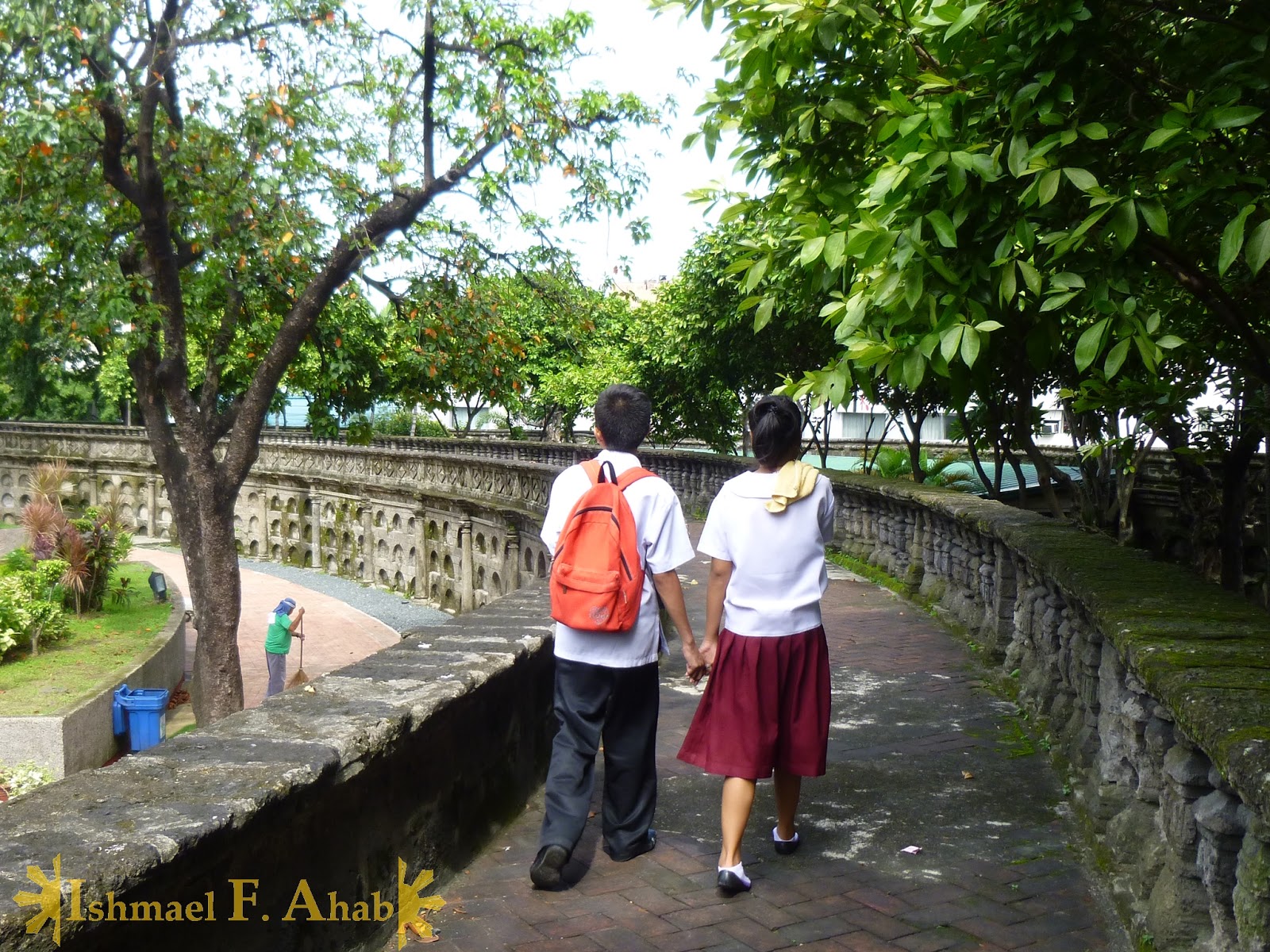

They found the perfect place to promise their undying love. I bet their parents will not be pleased.

Vandals are also common visitors to Paco Cemetery. They truly don’t have any respect, even for the dead:


Internment in Paco Cemetery stopped in 1912 and most of the niches are empty. However, around 65 people, including 22 children, are still within the vaults within the walls.

Niches for infants and children.

Only the members of the aristocratic class, living in the walled city of Intramuros were allowed to be interred in Cemeterio de Paco.  Each niche cost 20 Pesos for three years, and subject for renewals. No one is allowed to own the niche in perpetuity.

Niche of one of the young residents of Paco Cemetery.

So what happens if the family failed to renew the rental? The answer is: EVICTION. The remains of the dead are removed from the vault and buried in the common grave at the back of the cemetery. This means that being aristocratic and rich while alive will not guarantee that your remains will be safe forever. Death, indeed, is the equalizer between the poor and the rich.

Actually, vault rental is not unique in Paco Cemetery. Most of the cemeteries in the Philippines practice this. There were even reports of evicted dead thrown as garbage by scrupulous cemetery administrators. 


If the aristocrats are placed in vaults then those who rebelled against the colonial government are buried in the cemetery grounds. I found two white crosses can be found in the area between the two walls that mark burial grounds of the four great persons in Philippine history: GomBurZa and Jose Rizal.

Between the inner and outer walls.

Filipino priests; Mariano Gomez, Jose Burgos, and Jacinto Zamora, collectively known as the GomBurZa, were executed in 1872 by the colonial authorities because of their alleged involvement with the mutiny in Cavite.

GomBurZa's final resting place in Paco Cemetery.

Jose Rizal, then 10 years old, witnessed the execution of the three priests. He later wrote that GomBurZa’s death “awakened my imagination, and I vowed to devote myself to avenge such victims some day.” And he did avenge the three priests at but at a cost of his life. About 24 years after GomBurZa’s execution, Jose Rizal was executed at the same place as the three priests.

Spanish colonial authorities buried Jose Rizal’s remains in an unmarked grave in Paco Cemetery. They did this to prevent the revolutionaries from using Rizal’s body as a rallying point.

Jose Rizal's burial ground in Paco Cemetery.
The unmarked grave was later found by Narcisa, one of Jose Rizal’s elder sisters. She marked the grave with a marble slab inscribed with “R P J”, Jose Rizal’s initial in reverse. In 1912, Narcisa had the body exhumed hid it in her home in Binondo in an ivory urn until Jose Rizal’s remains were finally placed in his final resting place in Luneta Park.


GomBurZa and Jose Rizal were not the only notable persons who were interred in Paco Cemetery. Major General Henry Lawton, killed in the Battle of San Mateo, temporarily stayed in Paco Cemetery before he was sent to his final resting place in USA. Lawton is the highest-ranking American officer killed during the Philippine-American War.

Paco Cemetery is one of the most beautiful heritage sites in Manila. I actually enjoyed looking at the vaults even though some people consider it eerie. The thick walls filtered out the vehicular noise outside which made me think that I’m not in Manila. 


---

Information in blog post was obtained from the following sources:

1. Inscriptions and historical markers in Paco Cemetery.
.

The Abandoned House of Heneral Antonio Luna

There’s an old house nestled in the San Nicolas district of Manila that looks like an ordinary old house at first glance. This house has capiz windows, wooden walls at the top floor, and a large front door typical of the “bahay na bato” of the Spanish era.

                                                                                                                                                                                                                                                                                                                                                                                         
Heneral Antonio Luna's house along Urbiztondo, San Nicolas Manila

The old house is actually the birthplace of General Antonio Luna. Unfortunately, just like other historical houses in our country, General Antonio Luna’s birthplace is in great disrepair. The roof is about to fall off and the windows have missing capiz shells.

Second floor of Heneral Antonio Luna's house in San Nicolas, Manila

General Luna’s house looked bad on the outside and I shudder to think how worse it is in the inside.

Heneral Antonio Luna's house in Binondo, Manila

Another sad fact is that the front of General Luna’s birthplace became a tambakan, parking lot, and even a sleeping place of Binondo’s homeless.


General Antonio Luna is considered as the best Filipino general during the Filipino – American War. Heneral Luna was an excellent strategist that even the Americans respected him. He brought discipline and professionalism in the fledgling Philippine Army. His reforming works hurt many in the army, especialy those whom Luna considered as cowards ad insubordinates. Well, these cowards and subordinates murdered him in 1899 as allegedly ordered by President Emilio Aguinaldo.1

Historical Marker for Heneral Luna's house in Binondo, Manila

Keeping the old house in its sorry state is not the good way to honor the general. The government cannot do anything, however, since the house is a private property. Lorenzo Tan, the Filipino-Chinese who owned the house, said that he is willing to sell it to the government for 100 million pesos but he received this answer: “no funds available”.2

Heneral Antonio Luna's Birthplace in Binondo, Manila

Mr. Tan also questioned the claim that the old house was the birthplace of Heneral Luna because the historical marker was originally placed on his mother-in-law’s house located near the old house. The mother-in-law didn’t want the marker so the National Historical Commission transferred it to Mr. Tan’s house. The alleged true “birth house” of Heneral Luna is now a condominium.

It is sad to know that there were issues about the Heneral Antonio Luna’s house in Binondo. Is this the reason why the government is adamant in purchasing the house?

---

If you enjoyed reading this blog post then you will also enjoy reading about these historical houses:


---

Many information in this post were obtained from the following online articles:


A Peek in the Historic Halls of Aguinaldo Shrine

The white house of El Presidente Emilio Aguinaldo is always an eye-catcher whenever I pass by the town of Kawit. It always arrests my eyes partly because of its towering presence but mostly because of its historic appeal.

Aguinaldo Shrine on 5-Peso bill
The declaration of Philippine Independence immortalized on the old 5-Peso bill.

The house stands tall in Philippine history because this is the house where the declaration of our independence was read; where our flag was first unfurled; and where our national anthem “Marcha Nacionale” was first heard.

I didn’t get the opportunity to enter the Aguinaldo Shrine even though I visited it twice. My first visit was 3 years ago after an office errand in Cavite City. The second visit was last year when we watched the Christmas Lights and Sounds show.

Aguinaldo Shrine

My Beloved Wife and her kumare was more fortunate than me because Aguinaldo Shrine was open during their very first visit.

Entrance to Aguinaldo Shrine

The house was built in 1845. The current design was made between the years 1919 and 1921 to perpetuate the 1898 declaration of Philippine independence to the hearts and minds of the Filipino people.1

Historic balcony of Aguinaldo Shrine

The house of Emilio Aguinaldo is the cradle of Philippine Revolution not only against the Spaniards but also against the Americans. This is the reason why Aguinaldo Shrine is replete with the symbols of the Revolution like the three Ks, representing the Katipunan, at the top of the balcony. Another symbol is the carabao below the balcony.

White carabao of Aguinaldo Shrine

The Aguinaldo Shrine is not just a national museum but also a family museum of the Aguinaldos. The kumares entered the Shrine as if they were just entering a big house. They even entered the room where President Emilio Aguinaldo and his second wife Maria Agoncillo slept.

Emilio Aguinaldo's bedroom in Aguinaldo Shrine

The room has plenty of secret exits. Two of the secret exits are located inside the bathroom and the closet.2 I also read that there’s a secret tunnel connecting Aguinaldo Shrine and Kawit Church.3 These exits just shows that Emilio Aguinaldo prepared his means of escape. I guess being the enemy of both Spanish and American governments required this level of precautionary measures.

Bedroom of President Aguinaldo in Aguinaldo Shrine

Aguinaldo Shrine is divided into three sections: the Main House, the Tower, and the Family Wing.

Inside the Aguinaldo Shrine

The Main House is possibly the section where the Aguinaldo Family welcomed their guests. Being a president means that many people come and go. I don’t know what My Beloved Wife felt when she walked within this historic halls. As for me, I will feel elated because I know that I’m stepping on the same floor as the towering figures of our history.

Inside the Aguinaldo Shrine

I can imagine Aguinaldo hosting a dinner to the members of his cabinet. I can imagine Aguinaldo and the hot-blooded General Antonio Luna planning their war against the Spaniards. There’s so many things that happened inside this house that directed the course of our Nation.

Inside the Aguinaldo Shrine

Aguinaldo Shrine was visited by almost all Philippine presidents, especially during the Independence Day. Each president left their photo and message in this house.

Old photos of presidents who visited Agunaldo Shrine

The ceiling of the Main House is also replete with symbols like this map of the Philippines:

Philippine map on the ceiling of Aguinaldo Shrine

This map is incomplete since it didn’t include Sabah, which is still being claimed by our country. The map should also include the Kalayaan Islands in the West Philippine Sea.

Stairway to the tower of Aguinaldo Shrine

The Tower is located at the center of the house. It six floors and composed of the music room, library, and another room of Emilio Aguinaldo.

The Family Wing is the most private part of the Aguinaldo Shrine. There’s a terrace here that was said to be personally named by Emilio Aguinaldo as the Galeria de los Pecadores (Hall of Sinners) because of the subversive plots hatched here. It’s peculiar that Aguinaldo considered their plotting sinful. Did he regretted the revolution he hatched against the Spanish government or the trial against Andres Bonifacio?

Old photos of Emilio Aguinaldo in Aguinaldo Shrine

A wide garden surrounds the Aguinaldo Shrine. In front of it is a plaza where Caviteños can have their picnics or just enjoy the afternoon.

Garden outside of Aguinaldo Shrine

The plaza is the best place to take the photo of the whole Aguinaldo Shrine.

Aguinaldo Shrine

The car which I think was used by Emilio Aguinaldo was also on display. Too bad that it’s in a glass case so visitors can never experience a ride in this historic car.

Vintage car used by President Emilio Aguinaldo on display at the Aguinaldo Shrine

Emilio Aguinaldo’s car reminds me of the old warplanes on display in the PAF Aerospace Museum in Pasay.

There is also a souvenir shop near the Aguinaldo Shrine where visitors can buy some memorabilia. One interesting item for sale are the books defending Emilio Aguinaldo.

History books for sale at Aguinaldo Shrine

Emilio Aguinaldo is one the most hated man in Philippine history. He is pointed as the mastermind in the death of Andres Bonifacio and General Juan Luna. I too hated him in the past but I realized that what I read are mostly biased. Aguinaldo’s side of the story is mostly ignored. So now I think its better to look at our history objectively.

Handa Tagalog 1896

Aguinaldo Shrine may be reached by riding any bus going to Cavite City and Noveleta. Just tell bus driver or the conductor that you want to go down the Aguinaldo Shrine.


The Shrine is open to the public Tuesday to Sunday at 8 AM to 4 PM. Admission is free.

---

Read my other blog posts about the Aguinaldo Shrine.

The Historic Aguinaldo Shrine
A Christmas of Light and Sound at Aguinaldo Shrine

---

Footnotes:

1. Information sourced from the website of the National Historical Commission of the Philippines. Their website is down, unfortunately, because of a hacking incident last Independence Day.

2. Information sourced from the information board inside the Aguinaldo Shrine.

3. Traveler on Foot mentioned the secret tunnel from Aguinaldo Shrine to the church (or cemetery) 

Savory Restaurant – Another Manila’s Heritage Lost

Never judge a Chinese restaurant by its looks. Having a dilapidated building doesn't mean that the food they serve is not good. A friend once told me that a good Chinese restaurant looks dirty because their owners focus more on serving delicious food.

I guess this is true for Savory Restaurant located along Kalye Escolta. The uninitiated will likely deride this restaurant for its shabby appearance. But they will be surprised because the place is filled with customers every evening. In fact, the parking space beside Savory is always full.

Savory Restaurant before the Fire
Savory before the fire.

This restaurant was founded by the Ting brothers at the foot of Jones Bridge in the 1950s.1 Back then, Kalye Escolta was considered the greatest commercial center in Metro Manila. Big businesses all have their main offices in this place. An old office driver told me that in the past kapag nag-Escolta ka, sikat ka (if you go to Escolta then you’re fabulous).

Sadly, this iconic restaurant burned down last Thursday.

Savory Restaurant along Kalye Escolta, Manila after the fire last Thursday
Savory is "Business as Usual" no more.

Reports say that the fire started in the kitchen. The fire went out of control and thus engulfed the whole place. Thankfully, no life was lost during the incident.

My “blogger-sense” prompted me to visit Savory the day after the fire. Fire trucks were in the area and firefighters were still putting out remaining embers.

Firefighters still at work to stop the fire in Savory, Kalye Escolta, Manila


Smoke continued to rise up from the second floor

Burnt building of Savory, Kalye Escolta, Manila

The OTB and lotto outlet beside Savory was not spared. The Polland branch beside the lotto outlet (with a big sigh of relief to its owners) was saved.

Kalye Escolta, Manila

The fire that gutted Savory was the second incident that occurred along Kalye Escolta this year. The first incident was the fire in the upper floors of the City College of Manila.

City of College Manila

I never entered Savory even though I walk along Kalye Escolta and Jones Bridge plenty of times. But that doesn’t mean that I never tasted their yummy dishes. In fact, my officemates occassionally order Savory’s lomi and pancit canton for merienda. Savory’s famous fried chicken, on the other hand, is ordered during special occasions like birthdays, promotions, and Christmas.

The owners of Savory along Kalye Escolta are yet to reveal their plans regarding their restaurant. There’s a possibility that the current restaurant will be torn down and a new (and probably modern) building will replace it. If that happens then the iconic building that stood at the foot of Jones Bridge for decades will be lost forever.

---

Footnotes:

1. This info was obtain from the Original Savory website.
.

An Afternoon in the Philippine National Museum

I saw a tweet from the National Museum of the Philippines (@natmuseumph) that says that their entrance fee for this month is FREE! (oh yeah!). This is a rare opportunity so I grabbed it. I visited the museum last week.

National Museum of the Philippines


The free entrance fee was part of the Museums and Galleries Month celebration and can be availed until October 31. Anyone can freely enter its two buildings one of which holds artworks from the Spanish Era to recent times. The other building holds the archeological artifacts unearthed in the Philippines. It is the first building that I visited.

I was immediately amazed the moment I entered the museum. I felt transported to another era.

Inside the Philippine National Museum


That is just the beginning because I became more amazed when I entered the first gallery. My eyes fell upon a painting that I usually see in textbooks and the Internet. Juan Luna’s magnum opus: The Spoliarium.

Spoliarium in the Philippine National Museum


I didn’t expect that this painting would be so big. Standing in front of this painting is much better than viewing its photos and replicas.

Spoliarium is not the only artwork that made me say “wow”. Each gallery that I visited in this museum has at least one painting or sculpture that caught my attention.

A Little Info about the Philippine National Museum


The National Museum of the Philippines was established in October 29, 1901 during the years of American Occupation as the Insular Museum of Ethnology. Its main function is to serve as the repository of historical and archaeological artifacts and show them to the public. The museum currently has three buildings housing the National Art Gallery, Museum of the Filipino People, and the National Museum of Natural History. The National Museum also operates the Planetarium located in Luneta Park.

The National Art Gallery was formerly the Legislative Building. It was initially intended to be the National Library but then became the legislature building during the Commonwealth Period. Plenty of historic events occurred inside its halls some of which are the Constitutional Convention (1934) and the oath taking of presidents Manuel Quezon, Jose Laurel, and Manuel Roxas.*

Philippine National Museum damage during the Second World War
The legislative building (now known as the National Museum) damaged during the War (Source: Malacañang website).

It shared the same fate as the Manila Central Post Office as it was damaged during the Liberation of Manila at the end of the Second World War. Fortunately, the building was not levelled by bombs thus it was easily restored after the war. After housing the Philippine Congress, the office of the Prime Minister during the Martial Law years, the office of the Vice President, Senate, Sandiganbayan, and the Ombudsman; it was turned over to the National Museum in 1998 for the centennial celebrations of Philippine independence.


The National Museum, or particularly the National Art Gallery, is located just few meters away from the Manila City Hall. It can be reached by riding any jeepney or bus that will go to the city hall. Refer to the map above for directions.

What I Saw Inside the National Museum


Thrill seekers will find the National Museum’s art gallery a boring place because it only contains paintings and sculptures. But since I’m a self-confessed history enthusiast, I consider my visit an adventure to the past.

The National Art Gallery is composed of various galleries that displays artworks from the Spanish Era to modern times. Of the many names of Filipino artists that I read in the museum; the ones I know are Juan Luna, Napoleon Abueva, Vicente Manansala, Carlos “Botong” Francisco, Fernando Amorsolo, and Guillermo Tolentino. (Yeah I know, my knowledge of Filipino arts is very poor).

Philippine National Museum - Tinikling by Fernando Amorsolo
Tinikling by Fernando Amorsolo on display in the National Museum.

I found the National Art Gallery a good place to compare the classic style to modern style of artworks. In my opinion, the painting using the classic styles are much better than the modern style. I find the abstract art (one of the modern style of painting) chaotic and ugly. I prefer that humans look like humans instead of being presented as just squiggly lines. Despite of this, there are some modern-style paintings displayed in the museum that I liked like the Sarimanok of Abdul Mari Imao.

Philippine National Museum - Sarimanok by Abdul Mari Imao

Of the many galleries inside the National Museum, my favorites would be the galleries containing old Catholic arts and the paintings depicting the Basi Revolt in Ilocos. My first favorite gallery reminded me of my visit to the [name of meum in Cebu]. This gallery is field with old images of saints, religious paintings, and even old retablo (altars) from various churches around the country.

Old statues of Saint Francis and Saint Dominic in the Philippine National Museum
Saints Francis and Dominic with missing hands.

I noticed that most of the old sculptures of saints in the National Museum have missing hands. I am not sure but I believe that the hands were made of ivory or gold and were cut off by thieves. Other images in San Agustin Museum and other churches experienced such desecration from thieves.

Painting of the Holy Fanily in the Philippine National Museum

My second favorite gallery contains 14 paintings depicting the climax of the 1807 Basi Revolt in Ilocos. I liked it because it gave me a view of one of the largely ignored part of Philippine history. In fact, the Basi Revolt occupied just a few sentences in our high school history books.

Basi Revolt painting in the Philippine National Museum
Colonial government soldiers and Ilocano revolutionaries fighting at the banks of Bantoay River.

Much to the envy of Andres Bonifacio and others, Our National Hero has his own gallery in the National Museum. The gallery showcases some Rizal’s artworks, and paintings and sculptures made by other artists. Of all the artworks inside this gallery, my favorite would be the El Edillio un Azotea by Roman Faustino.

Painting of Jose Rizal in the Philippine National Museum

Various historians and Rizal fanboys glorify the National Hero by highlighting his relationships with women. Some of them claimed that Jose Rizal had girlfriends in the Philippines, Japan, Britain, and Germany. In short, they say that Pepe is a chickboy. Faustino’s painting reminded me of that depiction. Just look at Pepe’s arm in the painting. Nakaakbay agad. :-P

The Parisian Life by Juan Luna in the Philippine National Museum

Aside from the Spoliarium, the National Museum also displays another Juan Luna’s work: the Parisian Life. I didn’t know about this painting until one of curator said that they have the “controversial painting”. The Parisian Life became controversial because it was purchased by the GSIS for 25.4 million pesos. GSIS was criticized because of this because (as the critics said) GSIS has no right to use its funds to acquire works of art.

Of all the paintings that I saw in the National Art Gallery, my favorite would be the Dead Child painted by Simon Flores in 1896.

Painting of the dead child in the Philippine National Museum

I was drawn to the peaceful expression of the child. Maybe he died peacefully?

The paintings and sculptures that I posted here is just few of the scores of photo that I took during the whole afternoon. Unfortunately, the space for this post is limited so I cannot post them all. Maybe I’ll share those paintings in the future blog posts.

Schedules and Tips when Visiting the National Museum


There were few visitors during my visit to the National Museum that afternoon. I saw at least two group tours and one school field trip but they didn’t crowd the place. The curators said that weekdays are the best time to visit to avoid the Saturday and Sunday crowds.

PhilAm paintings in the Philippine National Museum

The entrance fee of 50 pesos will give you access to all the galleries of the National Art Gallery. Entrance fee is free during Sundays.

Taking of photography is allowed but the use of flash is prohibited. Curators strictly enforce this rule to prevent the deterioration of painting. In fact, a curator asked me to stop taking photos because my camera emits a strong light. I was allowed to resume photography when I covered the light with my handkerchief.

Touching any artwork is prohibited. Bringing in food and drinks, and pets is also prohibited.

Sad lady in the Philippine National Museum

The whole afternoon was enough for me to visit all of the galleries. And, mind you, my time in each gallery was not rushed. I took my time viewing the artworks until the closing time at 5 PM.

I am glad that I was able to Visit the National Museum. It was like being fed with sumptuous food course after course. The only difference is that at end of the afternoon, my feet were aching and my stomach is growling but my mind is satisfied.

---

Information sources:

1. Price of the Parisian Life was obtained from the article  "The Cost of Saving Our Cultural Heritage" by Bienvenido Lumbera at the NCCA website.

2. The history of the National Museum (old legislative building) was obtained from the NHI marker on the wall of the museum.