April 7, 1767 – the residents of the city of Ayutthaya are in a desperate situation. They have no food and other supplies are running low. Meanwhile, outside of the city walls is the Burmese army still persevering for more than a year of siege. The rainy season floods, which are their last hope, failed to drown the invading Burmese. There is no hope but death because the enemy didn’t want anything less than the utter destruction of their city.
The inevitable came at 4 o’clock in the afternoon. The city walls fell and the invading Burmese entered and slaughtered and burned and finally destroyed the once proud capital of Ayutthaya Kingdom. The beautiful palaces were torched. Even the glorious temples for Buddha were not spared.1 One of such Buddhist temples destroyed by the Burmese is Wat Mahathat.

Wat Mahathat (correctly spelled as Wat Mah That) is known as the Temple of the Great Relic because it once held the relics of Buddha. It was also the residence of the head monk of Ayutthaya Kingdom.2
Wat Mahathat is the first tourist spot that I visited in Ayutthaya Historical Park. Since I was not a Thai, I paid 50 baht as admission fee.

The ruins are everywhere and most of them are in the shades of orange due to the clay bricks used to construct the prangs, stupa, walls and structures of Wat Mahathat.

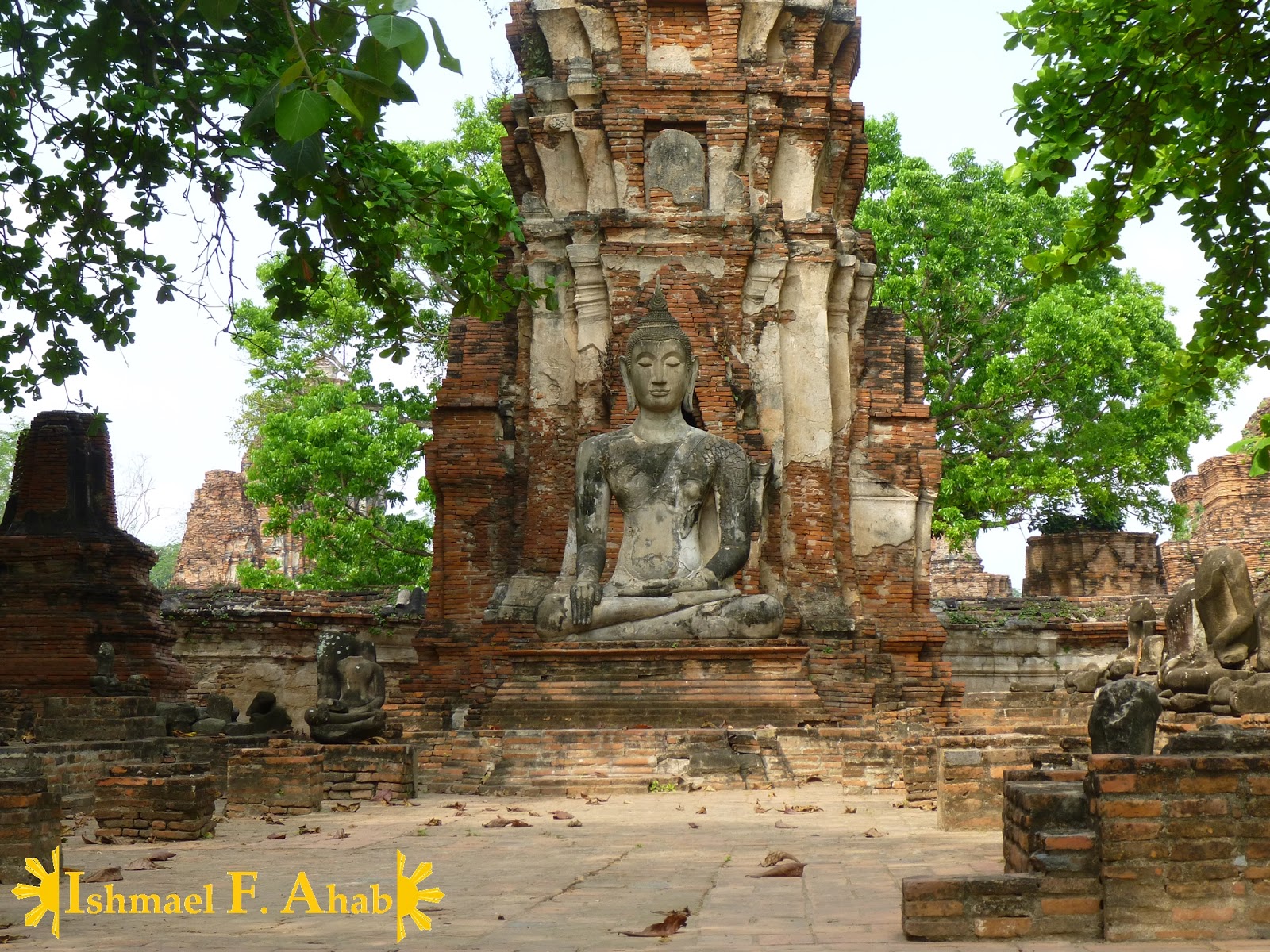
I was fortunate to enter Wat Mahathat before busloads of tourists arrived in Ayutthaya Historical Park. I was able to take good photos of the ruins of Wat Mahathat like this one:

That is a statue of the Buddha which I believed was hacked during the fall of Ayutthaya. Burmese invaders beheaded and removed the golden parts of Buddha statues of Ayutthaya.

I guess that getting the spoils of war is much more important than honouring their Buddha.

Wat Mahathat is approximately located at the center of Ayutthaya. It was placed in that location because the main prang or the temples main tower represents Mount Meru, which is the center of Buddhist universe.
 |
| The remaining base of Wat Mahathat's main prang. |
Wat Mahathat’s main prang stood 50 meters in the past.2 Now only its base remains.
Near the prangs is the Grand Hall where the monks once lived. What remained of its are just brick walls and the floor. The Buddha statues, the paintings, the gold ornaments that adorned it are now lost.

Near the Grand Hall is the most photographed object in Ayutthaya:

Buddha’s head stuck in a bodhi tree.
Too bad that taking selfie with Buddha’s head is not allowed. I just contented myself in taking zoom in photo of it.

Exploring the ruins of Wat Mahathat amazed me. I felt like an archaeologist trying to decipher the story behind the ruins. I also felt like a regular tourist who sometimes enjoys goofing around.
 |
| Me playing Samson among the ruins of Ayutthaya. |
---
Read my other adventures in Ayutthaya Historical Park:
Exploring Ayutthaya Historical Park (Part 2): The Crypt of Wat Ratchaburana
Exploring Ayutthaya Historical Park (Part 3): Close Encounter with Thai Elephants
Exploring Ayutthaya Historical Park (Part 4): St. Joseph Church of Ayutthaya
A Biker’s Adventure in Ayutthaya Historical Park
Read my other adventures in Ayutthaya Historical Park:
Exploring Ayutthaya Historical Park (Part 2): The Crypt of Wat Ratchaburana
Exploring Ayutthaya Historical Park (Part 3): Close Encounter with Thai Elephants
Exploring Ayutthaya Historical Park (Part 4): St. Joseph Church of Ayutthaya
A Biker’s Adventure in Ayutthaya Historical Park
References:
1. The Burmese - Siamese War (1765-67) in Wikipedia.
2. Wat Maha That in the History of Ayutthaya
.