Showing posts with label North Thailand. Show all posts

Sukhothai Historical Park: The Ruins of the First Capital of Thailand

“Would you like to go Sukhothai?” – this is the question that our generous Thai friend asked us the morning after our super adventure in North Thailand. He said that his parents are going to Sukhothai for a Rotary Club meeting and we will accompany them if we wanted to.

Our answer, of course, is YES even if I didn’t know what kind of a place Sukothai is. I’ll go as long as it’s an adventure especially if it’s an adventure in Thailand.

We spent almost the whole morning travelling along the winding road over the mountains and valleys. We reached Sukhothai town with empty stomachs so we dropped by a Sukhothai noodle soup restaurant for lunch.

Sukkhothai Noodle Soup Restaurant

Our hosts intentionally brought us to this restaurant so we could taste the gastronomic pride of Sukhothai: Kuaytiaw Sukhothai which literally means Sukhothai-style noodles.

Sukkhothai Noodle Soup

I enjoyed Sukhothai’s noodles. The broth, the pork meat and the thin noodles are very good combination.

We said our “thank yous” and “good byes” to Yam’s parents after the delicious lunch and off we go to the ruins of Sukhothai.

Tourists in Sukhothai Historical Park

The ruins are the remains of the once powerful Sukhothai Kingdom, which dominated Thailand during the 13th Century.

Map of Sukhothai Kingdom in the 13th Century
Sukhothai Kingdom in orange.

The height of Sukhothai’s influence is due to Ramkhamhaeng, the third ruler of the kingdom. He expanded Sukothai’s territory by invading kingdoms in the Malay Peninsula, Myanmar, and Laos.

King Rhamkhamhaeng statue in Sukhothai Historical Park
King Ramkhamhaeng of Sukhothai

Ramkhamhaeng is still respected highly by the Thais so never make a mistake of making fun of his statue or insulting his name. In fact, some considered him as the Founding Father of the Thai Nation.

The Sukhothai Historical Park occupies a very large rectangular area surrounded by walls. It is composed of 193 ruins of palaces, temples, and other structures. There are so many ruins to visit but we couldn’t visit them all so we just focused on a couple of major ruins of Sukhothai Kingdom.


Lone pagoda in Sukhothai Historical Park

The first ruin that we visited is Wat Mahathat, which reminded me of the colossal ruins in Athens.

Ruins of Sukhothai Historical Park

Wat Mahathat is located at the heart of Sukhothai and considered as the main temple of the whole Kingdom. It once housed a bronze Buddha image which was transferred to Bangkok by King Rama I.

Buddha statues in Sukhothai Historical Park
Remaining stone Buddha in Wat Mahathat.

The main feature of Wat Mahathat is its main stupa that looks like a lotus bud.

Lotus bud stupa of Wat Mahathat in Sukhothai Historical Park

At the base of this stupa is a relief of Buddha’s disciples.

Bas relief in Sukhothai Historical Park

It seems that these disciples are dancing.

The ruins are proof of the greatness of Sukhothai Kingdom. The old city has canal, dykes, dams and fortifications.

Pagodas in Sukhothai Historical Park

Unfortunately, Sukhothai’s greatness ended with the death of Ramkhamhaeng. All of its vassal kingdoms broke away until it was invaded by the Kingdom of Ayutthaya.

Standing Buddha statue of Sukhothai Historical Park

Compared to major tourist sites of Thailand that I visited, the old city of Sukhothai is the least crowded. I guess Sukhothai is too far away from Bangkok and few tourists dare to travel far.

Temle ruins in Sukhothai Historical Park

I am quite impressed with the ruins of Sukhothai especially because I came from a country that didn’t develop such kind of architecture. Our ancestors just used bamboos and wood as fortifications. We had to wait for the Spaniards for us to develop forts and structures made in stone.

Buddha in Sukhothai Historical Park

The ruins are not only thing that was left of Sukhothai Kingdom. The truth is that it created the Siam culture. The Thai alphabet, architectural styles, and even the Loi Krathong Festival traced their roots to Sukhothai Kingdom. This Kingdom is truly the “mother” of modern Thailand.

So for history buffs like me, the visit to Sukhathai Kingdom is worth considering.

---

Information for this post was obtained from the following sources:

The Kingdom of Sukhothai from AsiaWorld
Sukhothai Historical Park from Sawadee.Com
Ramkhamhaeng and Sukhothai Kingdom from Wikipedia
Historic Town of Sukhothai and Associated Historic Towns from UNESCO
Sukhothai Kingdom from Encyclopaedia Britannica
.

5 Chiang Rai Attractions You Shouldn’t Miss

Chiang Rai, the northernmost province of Thailand, is off the radar of tourists. In fact, its western neighbor Chiang Mai is more popular and attracts more tourists.

I visited many spots in Chiang Rai and I can say that I enjoyed the place. We visited temples, an art house, and even climbed a mountain. Chiang Rai has plenty of things to offer and here are the 5 of Chiang Rai attractions that you should not miss.

Doi Tung Royal Villa and Mae Fah Luang Garden


Chiang Rai Attractions: Doi Tung Royal Villa and Mae Fah Luang Garden

Doi Tung is a mountain in Chiang Rai that became the home of the King’s Mother. This is the best place to know more about the royal family through the visit in Royal Villa and the Hall of Inspiration. Another must see attraction in Doi Tung is Mae Fah Luang Garden, which features hundreds of different varieties of flowering plants. Know more about this Chiang Rai attraction by visiting my blog post about Doi Tung Royal Villa and Mae Fah Luang Garden.

Phu Chi Fah


Chiang Rai Attractions: Sea mist of Phu Chi Fah
Sea mist at Phu Chi Fah (Source: Chiang Rai Times).

Phu Chi Fah is the mountain at the east edge of Chiang Rai. It provides a spectacular view of Laos and the surrounding hill. The best time to visit Phu Chi Fah is in the months of November to January when you can witness a breathtaking view of the sea mist at sunrise.


Wat Rong Khun (White Temple)


Chiang Rai Attractions: Wat Rong Khun (White Temple)

Wat Rong Khun is not a typical Thai temple. This is where you’ll see pop culture icons displayed inside the wat. The best part of Wat Rong Khun is the sea of outstretched hands below the bridge to the main temple. The White Temple is a good place to relax  after visiting thousands of Thai temple in a day. Know more about this Chiang Rai attraction by visiting my blog post about the White Temple in Chiang Rai.

Golden Triangle


Chiang Rai Attractions: Golden Triangle
(Photo by Deror Avi)

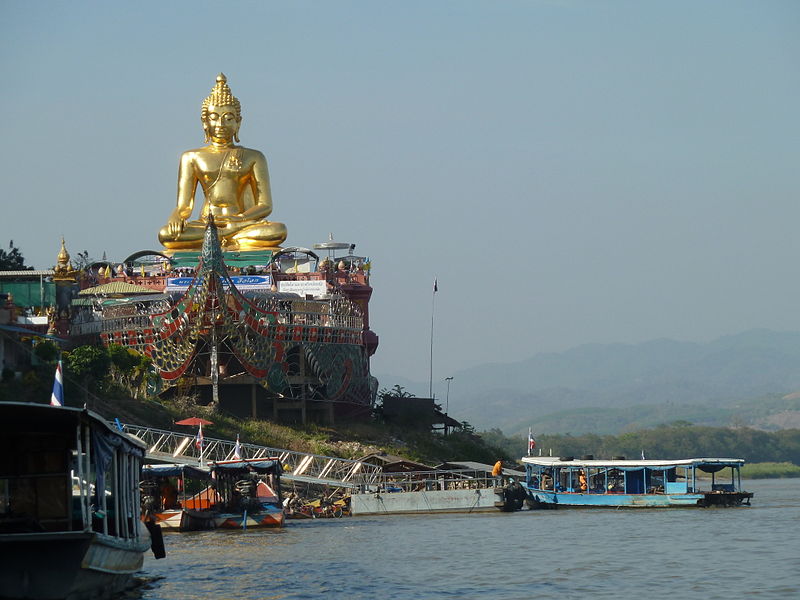
Golden Triangle is the area where the borders of Thailand, Myanmar, and Laos meet. The place is also the area where the Mekong River meets the Ruak River. Golden Triangle became infamous in the past because of its vast plantation of opium.

The Black House

Chiang Rai Attractions: Black House


It is not a temple. It is not a set from a horror movie. It is an art house. The Black House was built by the Thai national artist Thawan Duchanee as he tried to interpret the somber parts of Buddhism. The Black House features a long table with snake skins as runners, a room where devil-worshippers can meet, and (my favorite) the big black boar which actually served as the private room of the artist. Know more about this Chiang Rai attraction by visiting my blog post about the Black House.

There are other Chiang Rai attractions like the northernmost Thai town Mae Sai, the hill tribes, and the Mekong River. These attractions, the culture, and the food will make your visit to this northernmost Thai province truly memorable.

Know more about Chiang Rai by reading our adventures in North Thailand.

---

Information about Phu Chi Fah and Golden Triangle was obtained from Chiang Rai Sawadee.Com and Wikipedia.
.

North Thailand Road Trip (Part 9): Flower Overload at Doi Tung Royal Villa

I jokingly said, prior to my departure to Thailand, that I plan to meet the King. Well, my jest remained a jest because I didn’t meet the King nor any member of the royal family. Even my visit to the Grand Palace is a disappointment because I didn’t get a glimpse of the royal rooms. I just entered some rooms filled with guns and ancient weapons and that’s it. No big deal.

I didn't expect to enter any royal residence until we climbed up Mount Doi Tung for the last leg of our North Thailand Road Trip.

Doi Tung Royal Villa, Chiang Rai, Thailand

Doi Tung Royal Villa was built as the residence of Her Royal Highness the Princess Mother Srinagarinda. Mount Doi Tung was chosen because of its cool climate, which resembles that of Switzerland.

The Royal Villa is the centerpiece of the big project that the King’s Mother initiated in Doi Tung and surrounding area. The King’s Mother noticed that the hill tribe people in Northern Thailand are in grave poverty. She personally helped these people by bringing food, medicine, and other basic needs. She reached remote areas of North Thailand by riding a helicopter that’s why people call her Mae Fah Luang, which means Royal Mother from the Sky.1

Srinagarinda came from a poor family. Both of her parents died when she was 9 years old. This is the reason why the Princess Mother is concerned especially to the poor people in Thailand.1

Doi Tung Royal Villa, Chiang Rai, Thailand

The Royal Villa is deserted now because the Princess Mother died in 1995 years ago.2

The King opened the Royal Villa to the public to allow Thais (and tourists) get a glimpse of the life of their beloved Somdet Ya (Royal Grandmother).1 Photography was prohibited so I can’t post any photos of the Royal Villa’s interior here.

All I can say about the interior of the Royal Villa is that it’s simple but elegant, which I think perfectly fits the character of Srinagarinda.

I read that the villa had a good view of three countries: Thailand, Myanmar, and Laos.

A view from the Doi Tung Royal Villa

The Royal Villa is interesting but what I liked better was the Mae Fah Luang Garden.

Road sign to spots around Doi Tung Royal Villa

It felt so refreshing to be surrounded by greens. It was the same feeling when I visited the Phukhieo Wildilife Park. It was a good respite from the concrete forest of Bangkok.

Path to Mae Fah Luang Garden of Doi Tung Royal Villa

Mae Fah Luang Garden has scenic spots like this small lake…

Lake near the Doi Tung Royal Villa

…inhabited by ducks.

Ducks at the Doi Tung Royal Villa

Srinagarinda personally planted some of the flowers in the garden. Gardening was one of her hobbies, which she used to do at their house in Switzerland when they are in exile during the Second World War. This hobby of hers cultivated her concern for the environment.

Doi Tung Royal Villa as viewed from Mae Fah Luang Garden

Mount Doi Tung suffered deforestation due to the slash-and-burn activities of the people living in the area. Sangwan wants to restore the forest and uplift the life of the hill tribe people. The flowers in Mae Fa Luang Garden are harvested and sold, thus a source of income to the people.

Mae Fah Luang Garden of Doi Tung Royal Villa

My Beloved Wife will surely like this place because of the flowers. It feels so good to be surrounded by God’s beautiful creations.

Statue of Continuity in Doi Tung Royal Villa

Located at the center of Mae Fah Luang is a sculpture of kids as a human pyramid. Srinagarinda called it “Continuity” because she believe that continuity is the key in the success of all endeavors.

The sculpture was presented by Thai Airways and sculpted by Misiem Yipintsoi.

Hill Tribe banners at Doi Tung Royal Villa

Another interesting spot in Doi Tung would be the Hall of Inspiration.

Hall of Inspiration at Doi Tung Royal Villa

This is where we learned how Doi Tung rose from being a deforested and poor area to a premier tourist spot in Chiang Rai.

Some displays in the Hall of Inspiration, Doi Tung Royal Villa

Srinagarinda’s labor bear much fruit and is now enjoyed by the people living in Doi Tung. Tourism gave people jobs like these vendors on the road to the Royal Villa.

Street vendors along the road to Doi Tung Royal Villa

There is also a shop where tourists can buy flowering plants. I didn’t buy any since I will not stay long in Thailand.

Beautiful flowers for sale at Doi Tung Royal Villa

I only bought one ref magnet as my souvenir from this place.

I truly enjoyed our visit in Doi Tung. It was a refreshing end to a long road trip in North Thailand. Srinagarinda is a true inspiration and I believe that she is one the reason why the Thais revere the Royal Family.

---


---

Footnotes

1. “Srinagarinda” in Wikipedia
2. Milestone of Doi Tung in Doi Tung.Org
.

North Thailand Road Trip (Part 8): Mae Sai the Most North of Siam

After our short tour in the creepy Black House of Chiang Rai, our generous friends: Thai and Filipina couple Yam and J brought us to Mae Sai, the northernmost town of Thailand.

Northernmost marker in Mae Sai, Thailand

Mae Sai’s main tourist attraction is the opportunity to cross the border to the Myanmar town of Tachileik.

Immigration Office in Mae Sai, Thailand

I also had the same opportunity when we were in Mae Sai but I didn’t take it. The reason is that no one will accompany me and I think there’s not much to see Tachileik. I also had to undergo much hassle, like immigration checks, just for a few minutes of stay in Myanmar.

I just contented myself with taking photos of the bridge connecting Thailand and Myanmar:

Mae Sai Bridge, Mae Sai, Thailand

There’s plenty of people crossing the bridge.  Most of them are Thais and Myanmar people but there are tourists among the crowd.

Bridge connecting Tachileik, Myanmar and Mae Sai, Thailand

Mae Sai is also a good place to eat. I believe that there are restaurants here that sell Myanmar dish.

Our friend brought us to a noodle shop located beside Mae Sai River.

Kow Soy shop in Mae Sai, Thailand
Here comes my Kow Soy.

My noodle soup tasted fine just like the Kow Soy that I tasted in Chiang Rai.

Swimming children in Mae Sai River, Mae Sai, Thailand

Our seat overlooks Mae Sai River, the border bridge, and Myanmar – nothing much to see actually. Well, there were kids playing in Mae Sai River while we eat. I guess the border police of Thailand and Myanmar doesn’t care if these kids cross the boundary.

Since it’s a border town, its main economic activity is the trade of goods from Myanmar. So after finishing our Kow Soy we went next to Mae Sai border market.

Border Market in Mae Sai, Thailand

Mae Sai is popular for its jade industry. Jade stones are imported from Myanmar and then polished in Mae Sai. I saw a lot of jade figurines in the border market but I didn’t buy any.

Myanmar jade for sale in Mae Sai, Thailand

What I bought is a piece of Myanmar cloth for my Beloved.

Myanmar cloth for sale in Mae Sai, Thailand

I also bought wooden jewelry boxes for my mother and my mother-in-law, a ref magnet (which is a proof of my visit to Mae Sai), and other souvenir items.

Souvenirs for sale in Mae Sai, Thailand

Aside from items imported from Myanmar, Mae Sai border market also have items made from China. In fact, I saw some cheap items that are also available in Divisoria.

Chinatown in Mae Sai, Thailand

I think there’s sizable number of Chinese in Mae Sai. In fact, this town has big Chinese temple and many business owners are Chinese.

Chinese temple in Mae Sai, Thailand

There’s nothing much to expect in Mae Sai aside from being the northernmost town of Thailand. Even the border market is not worth effort for tourists to go all the way north.  Good thing that I had generous friends who brought us to Mae Sai because I will not go to this town if I’m traveling alone.

---

Read more of our adventures in North Thailand:

North Thailand Road Trip (Part 1): Lampang’s Hidden Gem
North Thailand Road Trip (Part 2): A Taste of Chiang Rai’s Kôw Soy
North Thailand Road Trip (Part 3):Coffee Time at Le Petit Café
North Thailand Road Trip (Part 4): The Bizarre White Temple of Chiang Rai
North Thailand Road Trip (Part 5): Eating Bugs in Chiang Rai Night Market
North Thailand Road Trip (Part 6): Our Moon and Sun Hotel Experience (Chiang Rai)
North Thailand Road Trip (Part 7): The Macabre Black House of Thailand
.

North Thailand Road Trip (Part 7): The Macabre Black House of Chiang Rai

It seems like the province of Chiang Rai is the weirdness capital of Thailand. This is where I saw the bizarre White Temple and tasted the fried bugs for sale in the night market. I thought that the weirdness stopped at these two travel experiences but I was very wrong because on the third day of our North Thailand road trip, Yam and J brought us to a place where monsters are tied to the ground...

Monster tied to the ground in the Black House, Chiang Rai, Thailand

…and houses are as black as a starless night.

Black House, Chiang Rai, Thailand

The Black House is one of the structures in the art complex built by the Thai national artist Thawan Duchanee.

Thawan Duchanee uses Thai and Buddhist motif and some of his artworks were considered blasphemous to Buddhism.1 In the Black House, Thawan interprets the human sufferings observed by Buddha in his journey to “enlightenment”.2

Inside the Black House, Chiang Rai, Thailand

The Black House is one cavernous house with a very long table in the middle of it. Snake skins serves as table runners. At the head of the table is a chair for an evil overlord.

Evil King's Throne in Black House, Chiang Rai, Thailand

At the sides are other tables for the evil minions.

Creepy table in Black House, Chiang Rai, Thailand

And near the corner are posts where they hang the flayed skins of their enemies.

Posts with dried skin in Black House, Chiang Rai, Thailand

What I mentioned above are silly but that’s what I imagined as I walked inside the Black House. The place made me think of the Devil and other evil spirits not the sufferings seen by Buddha.

Ornate door of the Black House, Chiang Rai, Thailand

The Black House is totally made of wood. The posts, the beams, and even the roof are wooden.

The macabre display inside the Black House are little creepy but what really shocked me is this:

Maharlika by Filipino artist Florence Cinco in the Black House, Chiang Rai, Thailand
"Maharlika" by Florence Cinco.

A canvass with the Filipino word “MAHARLIKA” which means “royal”.

I never expected to see a Filipino artwork in this place. In fact, I saw not only one but two artworks created by Filipino artists. The other artwork is “Tatlong Maria” by Salvador Javier Ching:

Tatlong Maria by Salvador Javier Ching in the Black House, Chiang Rai, Thailand

Our visit was just in time for an international festival that’s why artworks by foreign artists were on display in the Black House.

Aside from artworks made by Pinoys, there were artworks created by artists from USA, Sri Lanka, Korea, Vietnam, and many more.


Black House, Chiang Rai, Thailand
.
Surrounding the black house are other surreal structures like this big black thing that reminded me of the boar in Hayao Miyazaki’s Princess Mononoke.

Big black boar in the Black House, Chiang Rai, Thailand

The big black boar was actually Thawan’s room and it was off limits to visitors. I believe that the room is empty now since Thawan died September last year.3

Big black boar in the Black House, Chiang Rai, Thailand

The creepiest place in the whole art complex would be the one I dubbed as the “Hall of Evil Things”.

Creepy room in the Black House, Chiang Rai, Thailand

Hooded men on the chairs and a sacrificial virgin at the center are all it needs to make it more horrifying.

The macabre are everywhere in this art complex. Even the toilet was not spared!

Weird toilet in the Black House, Chiang Rai, Thailand

Thai and foreigners can enter the Black House. Admission is free although there are places where access is restricted. The house is open in the morning (9 AM to 12 noon) and afternoon (1 PM to 5 PM).

Black House, Chiang Rai, Thailand

I was not impressed with what I saw in the Black House. Thawan wanted us to see his interpretation of some Buddhist teaching. What I just saw is a set of a horror film. Don’t take my word on it, however, as people have varying interpretations when it comes to art. Visit the Black House and make your own interpretations and please return to this blog and tell us about your experience.

Carabao skulls at the Black House, Chiang Rai, Thailand

---

Travel Notes:

1. The Black House is not for everyone. Some will be offended by Thawan’s work as there are phalluses aside from the macabre display. This place is not advisable for kids.

2. Black Temple, as some people call this place, is incorrect since it is a house and not a wat. So, unlike real Thai temples, removing your shoes and strict dress code is not required when entering the Black House.

3. For more info about the Black House (i.e. commuting by bus), I highly recommend that you read this post in Thaizer.

---


---

Footnotes:

1. "Baan Dam (Black House) Chiang Rai" in Thaizer. Blogger Roy Cavangh mentioned that some of Thawan’s artworks were physically attacked because of its so-called blasphemy against Buddhism.

2. Ibid.

3. "Thawan Duchanee" Dies in Thaizer
.