Showing posts with label Philippine history. Show all posts

The Sad History of the Tombstone in front of Binondo Church

The floor in front of the door of Binondo Church catches my attention every time I enter the church. Of the bland marble stones laid in front of the church, only this big particular part has inscriptions that are difficult to understand. 


Tombstone of Juan Dionicio Coqua at the doors of Binondo Church
The mysterious tombstone at the door of Binondo Church.

The word that I read in the tombstone is AQVIYAZE JVAN DIONICIO. Below those big letters are 22 DED 1722 AÑ.

I suspected that this suspicious marble stone is a tombstone but I couldn't understand the text since I do not know how to read Spanish. So I enlisted the help of Google translate, which was also as clueless as me. At least Google search pointed me to a photo of a tomb of the Spanish king Don Pelayo that also bears the text AQVIYAZE. So, my suspicion was somehow confirmed that Binondo Church's tile is a tombstone.

A change in keywords brought me to an online paper which gave the proper rendering of the text. According to the paper, the text should be read as:

AQUI YAZE 

JUAN DIONICIO 

COQUA FALLEC EN 

27 DE F. DE 1722 AÑ

Super facepalm for me. I forgot that in old writings, the V should be read as U. 

The text, when translated to English, read as:

HERE LIES

JUAN DIONICIO

COQUA WHO DIED ON

27 OF FEBRUARY OF 1722

My suspicion is finally confirmed to be correct. That marble stone, or better known as piedra china, at Binondo Church's door marked the grave of Juan Dionicio Coqua, who died on February 27, 1722.

This discovery actually created more questions for me. Who is Juan Dionicio Coqua? And why was his tomb placed at the church’s door where churchgoers will step on it? These questions pushed me to do more online research and to the discovery of another dark part of our country’s history.

The history of Binondo is characterized by the inter-racial tension between the natives of Manila (the so called Indios), the Chinese immigrants, the Chinese mestizos (those who mostly have Chinese father and Indio mother) and the ruling Spaniards. The land of Binondo was donated in 1594 by Governor General Luis Pérez Dasmariñas to the Chinese who converted to Christianity. Some historians say that the donation was a way for the Governor General to skirt the royal decree of expelling the Chinese from Manila, possibly due to their involvement in the attack of Chinese pirate Limahong in 1574. However, based on another source, I believe another reason why the Chinese converts were transferred to Binondo was to separate the "good" Chinese from the "bad" Chinese living in the old Parian, which is located in the now Liwasang Bonifacio and Manila Post Office. 

Chinese as depicted in the Murillo-Velarde-Bagay Map
The Chinese or Sangleys as depicted in the Murillo-Velarde-Bagay Map. (Source: Wikimedia)

1594 is the year of great tension in Manila because of the arrival of a great number of Chinese ships loaded with men and weapons. The Spanish authorities suspected the Chinese but still welcomed their dignitaries. It was believed that the Chinese planned to invade Manila while the Spaniards were on a military campaign in Moluccas. However, they changed their minds when they saw the Spanish armada. 

The mandarins thought that the Spanish fleet is on a campaign in the Moluccas. The mandarins' intel was correct but already inaccurate. The military campaign to Moluccas was put into action by Governor General Governor Pérez de Dasmariñas in 1593. The military campaign did not push through, however, because the Chinese crew of the flag ship mutinied and killed the governor general. Had the Moluccas campaign pushed through then the Chinese mandarins may have been successful in invading Manila. Thus, it can be said that the planned invasion of Manila by China in 1593 was foiled by their fellow Chinese who mutinied during the Spanish military campaign to Moluccas.

Luis Pérez Dasmariñas, the son of the governor general killed by mutineers in the aborted Moluccas campaign, is the new governor general. As I said previously, Luis Pérez Dasmariñas is the governor general who made Binondo as the new settlement for the Chinese. In this new Chinatown, the Chinese were heavily taxed and had to pay large amount of fees as well as provide yearly labor to the government.

In May 1603, Chinese Mandarins visited Manila again. There mission is to search for a certain mountain in Cavite that produces great amount of gold and silver. The Spanish was suspicious of the mission but they still welcomed the mandarins like in their previous visit. The mandarins eventually left Manila but the colonial government were wary of the Chinese immigrants in Binondo. The result of this animosity is the so-called Chinese Rebellion of 1603 (according to colonial government sources) or the Chinese Massacre of 1603 (according to Chinese immigrant sources). The casualties of that event included the many dead Chinese immigrants, native Filipinos used as soldiers by the colonial government, and the death of colonial government officials that included Luis Pérez Dasmariñas himself.

Binondo, Manila circa 1739
Old map of Binondo circa 1739 as seen in the "Topographia de la Ciudad de Manila" by Hipolito Ximenez. (Source: The British Library)

Despite of the “bad blood”, the colonial government couldn't give up the Chinese immigrants because of their link to the Chinese mainland, which is vital for the success of the Galleon Trade. It is this link that the Dominican friars planned to take advantage of when Binondo was placed under their care 1596. The Dominicans used Binondo as their springboard for their missions to China.

The friars originally built Binondo Church with a cemetery adjoining it. Actually, the cemetery outside the church is for commoners while the prominent persons in the community, especially those who were the church's great benefactors, were buried inside the church. The big tombstone is then a proof that Juan Donicio Coqua was one of the prominent benefactors of Binondo Church.

Little is known about Juan Dionicio Coqua. Internet research did not yield good information. Facebook search yielded little result of any person who is surnamed Coqua. The only clue that I got is that coqua is a Latin word for "cook". Maybe Juan Dionicio Coqua was a cook or a restaurateur in Binondo.

Unfortunately, the prominence of Juan Dionicio Coqua and his family didn't guarantee that his final resting place will not be disturbed. There came a time when the Dominicans turned Binondo Church into a Filipino church. The result is that all piedra china were removed and destroyed. I cannot find any source when this happened but it can be after the British Invasion of Manila. During that incident, many Chinese immigrants sided with the British. Unfortunately, the Seven Years Wars between Spain and Britain ended and the treaty between the two nations declared that Manila will be returned to Spain. The Chinese in Manila received punishment from the Spanish colonial government and many of them were deported back to the mainland. Traces of Chinese culture in Binondo Church were possibly removed during that time.

The piedra china inside the church was defaced. According to the Richard T. Chu the Teresita Ang See, the Chinese characters, which is the vertical line on the piedra china, were removed from the tombstone of Donicio Cocqua.

There were other piedra china tiles on the floor of the Binondo Church but all of these were removed when the the church was wrecknovated renovated. The parish priest and the parish council who approved the allowed the destruction of centuries-old of historical artifacts.

Binondo Church is not the only church where the Chinese tombstones were disturbed. Santa Cruz Church, located at the other end of Ongpin Street, has piedra china tiles that are used to fence the plant box. 

Chinese Tombstones Outside of Santa Cruz Church, Manila
Piedra china outside of Santa Cruz Church.


The Chinese characters are clear. Some of the stones bear the text SEPULTURA, which means that they are indeed tombstones.

Chinese Tombstone Outside of Santa Cruz Church, Manila
"SEPULTURA" says the tombstone outside of Santa Cruz Church.


Santa Cruz Church is currently under the care of the Sacramentinos. However, the church was under the care of the Jesuits, who employed Chinese converts and Tagalogs in building the district of Santa Cruz from marshland into a liveable settlement.

It is sad to note that there is a dearth of study made into the history of the missing piedra china or Chinese tombstones in Binondo and Santa Cruz. This only means that there is much to be uncovered about the history of Manila, which I think will enrich our view of this city and the whole Philippines. Alas! The current state of these valuable artifacts shows that the living Filipinos of today do not care about the lives of the dead Filipinos and the stories that they can tell.

- - -

Read more about Binondo in these blog posts:

1. Visita Iglesia 2019: Our Lady of the Most Holy Rosary Chinese Parish Church (Binondo, Manila)

2. Visita Iglesia: Binondo Church

3. Chinese New Year Feast along Ongpin Street

4. Chinese New Year in Binondo Chinatown

5. A Walk through Quintin Paredes Street

6. A Parade of Delicious Chinese Dishes

7. Yummy Hopia from Salazar Bakery

8. Searching for Wedding Rings and a Bad Day in Binondo Chinatown

9. Lunch Break at Lan Zhou La Mien

10. Eng Ho's Mamon Cake

- - -

Historical info in this blog post was sourced from the following:

1. The massacre of 1603: Chinese perception of the Spaniards in the Philippines  by José Eugenio Borao

2. Chinese mestizo and natives' disputes in Manila and the1812 Constitution: Old privileges and new political realities(1813–15) by Ruth de Llobet

3. Toward a History of Chinese Burial Grounds in Manila during the Spanish Colonial Period by Richard T. Chu and Teresita Ang See

.

Historical Cavite: The Casa Tribunal of Noveleta

Historical Cavite: Casa Tribunal of Noveleta

There is an old house that always arouses my curiosity every time I visited my in-laws in the town of Noveleta. It is not the age of the house nor its Spanish architectural style that makes me wonder but its being out-of-place in the town of chaotic concrete.

Casa Tribunal of Noveleta, Cavite

The house in question is the Casa Tribunal, which is not a house but actually the former municipal hall of Noveleta. This was once the town’s center of authority during the Spanish Period until after the end of the Second World War when the municipal mayor's office was transferred to a new building a few meters away.

Noveleta Town Hall


The municipal government does not know what to do with Casa Tribunal after it vacated its premises. Casa Tribunal became a school then turned into a library and children’s clinic. After being vacant for many years, Casa Tribunal became the provincial library and then become the office of the Kawanihan ng Rentas Internas or the Bureau of Internal Revenue (BIR), which also vacated the place eventually.

Obelisk Marker of Noveleta, Cavite

Nowadays, Casa Tribunal is always closed or at least closed whenever I was in town. Thus, I was only able to take photos of its exterior.

Stairs of Casa Tribunal in Noveleta, Cavite

It was unfortunate that I was not able to enter Casa Tribunal. The house holds plenty of cultural and historical treasures as seen in this Youtube video

Inside Casa Tribunal of Noveleta, Cavite
Inside Casa Tribunal featuring a painting of the Battle of Calero Bridge. (Source: Noveleta Town Youtube)

Casa Tribunal is the last standing heritage building in the area. All the buildings around it are made of modern concrete. The palenque, the new municipal hall, and even the town's church are of modern architectural style.

Holy Cross Parish Church in Noveleta, Cavite
Holy Cross Parish Church in Noveleta, Cavite.

It is sad that Casa Tribunal is relegated to the side, hidden and ignored by the current residents of Noveleta. Its condition is a far cry to its major place in the history of Cavite. Casa Tribunal is the place where Tagalog revolutionaries tasted one of their major victories.


While Andres Bonifacio and his katipunero battled it out with the Spanish colonial forces in Manila and Bulacan, the Caviteños made their move on the 31st day of August 1896. The Tagalog revolutionaries simultaneously attacked the government forces in General Trias (formerly San Francisco de Malabon), Pasong Kalabaw, Kawit, and Noveleta. The attack is now called as the “First Cry of Cavite”.

Historical Marker of Casa Tribunal in Noveleta, Cavite

The katipunero of Sangguniang Magdiwang attacked the government forces stationed in Noveleta. The attack was commanded by Mariano Alvarez, who is the capitan municipal of Noveleta and also the head of the Magdiwang faction. He is also the uncle of Gregoria de Jesus, who is Andres Bonifacio’s wife. Pascual Alvarez, Mariano’s nephew, led the attack in Casa Tribunal, where they killed Capitan Antonio Rebolledo and Tenyente Francisco Naval of the Guardia Civil. They also captured some soldiers of the Guardia Civil.

Cuartel de la Guardia Civil in Noveleta Cavite (1897)
Cuartel de la Guardia Civil occupied by revolutionaries, 1897. (Source: ABC Foto)

Mariano Alvarez is now considered a great hero of Cavite. In fact, the town of GMA is named after him. The Battle of Noveleta is not his first brush with the Spanish authorities. He was earlier placed on the death row after he gave an Spanish infantry officer a dirty water to drink. He was sentenced to death but was released through the intervention of the provincial governor due to the protest of the townsfolk. Later on, he was suspected to be part of the 1872 Cavite Mutiny. The authorities placed him in solitary confinement with his neck and feet chained to the prison walls. He was sent to Manila to be executed but was released.

Mariano Alvarez
Mariano Alvarez (Source: GMA Municipality)

Mariano Alvarez managed to return to the good favors of the government, thus he was able to be elected as capitan municipal of Noveleta. I bet that the Spanish forces in Noveleta were surprised by the attack because they thought that the alcalde is on their side.

Artillery Bombardment during the Battle of Noveleta
Artillery bombardment during the revolution in Noveleta. (Source: Foro Policia)

The katipunero’s victory  was so decisive that Noveleta was free from Spanish control during the whole course of the revolution. The town became the seat of the Magdiwang faction, which stood in opposition to the Magdalo faction of Emilio Aguinaldo. The Game of Thrones level of struggle between these two factions led to the dissolution of Katipunan and the death of its Supremo.

Tribunal ng Noveleta Marker

The current condition of Casa Tribunal just reflects the fact that Noveleta has already forgotten its past. Its history was only recalled from time to time whenever there's a centennial celebration or other big historical commemoration. I guess the current condition of Noveleta’s Casa Tribunal fits its place in history as the seat of the Magdiwang faction. In the course of the revolution, the Magdalo faction obscured the Magdiwang faction. It is quite fitting then that the Aguinaldo Shrine in Kawit, which is the seat of the Magdalo faction, obscured the Casa Tribunal of Noveleta.

Emilio Aguinaldo Waving the Philippine Flag mural in Kawit, Cavite
Emilio Aguinaldo waving the Philippine flag.

The Abandoned House of Heneral Antonio Luna

There’s an old house nestled in the San Nicolas district of Manila that looks like an ordinary old house at first glance. This house has capiz windows, wooden walls at the top floor, and a large front door typical of the “bahay na bato” of the Spanish era.

                                                                                                                                                                                                                                                                                                                                                                                         
Heneral Antonio Luna's house along Urbiztondo, San Nicolas Manila

The old house is actually the birthplace of General Antonio Luna. Unfortunately, just like other historical houses in our country, General Antonio Luna’s birthplace is in great disrepair. The roof is about to fall off and the windows have missing capiz shells.

Second floor of Heneral Antonio Luna's house in San Nicolas, Manila

General Luna’s house looked bad on the outside and I shudder to think how worse it is in the inside.

Heneral Antonio Luna's house in Binondo, Manila

Another sad fact is that the front of General Luna’s birthplace became a tambakan, parking lot, and even a sleeping place of Binondo’s homeless.


General Antonio Luna is considered as the best Filipino general during the Filipino – American War. Heneral Luna was an excellent strategist that even the Americans respected him. He brought discipline and professionalism in the fledgling Philippine Army. His reforming works hurt many in the army, especialy those whom Luna considered as cowards ad insubordinates. Well, these cowards and subordinates murdered him in 1899 as allegedly ordered by President Emilio Aguinaldo.1

Historical Marker for Heneral Luna's house in Binondo, Manila

Keeping the old house in its sorry state is not the good way to honor the general. The government cannot do anything, however, since the house is a private property. Lorenzo Tan, the Filipino-Chinese who owned the house, said that he is willing to sell it to the government for 100 million pesos but he received this answer: “no funds available”.2

Heneral Antonio Luna's Birthplace in Binondo, Manila

Mr. Tan also questioned the claim that the old house was the birthplace of Heneral Luna because the historical marker was originally placed on his mother-in-law’s house located near the old house. The mother-in-law didn’t want the marker so the National Historical Commission transferred it to Mr. Tan’s house. The alleged true “birth house” of Heneral Luna is now a condominium.

It is sad to know that there were issues about the Heneral Antonio Luna’s house in Binondo. Is this the reason why the government is adamant in purchasing the house?

---

If you enjoyed reading this blog post then you will also enjoy reading about these historical houses:


---

Many information in this post were obtained from the following online articles:


A Peek in the Historic Halls of Aguinaldo Shrine

The white house of El Presidente Emilio Aguinaldo is always an eye-catcher whenever I pass by the town of Kawit. It always arrests my eyes partly because of its towering presence but mostly because of its historic appeal.

Aguinaldo Shrine on 5-Peso bill
The declaration of Philippine Independence immortalized on the old 5-Peso bill.

The house stands tall in Philippine history because this is the house where the declaration of our independence was read; where our flag was first unfurled; and where our national anthem “Marcha Nacionale” was first heard.

I didn’t get the opportunity to enter the Aguinaldo Shrine even though I visited it twice. My first visit was 3 years ago after an office errand in Cavite City. The second visit was last year when we watched the Christmas Lights and Sounds show.

Aguinaldo Shrine

My Beloved Wife and her kumare was more fortunate than me because Aguinaldo Shrine was open during their very first visit.

Entrance to Aguinaldo Shrine

The house was built in 1845. The current design was made between the years 1919 and 1921 to perpetuate the 1898 declaration of Philippine independence to the hearts and minds of the Filipino people.1

Historic balcony of Aguinaldo Shrine

The house of Emilio Aguinaldo is the cradle of Philippine Revolution not only against the Spaniards but also against the Americans. This is the reason why Aguinaldo Shrine is replete with the symbols of the Revolution like the three Ks, representing the Katipunan, at the top of the balcony. Another symbol is the carabao below the balcony.

White carabao of Aguinaldo Shrine

The Aguinaldo Shrine is not just a national museum but also a family museum of the Aguinaldos. The kumares entered the Shrine as if they were just entering a big house. They even entered the room where President Emilio Aguinaldo and his second wife Maria Agoncillo slept.

Emilio Aguinaldo's bedroom in Aguinaldo Shrine

The room has plenty of secret exits. Two of the secret exits are located inside the bathroom and the closet.2 I also read that there’s a secret tunnel connecting Aguinaldo Shrine and Kawit Church.3 These exits just shows that Emilio Aguinaldo prepared his means of escape. I guess being the enemy of both Spanish and American governments required this level of precautionary measures.

Bedroom of President Aguinaldo in Aguinaldo Shrine

Aguinaldo Shrine is divided into three sections: the Main House, the Tower, and the Family Wing.

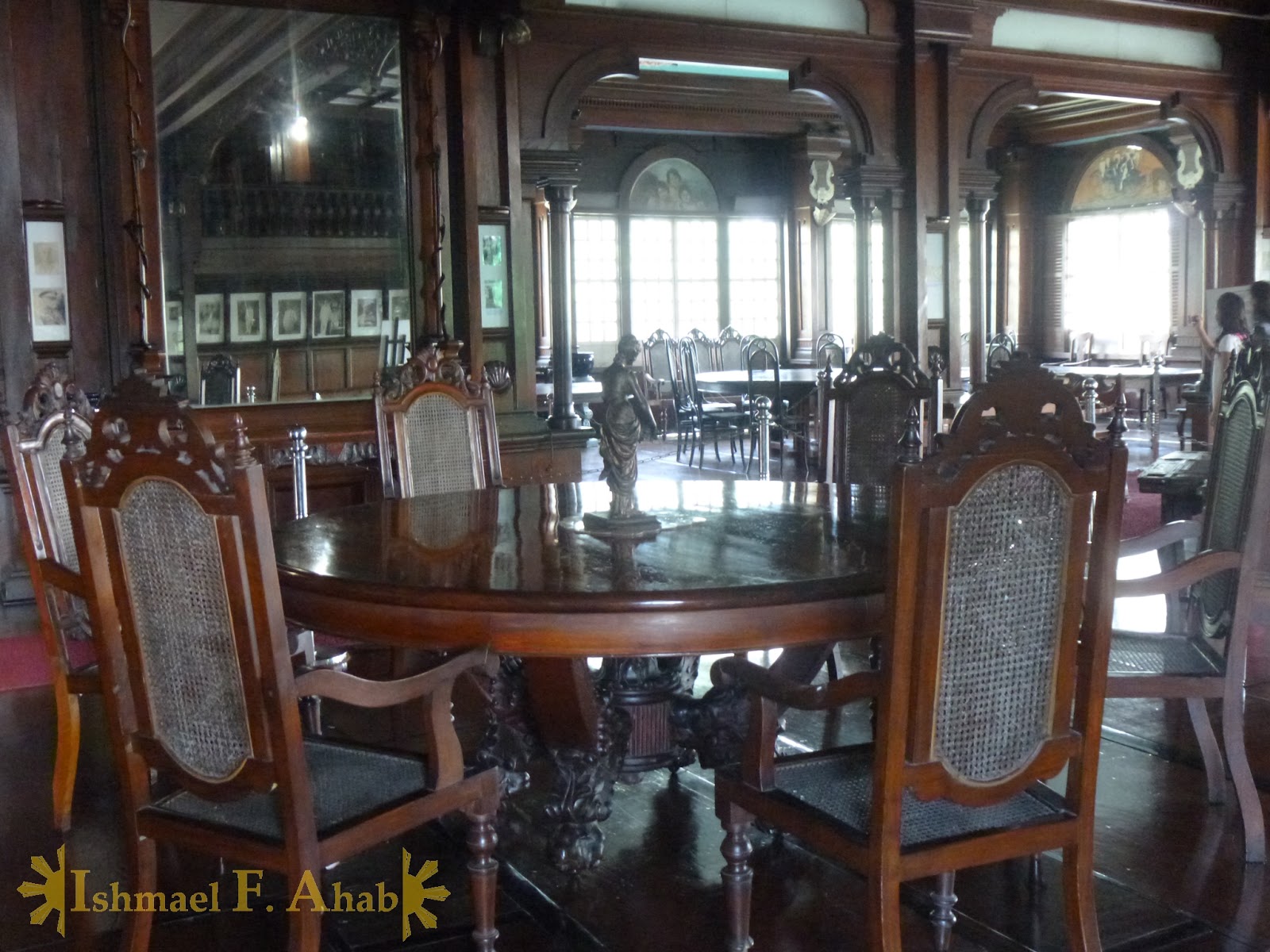
Inside the Aguinaldo Shrine

The Main House is possibly the section where the Aguinaldo Family welcomed their guests. Being a president means that many people come and go. I don’t know what My Beloved Wife felt when she walked within this historic halls. As for me, I will feel elated because I know that I’m stepping on the same floor as the towering figures of our history.

Inside the Aguinaldo Shrine

I can imagine Aguinaldo hosting a dinner to the members of his cabinet. I can imagine Aguinaldo and the hot-blooded General Antonio Luna planning their war against the Spaniards. There’s so many things that happened inside this house that directed the course of our Nation.

Inside the Aguinaldo Shrine

Aguinaldo Shrine was visited by almost all Philippine presidents, especially during the Independence Day. Each president left their photo and message in this house.

Old photos of presidents who visited Agunaldo Shrine

The ceiling of the Main House is also replete with symbols like this map of the Philippines:

Philippine map on the ceiling of Aguinaldo Shrine

This map is incomplete since it didn’t include Sabah, which is still being claimed by our country. The map should also include the Kalayaan Islands in the West Philippine Sea.

Stairway to the tower of Aguinaldo Shrine

The Tower is located at the center of the house. It six floors and composed of the music room, library, and another room of Emilio Aguinaldo.

The Family Wing is the most private part of the Aguinaldo Shrine. There’s a terrace here that was said to be personally named by Emilio Aguinaldo as the Galeria de los Pecadores (Hall of Sinners) because of the subversive plots hatched here. It’s peculiar that Aguinaldo considered their plotting sinful. Did he regretted the revolution he hatched against the Spanish government or the trial against Andres Bonifacio?

Old photos of Emilio Aguinaldo in Aguinaldo Shrine

A wide garden surrounds the Aguinaldo Shrine. In front of it is a plaza where Caviteños can have their picnics or just enjoy the afternoon.

Garden outside of Aguinaldo Shrine

The plaza is the best place to take the photo of the whole Aguinaldo Shrine.

Aguinaldo Shrine

The car which I think was used by Emilio Aguinaldo was also on display. Too bad that it’s in a glass case so visitors can never experience a ride in this historic car.

Vintage car used by President Emilio Aguinaldo on display at the Aguinaldo Shrine

Emilio Aguinaldo’s car reminds me of the old warplanes on display in the PAF Aerospace Museum in Pasay.

There is also a souvenir shop near the Aguinaldo Shrine where visitors can buy some memorabilia. One interesting item for sale are the books defending Emilio Aguinaldo.

History books for sale at Aguinaldo Shrine

Emilio Aguinaldo is one the most hated man in Philippine history. He is pointed as the mastermind in the death of Andres Bonifacio and General Juan Luna. I too hated him in the past but I realized that what I read are mostly biased. Aguinaldo’s side of the story is mostly ignored. So now I think its better to look at our history objectively.

Handa Tagalog 1896

Aguinaldo Shrine may be reached by riding any bus going to Cavite City and Noveleta. Just tell bus driver or the conductor that you want to go down the Aguinaldo Shrine.


The Shrine is open to the public Tuesday to Sunday at 8 AM to 4 PM. Admission is free.

---

Read my other blog posts about the Aguinaldo Shrine.

The Historic Aguinaldo Shrine
A Christmas of Light and Sound at Aguinaldo Shrine

---

Footnotes:

1. Information sourced from the website of the National Historical Commission of the Philippines. Their website is down, unfortunately, because of a hacking incident last Independence Day.

2. Information sourced from the information board inside the Aguinaldo Shrine.

3. Traveler on Foot mentioned the secret tunnel from Aguinaldo Shrine to the church (or cemetery) 

Andres Bonifacio's Monuments Around Metro Manila

Ask a Filipino who of the prominent Filipinos in history they idolized. It is very likely that majority of the answers will be shared by Jose Rizal and Andres Bonifacio.
.
Portrait of Andres Bonifacio

Andres Bonifacio grew up as the father for his siblings. They sold home-made abaniko (fan), cane and other knick-knacks for a living. Together with Emilo Jacinto (the so-called “Brains of Katipunan) and other revolutionaries, he established the KKK (not the Ku Klux Klan) which stands for “Kataastaasang Kagalanggalangang Katipunan ng mga Anak ng Bayan” or Katipunan. KKK rebelled against the Spaniards and their rebellion paved the way for the declaration of the Philippine Independence in 1898.

I observed that Andres Bonifacio has few monuments as compared to Jose Rizal, who has statues in almost all the public schools around the country. Some towns even have their own “Rizal Park” like the town of San Jose in Occidental Mindoro.

All of the Andres Bonifacio monuments that I visited are located in Metro Manila. Here are some of them:


1. Andres Bonifacio Monument, Caloocan City


Andres Bonifacio Monument
(Source: WikiPilipinas)
Andres Bonifacio Monument in Caloocan City is more popularly known as Monumento. It is at the center of the rotunda where Rizal Avenue, EDSA, Manila North Road and Samson Road converges. The monument is composed of Andres Bonifacio and other heroes of the Katipunan. The monument was created by Guillermo Tolentino.


2. Andres Bonifacio in Tutuban Area


Andres Bonifacio at Tutuban

I accidentally discovered another Andres Bonifacio Monument when I got lost in Divisoria. I reached Tutuban Area and saw this one big statue of a man with who is writing on a piece of paper. The monument serves as a reminder that Tutuban Area is the place where Andres Bonifacio was born.


3. Andres Bonifacio amidst the high buidings


Andres Bonifacio in Taguig
(Source: Traveller's Point)
I also saw one Andres Bonifacio Monument in the the business district of Taguig City. It made me wonder what will the true Andres Bonifacio think if he is actually standing there surrounded by towers of city.


4. Andres Bonifaco in UP Diliman


Andres Bonifacio - Grito de Balintawak Monument, UP Diliman
Grito de Balintawak Monument in UP Diliman.
Rallyists of UP Diliman identify themselves with Andres Bonifacio, whom they hailed as the hero of the working class. It is no wonder then that an Andres Bonifacio Monument is standing in front of the Vinzon's Hall, which houses the student council and the “tambayans” of commie student groups.


5. Posing in front of the Post Office


Andres Bonifacio - Liwasang Bonifacio

Many toursist take their photo in front of the Manila Central Post Office building. Andres Bonifacio is also one of them.


6. Andres Bonifacio Shrine, Manila


Andres Bonifacio Shrine, Manila
(Source: TripAdvisor)
The most dramatic depiction of Andres Bonifacio is the Andres Bonifacio Shrine that is located near the Manila City Hall. The shrine has one big statue of Andres Bonifacio carrying a bolo. The shrine shows the life story of the Philippine hero from his childhood to his death at the hands of Emilio Aguinaldo's minions. The Andres Bonifacio Shrine was unveiled during the Centennial Independence celebration in 1998.

Tomorrow, the Philippines will commemorate the death of Andres Bonifacio. The life of this Filipino patriot is a tragedy. He started Katipunan with the goal of liberating Filipinos from the rule of Spanish Colonial Government. Revolution sparked in Manila and then the whole Philippines. The sad fact is that Andres Bonifacio did not won any battle against the Spaniards. He was deposed by the Illustrados (rich Filipinos) and executed in Cavite.

The death of Bonifacio shows us how divided the Philippine Republic is since the very beginning. Andres Bonifacio is remembered through his monuments that glorify him. Monuments, however, are not enough to commemorate the man and his tragedy, which is also the tragedy of the Filipino people.

---

Visit Ahab Reviews and Tips and read my complaints about AirPhilippines.

.