Showing posts with label Thailand. Show all posts

The Bear is Going Home

My Beloved girlfriend (who is now My Beloved Wife) asked me to bring a bear to Thailand. She said that that bear will be my companion during my 6-month stay abroad.

Well, that bear was a good companion indeed. I even gave it a place on my bed. Now that I’m going back to the Philippines, I decided to carry him instead of putting him in my luggage.

Bear Ahab in Suvarnabhumi Airport

I thought that I look weird in carrying the big Teddy Bear around the airport but I can always say that the bear is for My Beloved.

Teddy bear in Suvarnabhumi Airport (Bangkok)

I don’t have enough money for another ticket so the bear has no choice but to sit on my lap.

Bear Ahab in Philippine Airlines

We are flying in a Philippine Airlines flight. It was good flight. The food was fine and we spent the flight time watching movies.

Food by Philippine Airlines

We even watched the sun as it sets over South China Sea West Philippine Sea.

Orange sky as viewed in Philippine Airlines flight

It was evening when we reached Manila. The Bear sighed because he knew that we're still a long way from Home.

The Bear Ahab in Philippine Airlines plane

---

And this ends my blog posts about my adventures in the Kingdom of Siam. It was pleasant stay in that country. I learned a lot and I saw a lot. I met a lot of people too and some of them became good friends.

I do hope to come back to Thailand in the future and write more blog posts about it.


.

Enroute to Manila: Waiting A Little in Suvarnabhumi Airport (Bangkok)

My gateway to Bangkok was once inhabited by snakes. And they are not just any snake; they are the mythical Nagas – creatures that was believed to inhabit the netherworld and keeper of earth’s treasures.  Thus to appeal to Naga’s not to be angry for invading their territory, the gatekeeper erected this monument.

Demon pulling a big snake in Suvarnabhumi Airport in Bangkok, Thailand

The gateway, which is the Suvarnabhumi Airport, was actually built in an area previously called as Cobra Swamp. So, I guess, the reference to the mythical Naga is not only based on superstition.

Angry naga in Suvarnabhumi Airport (Bangkok, Thailand)

The name Suvarnabhumi means “Realm of Gold” and was the name given by the King of Thailand.

I read in Wikipedia that Suvarnabhumi Airport, a.k.a. Bangkok International Airport, is the largest airport in the world in terms of area. It has the world tallest control tower and the largest single-building airport terminal. Suvarnabhumi Airport is ranked as the top 20 busiest airport in the world and top 6 busiest airports in Asia.

Inside Suvarnabhumi Airport in Bangkok, Thailand

Suvarnabhumi Airport was my only gateway to Bangkok because I entered Thailand only through this airport. I passed through it around six times and I couldn’t say anything bad about. In fact, it is one of my favorite airports.

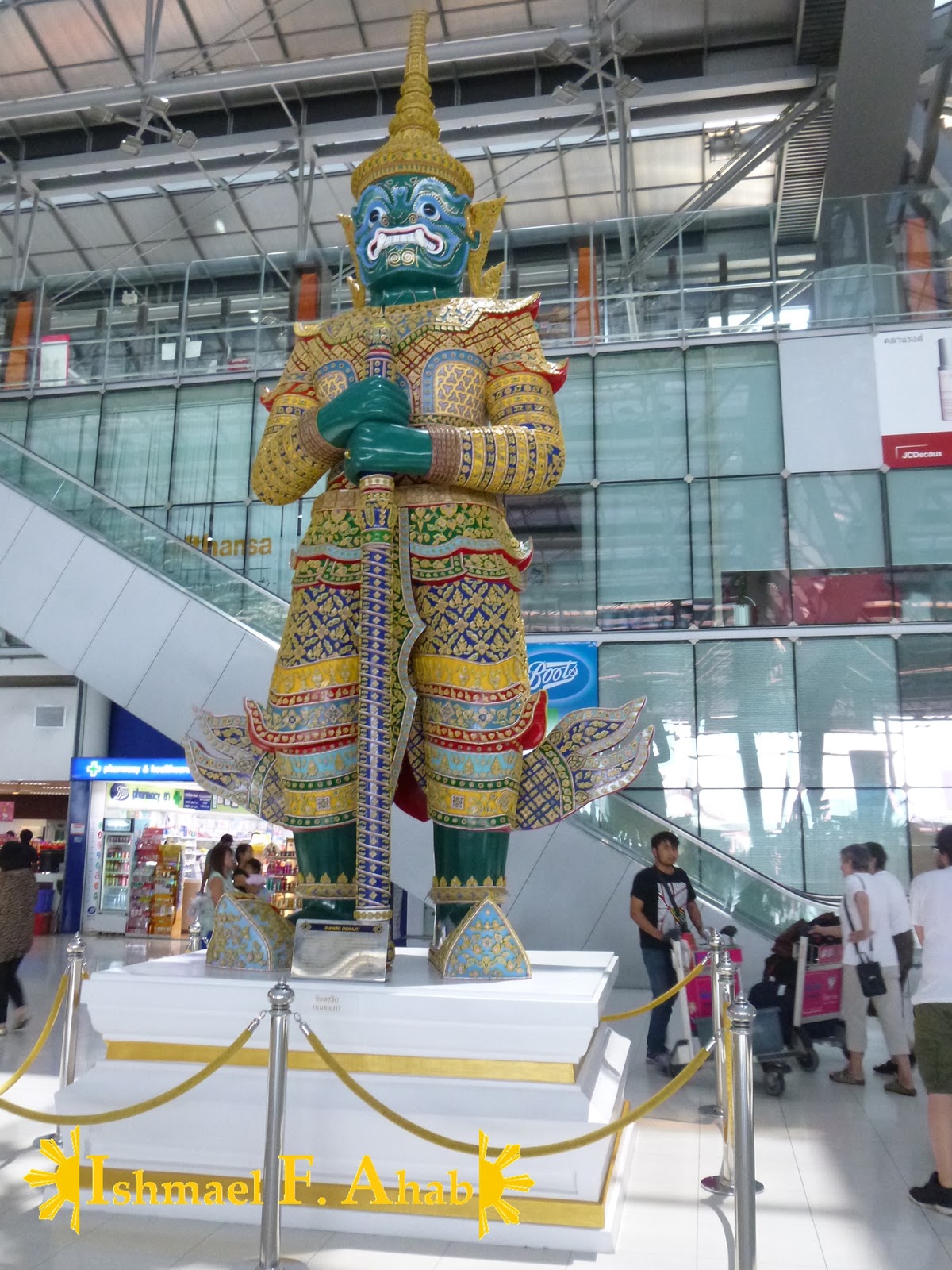
The Naga statue is not the only monument that welcomes air passengers. Popular Buddhist myth characters are also present like Indrajit.

Indrajit in Suvarnabhumi Airport (Bangkok, Thailand)

Indrajit is one of the statues that also welcomed me in Wat Arun.

Ceiling of Suvarnabhumi Airport in Bangkok, Thailand

There are plenty of things that I like with Suvarnabhumi Airport. One is that they have walkalators. Another is that they have drinking fountains. And what I like the most is this airport is spacious and have plenty seats for passengers waiting for their flight. They even have free WiFi connection, which I used to chat with my loved ones before I board the aircraft.

Passengers checking their flight status in Suvarnabhumi Airport (Bangkok, Thailand)

Just like other airports, Suvarnabhumi Airport has restaurants and a Duty Free Shop.

Coffe shop in Suvarnabhumi Airport (Bangko, Thailand)

Suvarnabhumi Airport replaced the old airport located within Bangkok. It was developed in conjunction to Thailand’s booming tourism industry. I guess that the Thai government realized, like what the Philippine government is realizing now, that the old and small airport will hinder the growth of tourism industry.

How I Went to Suvarnabhumi Airport from Bangkok

I usually went to Suvarnabhumi Airport by riding taxi cabs since it is the easiest means of going there. However, I also tried riding the train going to this airport.

Railway to Suvarnabhumi Airport in Bangkok, Thailand

The train is another reason why Suvarnabhumi is my favorite airport. Just imagine the convenience that it gives to tourists and local passengers who don’t want to be trapped in the heavy traffic in Bangkok. How I wish that our MRT or LRT in Manila have stations in each terminal of NAIA. I believe that being connected to the train system will make predatory taxi drivers behave because people have alternative way of going to Metro Manila from the airport.

The growth of tourism industry goes hand-in-hand with the improvement in the transportation system. Thai government realized this thus they built Suvarnabhumi Airport. My country, the Philippines, is now having the same realization. There are plans of building another commercial airport in Cavite or transferring flights to faraway Clark in Pampanga. I do hope that the Philippine government take a look at what the Thai government has done and copy some of the positive things, particularly the (1) development of big airports that can handle large volumes of air traffic and (2) the connection of the airport terminal with the rapid train system.
.

5 Reasons Why Bangkok is Better than Manila

Thailand and Philippines are South China Sea apart but these two nations have plenty of similarities. In fact, the Thais and Filipinos are difficult distinguish from one another. Many Thais mistook me as their kababayan during my 6 months stay in their country.

The capital cities of these two countries, Bangkok and Manila, also have plenty of similarities. Both cities have street vendors. Both cities have three-wheeled public vehicles. And both cities are peppered with malls. The main difference that I noticed is that Bangkok do things better and more orderly than Manila. Here are the reasons why:

1. Bangkok’s River Transport System is Well Managed

Boat in Chao Phraya River, Bangkok


What I admired the most with Bangkok is that it maximize the use of Chao Phraya River in transporting goods and people. Unlike the Pasig River of Manila, the Chao Phraya River is alive with boats that ferry tourists and locals. The river front is also alive with hotels, restaurants, and tourist spots like the Wat Arun and the Grand Palace.

Pasig River, on the other hand, is dead. The ferry boats operated by MMDA has few passengers. Its river front is occupied by factories and slums. The river is so polluted that it symbolized our failure in urban planning and city management.

2. Public Vans are More Spacious and Comfortable

Spacious van in Bangkok, Thailand


I avoid riding UV Express vans as much as possible because I consider it the most uncomfortable public vehicle in the Philippines. More often than not, I get squished whenever I ride these things as the drivers cram as many passengers as possible.

It was a different experience when I rode the public vans in Bangkok. It is more comfortable since the van is more spacious and I never experienced being crushed by fellow passengers.

3. Orderly Train System

Train platform in Bangkok


Citizens of Bangkok enter their trains in an orderly manner. They follow the markings that were placed on the platform. They don’t push one another when boarding and alighting the trains.

In Manila, people ignore the platform markings. Everybody wants to go ahead. Thus, the people boarding the train block those who are alighting the train. The result is a lot of pushing and angry heads. Good thing that the MRT now strictly implements order in its stations. I noticed, during the last time that I rode the MRT, that passengers now follow the platform markings.

4. Tuktuk > Kuliglig

Thai taxi = tuktuk


The kuliglig is the new king of the Manila’s roads. These improvised trikes block the streets, do counterflows wherever they want, and they don’t care about other vehicles. They also look dirty and not advisable for tourists.

Bangkok’s tuktuk has the same reputation as Manila’s kuliglig. The former’s advantage over the latter is that it looks cleaner and more presentable to tourists.

5. Well Managed Tourist Spots

Wat Arun and the Grand Palace are few of the heritage sites that Bangkok are proud of. Manila, on the other hand, have Intramuros, Luneta Park, Paco Cemetery and various churches that are older than the Thai capital.

I believe that Manila have grander and older heritage sites than Bangkok. The sad fact is that our heritage sites were ignored by the government, and even by the Filipino people. Intramuros was allowed to lose its glory. Luneta Park’s skyline was now destroyed by a towering eyesore. Old churches were wrecknovated by parish priests who have no respect to tradition and history.

Bangkok invested in their heritage sites. They made sure that the Grand Palace and other temples are well-maintained. The Thais honored their history and are proud of their culture. Now they are reaping their rewards, which is equal to thousands of dollars brought by foreign tourists.

-0-0-0-

This post is never meant to demean Manila. I love Manila and I’m proud of its history. The truth must be exposed, however, and the truth is that other cities in Southeast Asia were so much ahead of us. I do hope that one day Manila will become great again and return to its place as the queen of East Asian cities.
.

Exploring Ayutthaya Historical Park (Part 6): Good Bye Old City of Siam

It was already four PM when I bid farewell to the skeletons of the Portuguese Village and started biking to the old city. I had enough of Thai temples for the day so I had no intention of visiting one until I passed by this white wat along the way:

Wat Buddhai Sawan in Ayutthaya Historical Park

Well, there’s no harm in touring another temple so I decided to do a last temple visit.

This temple is Wat Buddhai Sawan. It was one of the first temples erected in the early years of Ayutthaya Kingdom. In fact, this was built during the reign of Ayutthaya's first king, U-Thong.

The main temple is very similar to Wat Ratchaburana, which is located in the old city.

Wat Buddhai Sawan in Ayutthaya Historical Park
                               
Unlike the temples in the old city, the Buddha statues in Wat Buddhai Sawan are intact. It is as if the invading Burmese did not dare harm this temple.

Buddha statues in Ayutthaya Historical Park

There are also some golden Buddha statues, which I believe were installed recently.

Golden buddha statues in Ayutthaya Historical Park

They look similar with the Buddhas in Bangkok’s Wat Arun.

I bet that if there were golden buddhas in this temple in the past the invading Burmese surely took them home.

The unique sight that I saw in Wat Buddhai Sawan is the statue of the reclining Buddha.


This buddha statue was also left unharmed by the invaders.

Buddha peeking in Ayutthaya Historical Park

There’s not much to see in Wat Buddhai Sawan, so I resumed biking to the old city.

Visitors in Ayutthaya Historical Park

I went back to Better Café to return the bike and have some refreshments before going home.

Coffee shop in Ayutthaya Historical Park

I ordered a glass of blueberry smoothie and a piece of cake. There’s nothing special about these food but they are refreshing nonetheless. This is perfect reward for my successful tour around Ayutthaya Historical Park.

Smoothies in Ayutthaya Historical Park

As I mentioned in a previous post, Better Café is the shop where I rented my bike. The rental costs 100 Baht for whole day. Good thing that I rented a bike because I couldn’t reach the many interesting spots in Ayutthaya by just walking.

Ayutthaya Historical Park

So, that’s it! The last part of my adventure in Ayutthaya, the old capital of Thailand. It was one of the best adventures that I had during my 6-month stay in this country. I really enjoyed this place a lot even though I travelled alone.

---
Read more of my adventure in Ayutthaya Historical Park

Exploring Ayutthaya Historical Park (Part 1): The Ruins of Wat Mahathat
Exploring Ayutthaya Historical Park (Part 2): The Crypt of Wat Ratchaburana
Exploring Ayutthaya Historical Park (Part 3): Close Encounter with Thai Elephants
Exploring Ayutthaya Historical Park (Part 4): St. Joseph Church of Ayutthaya
Exploring Ayutthaya Historical Park (Part 5): The Gruesome Skeletons and Ruins of the Portuguese Village
A Biker’s Adventure in Ayutthaya Historical Park

.

Exploring Ayutthaya Historical Park (Part 5): The Gruesome Skeletons and Ruins of the Portuguese Village

I signed up for an archaeology class during my first year in college. It was a disappointment. I thought that we’ll be visiting archaeological sites and dig up some relics. All that I did was read books, attend class, and pass some papers.

I didn’t took another Archaeology class again and I thought that seeing an excavation site is not meant for me. I was wrong because 10 years later I accidentally visited an excavation site – not in the Philippines but in Ayutthaya, Thailand.

Ruins of Portuguese Village in Ayutthaya Historical Park
Ruins of the Portuguese Village.

The ruins is what remained of the Portuguese Village in Ayutthaya. It was the home of Portuguese traders, soldiers and priests – who settled in the rich Kingdom of Ayutthaya.

Map of Ayutthaya (a.k.a. Iudia by the Portuguese)
The map of Ayutthaya Kingdom.

The Portuguese Village is located far away from the popular tourist spots of Ayutthaya Historical Park. I believe that very few tourist buses venture here. From St. Joseph Church, I biked to the village for about 20 minutes.

The place is empty. I was the only tourist who was in the village at that time and it was a good thing. It meant that I can roam the place without other people photobombing my shots.

Marker of the Portuguese Village in Ayutthaya Historical Park

The Portuguese Village is a testament of the very long relationship between Thailand and Portugal, which started in 1511 when a Portuguese diplomatic mission was sent to the Siamese court. The mission was meant to settle any dispute on Portugal’s invasion of Malacca. The diplomatic mission was a success because the king has no dispute. In fact, the king and the Portuguese immediately created a good relationship after that first diplomatic mission.

Ruins of Portuguese Village in Ayutthaya Historical Park

Five years after the first diplomatic mission, Portugal and Ayutthaya concluded a trade treaty. Portugal will supply firearms and ammunition while Ayutthaya guaranteed the Portuguese a place for their settlement.


Around 300 Portuguese, most of them traders and soldiers, settled in Ayutthaya. Almost 200 years later, the population grew to 4,000 people.

Stamp commemorating the 500 years of Portugal and Thailand diplomatic relations
Commemorative stamps celebrating the 500 years of diplomatic relationship between Portugal and Siam.

Aside from trading, the Portuguese also served as mercenaries for the Thai king. They fought wars against the Burmese. They also trained Siamese soldiers on the use of firearms.

The Portuguese village was not spared when Burmese invaders razed the city of Ayutthaya in 1767. The Portuguese fought bravely but they were short on ammunition and supplies so they had no choice but to surrender.

The ruins were the remains of Saint Peter Church, administered by the Dominicans. It is composed of low brick walls that separates the rooms. The rooms are recognizable thanks to the signs posted by archaeologists, like this room of the priest:

Residence of the priest in Portuguese Village in Ayutthaya Historical Park

The room in the photo below is the toilet:

Toiled in Portuguese Village in Ayutthaya Historical Park

Their latrine is quite big, right?

The Dominicans made their own soap as evidenced by the room where the soap ferment pit is located:

This where they make the soap in Portuguese Village in Ayutthaya Historical Park

Then there is the altar room:

The location of the altar in Portuguese Village in Ayutthaya Historical Park

The altar was gone since the Burmese ransacked the holy and precious things in the church.

The former place of the altar in the Portuguese Village in Ayutthaya Historical Park

Aside from the Dominicans, the Jesuits and Franciscans were also present in the Portuguese Village.

Excavation site in Portuguese Village in Ayutthaya Historical Park
Excavation site of an old Catholic cemetery in Ayutthaya.

In the building behind the church ruins is the most exciting part of the excavation site. It is the cemetery where some of the skeletons are displayed to any tourists who cared to visit.

Remains of the dead in Portuguese Village in Ayutthaya Historical Park

People who were buried in the village is composed, not only of the Portuguese, but also of Thai who converted to Christianity.

Skeleton of early Christians in Portuguese Village in Ayutthaya Historical Park

The skeletons were not the only items excavated in the Portuguese Village. There were also crucifixes and other religious items, coins, and Chinese porcelains. Sadly, I didn’t find any of such items lying around. That would’ve been an excellent souvenir for this trip.

Archaeological relics in the Portuguese Village in Ayutthaya Historical Park

At the back of the excavation site is an interesting sight. It is a small house built by Thais for the spirits.

Small house for Saint Peter and Saint Paul in Ayutthaya Historical Park

This “spirit house” is unusual because it housed the statues of Saint Peter and Saint Paul.

Saint Peter and Saint Paul in the Portuguese Village of Ayutthaya Historical Park

Incense and flowers are offered to them too just like the revered heroes of Thailand.

I am glad that I went beyond the usual during my tour around the old city of Ayutthaya. I was able to visit some unusual spots like the Ayutthaya Church and the ruins of the Portuguese Village. My biking under the sun was not in vain.

---

Travel Notes:

1. The Portuguese Village is usually not included in the itinerary of Ayutthaya tours so don’t expect any tour company to take you there. The village can be reached by riding a tuktuk or a taxi. The best way to reach the village by biking. Bikes may be rented from shops in Ayutthaya.

2. There was no entrance fee during my visit to the Portuguese Village. In fact, the people guarding the excavation site didn’t bother me when I took photos and roamed the place.

3. There were no shops in the vicinity of the Portuguese Village so it is advisable that you purchase water and food while in the main city of Ayutthaya.

---

Exploring Ayutthaya Historical Park (Part 4): St. Joseph Church of Ayutthaya

Searching for a Catholic church in Thailand is like finding a needle in the haystack. Catholics are rare in Thailand that they’re only 0.46% of the total Thai population. This is the reason why I was so happy when I saw a Catholic church on the other side of the river during my tour around the ruins of Ayutthaya Kingdom.

Ayutthaya Historical Park - Church by the River

I biked around 30 minutes just to reach this church. There were no clouds in the sky and the sun burned me with full force. All the sweat and exhaustion paid off when I finally reached the church and then welcomed by the gold and white colors of the Vatican flag.
Flags in Ayutthaya Historical Park

A cemetery greeted me when I entered the gate.

Ayutthaya Historical Park - Cemetery near St. Joseph Church

I spent some time looking at some of the interesting tombs and markers, some of which combined Siamese and Christian elements like this one:

Grave marker near St. Joseph Church, Ayutthaya Historical Park

The engraving definitely depicts the child Jesus but in a posing similar to that of Buddha. The necklace around his neck is similar to the Buddhist beads.

Image of the Holy Child in St. Joseph Church in Ayutthaya Historical Park

Another tomb marker depicts the Sacred Heart.

Sacred Heart in St. Joseph Church, Ayutthaya Historical Park

Even this marker has Siamese art elements. Just look at the lotus flowers at the three ends of the cross.

Old Crosses in St. Joseph Church, Ayutthaya Historical Park

Some of the tomb markers are half-buried in the ground. I believe that these are the tombs for people buried a long time ago.

St. Joseph Parish Church is one of the oldest churches in Thailand. I believe that it was older than the Catholic churches in Bangkok since Ayutthaya was the first capital of the Kingdom of Siam.

St. Joseph Church was first built in wood in 1673 after King Narai provided the French missionaries with a large piece of land and assistance. It was said that the king was pleased with missionaries’ concern for the welfare of his people. This is also a political move since the king counted on the French to contain the influence of the Dutch.

Archaeological finds in St. Joseph Church, Ayutthaya Historical Park
Excavated archaeological relics in St. Joseph Church.

The church was rebuilt in bricks between 1685 and 1695. Unfortunately, it was destroyed when Burma invaded Ayutthaya in 1767. The invading Burmese promised that no harm will come to the church if the Bishop, priests, and all Christians hiding in the church will surrender. The Christians surrendered but the Burmese didn’t keep their word. The church was looted and then burned.

The French missionaries, under the leadership of Bishop Jean Louis Vey, started to rebuild St. Joseph Church in 1883 and completed in 1891. Due its importance to the history of the Catholic Church in Siam, Bangkok Archbishop Michael Michai Kitbunchu started the renovation of the church in 2003.

St. Joseph Church located outside of Ayutthaya Historical Park

St. Joseph Church is in Romanesque style. Its façade is quite similar with Church of Kalawar in Bangkok because each church has a single bell tower at the center.

Inside St. Joseph Church in Ayutthaya Historical Park

The interior of St. Joseph Church is not as grand as that in Bangkok Cathedral. But it was a breath of fresh air from the suffocating mass of ruins of old city of Ayutthaya.

The altar of St. Joseph Church in Ayutthaya Historical Park

The image of St. Joseph, the parish’s patron saint, is at the altar. He is carrying the infant Jesus in his arms.

I say that St. Joseph Church in Ayutthaya is simple yet its beauty is in its simplicity.

Stained glass windows of St. Joseph Church, Ayutthaya Historical Park

I am glad to discover this church. I am also glad that the church was open and the good people of this church allowed me to stay for a while and take photos.

St. Joseph Church is the beacon of faith in the whole of Thailand. It stood for hundreds of years and I hope that it will stand for hundreds of years more.

---

Read more about other Catholic churches in Thailand:

Our Lady Mother of God Church in Rangsit, Pathumthani
Holy Redeemer Church in Bangkok
St. Louis Church in Bangkok
Kalawar Church in Bangkok
Bangkok Cathedral

---


.