
Friday is Quiapo Day. Devotees and parishioners fill up Quiapo Church entirely and even extends to areas outside of the church. This is an opportunity for vendors to maximize their profit by selling stuffs related to the faith of the people. I saw some vendors selling rosaries, anting-anting, sampaguita and religious relics. Some are just tapping churchgoers to ask for some money. Each has their own story. Each has their own lifestyle and routine. But what is caught the most by my camera is the story of two guys, who are on wheel chairs, not begging for money but use their remaining capacity to earn a living.
The sun is high as I arrived at a very historic place, the Plaza Miranda. This is where a bombing happened in 1972 that killed nine people. It is regarded as the place of Philippine political discourse and one of the markers before the Martial Law. I wonder if people here are aware of the significance of the place where they are standing. I hope that they appreciate even the small things they may not be aware of.
This guy caught my eyes. His job was extreme and ordinary. ‘Kuya,’ as I called him, startled me because he works despite of his inability to walk. He is a Sampaguita vendor in front of the Quiapo Church. At first I felt sorry for this guy but as I watched his work, I can see an inspiration.
Determination and perseverance. Even under the sun, ‘Kuya’ strived to sell sampaguita. I felt sorry to see him alone in such a busy street with no one buying from him. Later, I saw that that loneliness is only for a short time because he has his ‘kabaro’ which I call ‘Kuya (2).’ They don’t mind if they didn't sell. They are even located in a place not attractive to buyers. But I can still see the smile on their faces. What's important is that they have something to talk about.
Upon seeing this, I immediately ran to them and ask them if that job could make them survive. ‘Kuya (2)’ even smiled back at me saying, “minsan may pangkain lang sapat na.” He said that even in a Friday they are not sure if they will earn or not. This is what I love with these two - they are very entertaining. It seems that they are friendly to all those selling in Plaza Miranda. No competition, they were all friends.
When I get in touch with them, many parishioners bought at them. It is where I feel as if I am a gift from heaven to them. I said to them, “kuya malaking kita ‘yon ha.” But he replied, “’di pa rin natin masasabi ‘yan. Mamayang gabi pa malalaman.” Many devotees, person by person, started buying at them. I saw their pockets started to have many coins then I asked them, “magkano ho puhunan ‘niyo diyan at kita niyo sa isang araw?” Then he replied, “minsan nasa sixty, ‘yung puhunan namin 350, nakakakain naman kami.”
Their life is not easy. It is hard to move their wheelchairs when authorities are confiscating their sampaguitas and when vehicles are crossing their way. It is even hard to stay under the sun. Yet, they don’t forget to smile. This was the realization in my life that I had because of this photo essay - contentment. We are busy on our work. We are busy pleasing people. We are busy because of our complicated lives. We spent time in depositing money in our banks. We become stressed to all the school requirements yet, these two guys remind me not to forget smiling. I realized that it is us who makes our lives complicated. Their lives are happier than ours. This makes me feel that simple life is better. It is easier to only worry for the food that we are about to eat. How lucky are these people that even in their wheelchairs, they found happiness and contentment. Before I left them, ‘Kuya’ told me that he is also a college graduate. He even knew that I am a Mass Communication student without me telling him.
The sun is high as I arrived at a very historic place, the Plaza Miranda. This is where a bombing happened in 1972 that killed nine people. It is regarded as the place of Philippine political discourse and one of the markers before the Martial Law. I wonder if people here are aware of the significance of the place where they are standing. I hope that they appreciate even the small things they may not be aware of.
This guy caught my eyes. His job was extreme and ordinary. ‘Kuya,’ as I called him, startled me because he works despite of his inability to walk. He is a Sampaguita vendor in front of the Quiapo Church. At first I felt sorry for this guy but as I watched his work, I can see an inspiration.
Determination and perseverance. Even under the sun, ‘Kuya’ strived to sell sampaguita. I felt sorry to see him alone in such a busy street with no one buying from him. Later, I saw that that loneliness is only for a short time because he has his ‘kabaro’ which I call ‘Kuya (2).’ They don’t mind if they didn't sell. They are even located in a place not attractive to buyers. But I can still see the smile on their faces. What's important is that they have something to talk about.
Upon seeing this, I immediately ran to them and ask them if that job could make them survive. ‘Kuya (2)’ even smiled back at me saying, “minsan may pangkain lang sapat na.” He said that even in a Friday they are not sure if they will earn or not. This is what I love with these two - they are very entertaining. It seems that they are friendly to all those selling in Plaza Miranda. No competition, they were all friends.
When I get in touch with them, many parishioners bought at them. It is where I feel as if I am a gift from heaven to them. I said to them, “kuya malaking kita ‘yon ha.” But he replied, “’di pa rin natin masasabi ‘yan. Mamayang gabi pa malalaman.” Many devotees, person by person, started buying at them. I saw their pockets started to have many coins then I asked them, “magkano ho puhunan ‘niyo diyan at kita niyo sa isang araw?” Then he replied, “minsan nasa sixty, ‘yung puhunan namin 350, nakakakain naman kami.”
Their life is not easy. It is hard to move their wheelchairs when authorities are confiscating their sampaguitas and when vehicles are crossing their way. It is even hard to stay under the sun. Yet, they don’t forget to smile. This was the realization in my life that I had because of this photo essay - contentment. We are busy on our work. We are busy pleasing people. We are busy because of our complicated lives. We spent time in depositing money in our banks. We become stressed to all the school requirements yet, these two guys remind me not to forget smiling. I realized that it is us who makes our lives complicated. Their lives are happier than ours. This makes me feel that simple life is better. It is easier to only worry for the food that we are about to eat. How lucky are these people that even in their wheelchairs, they found happiness and contentment. Before I left them, ‘Kuya’ told me that he is also a college graduate. He even knew that I am a Mass Communication student without me telling him.
.
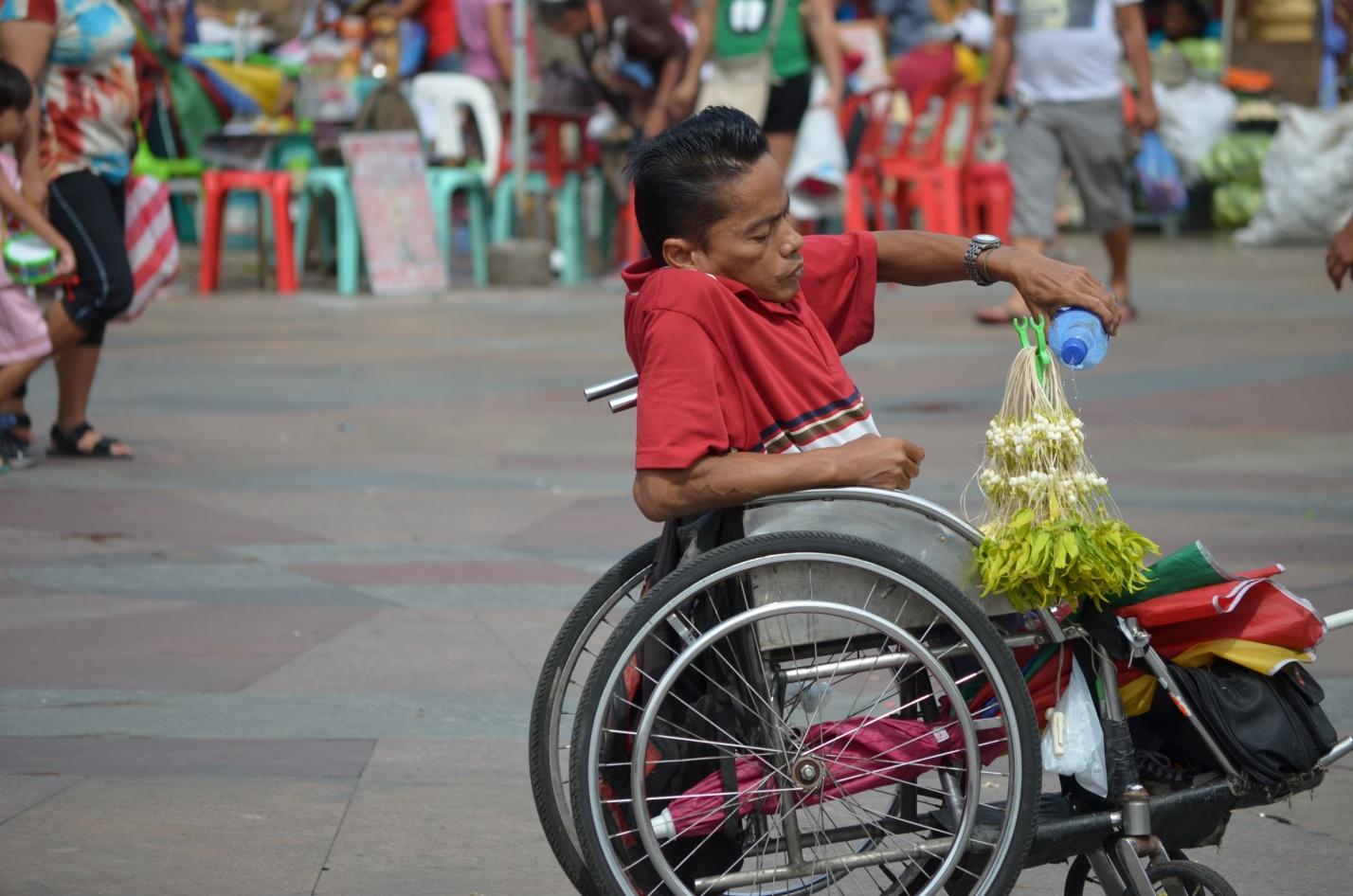 |
| Kuya is ready to sell sampaguita on a Friday, Quiapo Day, at Plaza Miranda where many devotees are expected. |
.
 |
| Kuya waits for the Final Blessing so that he can sell to parishioners who are getting out of the church. |
.
 |
| The shadow is the effect of the sun as it rises which kuya does'nt bother to evade. He instead covered his head with towel but still he has no buyer. |
.
 |
| Kuya's 'kabaro' arrives with a pack of stories to tell him. Smile is inevitable from their faces even if they haven't sold sampaguita yet. |
.
 |
| Kuya and his kabaro were not just the Sampaguita vendors there. That is why it is hard for them to sell. |
.
 |
| Still, they welcome their co-vendors and even chat with them. They treat them as friends not competitors. |
.
 |
| Kuya's 'kabaro' continues to call churchgoers to buy sampaguita from them. |
.
 |
| Kuya and his 'kabaro’ still fail to sell their Sampaguita and people just ignore them. |
.
 |
| Finally, kuya's ‘kabaro’ has his 'buena mano' and this made kuya smile. |
.
 |
| Kuya's 'kabaro' continues to sell not just once but twice. Kuya said that his capital for this is P350. |
.
 |
| Children begging for alms is a usual event once a buyer bought sampaguita from them. |
.
 |
| It's hard for them to move their wheelchairs once vehicles cross their way but they continued to sell our National Flower. |
.
 |
| Police authorities let the sampaguita vendors sell in the prohibited area as long as they don’t disturb church services. |
.
---
The photos taken and the article written by Eljohn Marin, a student and an aspiring lawyer. Visit his blog: The Law and Me.
 |
| She is their last buyer as I leave the area. Kuya said that their usual profit is P60 per day yet they are happy for they survive each day with food. |
The photos taken and the article written by Eljohn Marin, a student and an aspiring lawyer. Visit his blog: The Law and Me.


